“Avoid Evil, Do Good, Purify the Mind” (Dhammapada 183)
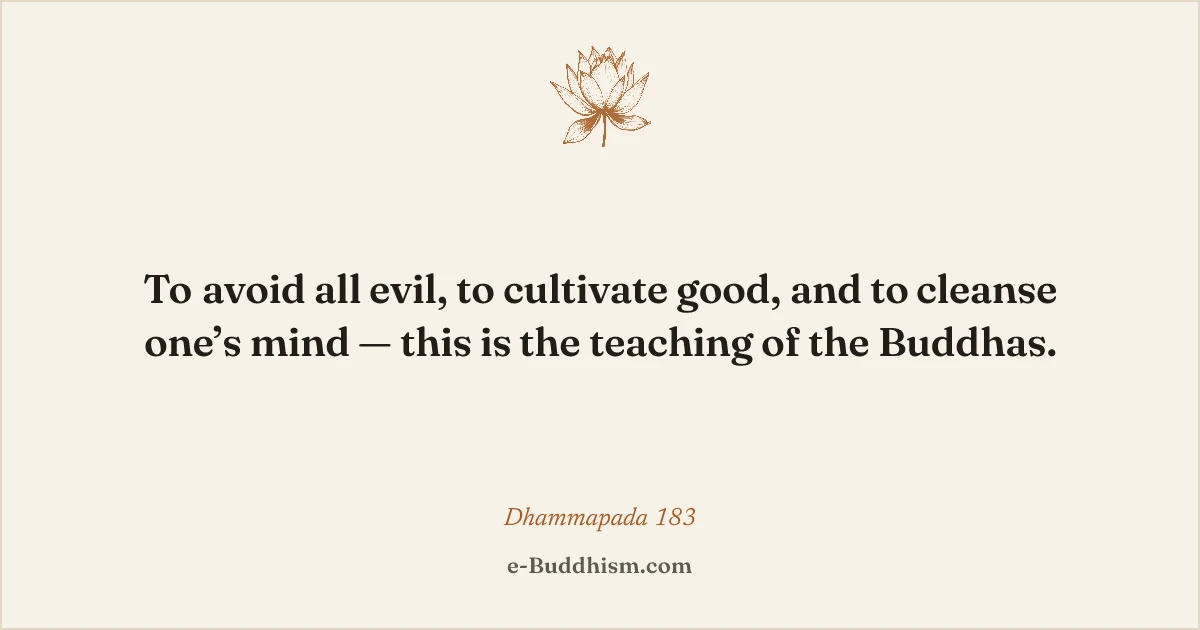
If you wanted the whole of Buddhism in one line, this verse is the tradition’s own answer. “To avoid all evil, to cultivate good, and to cleanse one’s mind — this is the teaching of the Buddhas.” Three steps: stop doing harm, actively do good, and purify the mind behind both.
Here is the verse, why it is threefold, and where it comes from.
“To avoid all evil, to cultivate good, and to cleanse one’s mind — this is the teaching of the Buddhas.” — The Buddha, Dhammapada 183 (trans. Acharya Buddharakkhita)
What ‘avoid evil, do good, purify the mind’ means
The verse is built as a ladder of three steps, and the order is deliberate.
Avoid all evil. First, stop causing harm — the restraint of the precepts: not killing, stealing, lying, and so on. This is the floor beneath everything else.
Cultivate good. Restraint alone is not enough; Buddhism is not merely a list of “do nots.” The second step is positive — generosity, kindness, patience, the active doing of good.
Cleanse one’s mind. And here is the step that completes the other two. You can refrain from harm and even do good while the mind stays full of greed, resentment, and conceit. The third step turns inward: through meditation and wisdom, the mind itself is purified, so that goodness stops being effort and conformity and becomes one’s nature. This is why the verse is “the teaching of the Buddhas,” plural — the tradition holds it to be the shared essence of every awakened teacher, not one master’s slogan.
Together the three are the threefold training — ethical conduct (sīla), meditation (samādhi), and wisdom (paññā) — which the Noble Eightfold Path lays out in full.
Where ‘avoid evil, do good, purify the mind’ comes from
The verse is Dhammapada 183, from the Buddhavagga (the “Chapter on the Buddha”), in the Pali Canon; the wording here is Acharya Buddharakkhita’s. It is sometimes called the Ovāda-pāṭimokkha, the verse of “exhortation,” and it is traditionally recited at the festival of Māgha Pūjā, which remembers a great gathering of the Buddha’s enlightened disciples.
Why ‘avoid evil, do good, purify the mind’ matters
In three short clauses the verse answers a question every newcomer asks: what does Buddhism actually want me to do? Not believe a doctrine, but live a sequence — do no harm, do good, and keep cleaning the mind that does both. It is a teaching you can begin today and never finish.
Browse more sourced lines in our real Buddha quotes collection.
Frequently asked questions
What is 'the teaching of all the Buddhas'?
Dhammapada 183 says it is threefold: 'To avoid all evil, to cultivate good, and to cleanse one's mind.' The tradition treats this single verse as the essence shared by every Buddha across the ages — restraint from harm, the active doing of good, and the purification of one's own mind. It is sometimes called the Ovāda-pāṭimokkha, the 'exhortation' verse.
Why purify the mind if you already avoid evil and do good?
Because the first two can be done for the wrong reasons or with a mind still full of greed, hatred, and pride. The third step is what makes the other two complete: cleansing the mind through meditation and wisdom so that goodness flows from a genuinely transformed heart, not just outward conformity. Ethics without inner change is unfinished.
Where is the verse from, and why is it linked to Māgha Pūjā?
It is Dhammapada 183, in the chapter called the Buddhavagga. The verse is traditionally recited at the festival of Māgha Pūjā, which commemorates a great spontaneous gathering of the Buddha's enlightened disciples, to whom the Buddha is said to have given this very summary of the teaching.