The Art of Letting Go in Buddhism (Without Going Numb)
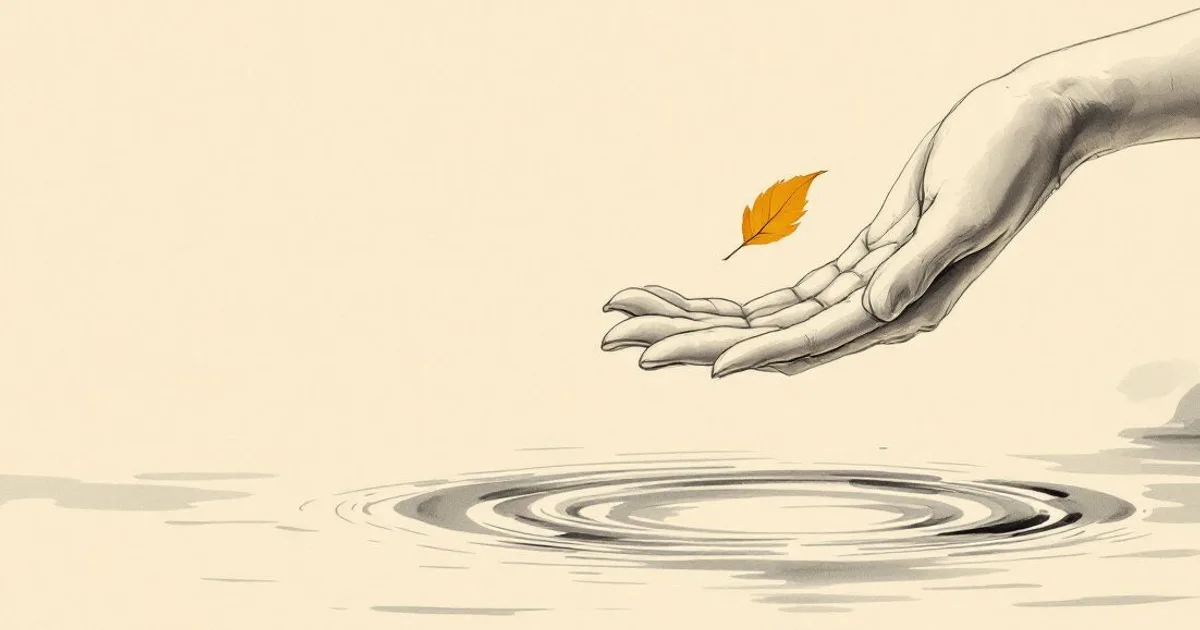
“Letting go” is the most quoted and most misunderstood phrase in popular Buddhism. It does not mean not caring, going numb, or cutting people off. It means releasing the craving that, according to the second noble truth (SN 56.11), turns ordinary change into suffering — the grasping demand that good things never end and that we stay permanently in control.
The Buddha pushed this so far that he taught letting go even of his own teaching, like a raft you set down once it has carried you across (MN 22).
First, What Letting Go Is Not
Because the phrase gets used so loosely, it helps to clear away what it doesn’t mean before saying what it does.
- It is not going numb. Letting go is not anaesthesia. You are not trying to stop feeling grief, love, or delight — those are the texture of a human life, and the path does not ask you to amputate them.
- It is not cold detachment. A heart that has stopped caring is not free; it is just shut. The tradition praises equanimity, which is steadiness that holds love inside it — not indifference, which holds nothing.
- It is not giving up or passivity. Letting go is not a shrug. You can pour yourself fully into work, relationships, and causes while releasing the clutch on the outcome.
- It is not suppression. Shoving a feeling down is the opposite of letting it go. You can only release what you’ve first been willing to feel.
The tradition has its own name for the numb version
This is not a modern correction applied to an old teaching; the early discourses draw the line themselves. In the Saḷāyatanavibhaṅga Sutta the Buddha sorts equanimity into two kinds, and the first is precisely the blankness that gets mistaken for spiritual attainment.
When seeing a sight with their eyes, equanimity arises for the unlearned ordinary person—a foolish ordinary person who has not overcome their limitations and the results of deeds, and is blind to the drawbacks. Such equanimity does not transcend the sight. That’s why it’s called domestic equanimity.
“Domestic” equanimity — household equanimity — is unbotheredness that has not seen anything: the shrug of a mind that stopped paying attention. Set against it is “renunciate equanimity”, which arises once a person has understood “the impermanence of sights—their perishing, fading away, and cessation” and which, the discourse says, “transcends the sight” (MN 137:15.2–15.3). The two can be indistinguishable from outside and are opposites inside: one mind has closed, the other has looked all the way through. The sutta is not neutral between them either — it tells the practitioner to rely on the second in order to give up the first (MN 137:16.7). Real equanimity is a species of clear sight, which is why it can hold love inside it and indifference cannot.
Get these confusions out of the way and the real teaching comes into focus: the thing to be released is not the world, and not your love for it, but the grasping.
What Is Actually Released: Craving
The Four Noble Truths lay it out with almost surgical clarity. The first names suffering; the second locates its origin in craving (taṇhā) — the thirst for things to be other than they are. The third truth, cessation, is then defined in SN 56.11 as the “fading and cessation, renunciation, relinquishment, release, and letting go of that very craving.” Letting go is not a vague mood in Buddhism. It is the precise mechanism by which suffering ends: where the grasping fades, the suffering built on it has nothing left to stand on.
This is why letting go and caring are not opposites. The craving and the care are two different things, even though they usually arrive tangled together. You can love a person completely and still release the craving to control them, to keep them unchanged, to be guaranteed they’ll never leave. Pull the craving out and what remains is not less love — it is love with its claws retracted.
The four things we actually clutch
Craving is the thirst; grasping (upādāna) is what the thirst does with its hands. In his analysis of dependent origination the Buddha breaks that grasping into four kinds, and the list is not the one most people expect.
And what is grasping? There are these four kinds of grasping. Grasping at sensual pleasures, views, precepts and observances, and theories of a self. This is called grasping.
Only the first of the four is about objects. The other three are an opinion held too tightly, a practice mistaken for the point of practice, and an idea of who you are. When we hear “letting go” we picture clearing a cupboard or ending a relationship; the Buddha’s own list puts being right, being good at this, and being someone on the same shelf as the things we want. It also explains why the discourses describe the way out of something not as fleeing it but as loosening its pull — the escape from bodily form is defined entirely from the inside: “Removing and giving up desire and greed for form: this is its escape” (SN 22.26, trans. Bhikkhu Sujato). Nothing is thrown away in that sentence. What changes is the grip.
Which Pali Word Does “Letting Go” Translate?
Serious readers arrive with this question, and the honest answer is that there is no single word. English “letting go” stands in for a small family of Pali terms that are not synonyms, and confusing them is where much of the muddle begins.
The vocabulary behind one English phrase
- Taṇhā — craving
- ”Thirst”: what is let go of, never a name for the letting go itself. See craving and the glossary entry for taṇhā.
- Upādāna — grasping, clinging
- The act of taking hold, in four kinds: sensual pleasures, views, precepts and observances, theories of a self (SN 12.2).
- Nekkhamma — renunciation
- Letting go given a shape in a life. SN 45.8 defines right purpose, the second factor of the Eightfold Path, as “The purpose of renunciation, good will, and harmlessness.”
- Virāga — fading away, dispassion
- Not an act of will but a colour draining out: the pull of a thing weakening until it no longer moves you.
- Nissaraṇa — escape
- The way out of a thing, which the discourses define as the removing and giving up of desire and greed for it rather than as the removal of the thing (SN 22.26).
- Vossagga, paṭinissagga — letting go, relinquishment
- The two words English most often renders as “letting go” itself. Bhikkhu Sujato translates both as “letting go”; Ṭhānissaro Bhikkhu gives the same path formula as “resulting in relinquishment” (SN 45.2).
Of these, vossagga carries the phrase’s full weight, and it repays a look at where the Buddha puts it. He does not offer letting go as one technique among others. He describes every factor of the path as tending towards it, the way fruit tends towards ripeness.
It’s when a mendicant develops right view, which relies on seclusion, fading away, and cessation, and ripens as letting go.
The formula repeats for all eight factors, and the verb is the thing to notice: the path ripens as letting go. It is what grows at the end of a long cultivation, not an instruction to be barked at a beginner on day one — worth remembering whenever someone is told to “just let it go” as though it were a decision available on demand. Bhikkhu Sujato notes in the same translation that vossagga belongs to a wide family of Pali words meaning to let go, and that the discourses also use it for generosity: one word covers opening your hand around a possession and opening it around yourself. In the vocabulary of the early texts, letting go is a near neighbour of giving.
The Raft You Put Down
The Buddha’s most striking image for letting go appears in the Alagaddupama Sutta (MN 22) — the parable of the raft, which has a page of its own here. Imagine, he says, a traveller who comes to a wide river. The near bank is dangerous; the far bank is safe. There’s no bridge, so he gathers grass and branches, binds a raft, and paddles across. The raft has served him perfectly. Now — what should he do with it?
He shouldn’t, the Buddha observes, think this raft has been so useful, I’ll carry it on my back wherever I go. He should haul it up on the shore, or push it back into the stream, and walk on unburdened. The raft, he says, is “for the purpose of crossing over, not for the purpose of holding onto.” And then comes the radical turn: the teaching itself is like that raft. Even the Dharma is something to use and then release — and if even the path is to be held lightly, how much more lightly should we hold our opinions, our grudges, our plans, our image of how life was supposed to go.
In the same discourse the Buddha warns that grasping his teaching wrongly is like seizing a water-snake by the coils: handled clumsily, even something good will turn and bite you. Clinging spoils what it clings to — including spiritual things. People can grip “non-attachment” itself as one more possession. The raft is a standing reminder that the point was never to own anything, even wisdom; the point was to get free.
The Deepest Letting Go: “Not Mine”
MN 22 also points to the most fundamental release of all. The Buddha invites us to regard each part of experience — body, feelings, perceptions, mental habits, awareness itself — with the same refrain: “This is not mine, this is not my self, this is not what I am.” This is the teaching of not-self (anattā), and it is easy to misread, so let’s be careful: it is not a denial that you exist, and it is not nihilism. It is the loosening of the reflex by which we wrap our identity around passing things and then suffer when they change.
In everyday terms, this is the move from my humiliation, my loss, my failure — each my a tiny hook of ownership — toward simply seeing a feeling arise and pass without building a permanent self around it. It is subtle, and it deepens over a lifetime of practice rather than in an afternoon. But even a little of it is a great relief: the weight we carry is largely the weight of mine. (On holding praise and blame online more lightly, see Buddhism and social media.)
What Different Traditions Ask You to Let Go
“Letting go” sounds like a single instruction, but the schools fill it in differently, and the differences are more useful than the common ground.
Theravāda and the early discourses stay closest to the diagnosis above: what goes is craving and the four graspings. The outward form that release can take is nekkhamma, renunciation — historically the going forth into homelessness that began with the Buddha’s own departure — but even there the emphasis stays inward, since the escape from a thing is defined as the loosening of desire for it rather than the loss of the thing.
Tsongkhapa and the Gelug lamrim put renunciation at the gate rather than treating it as a late refinement. The reformer whose lineage became the Gelug school opens The Three Principal Aspects of the Path with it — renunciation, then bodhicitta, then the view of emptiness — and he measures it not by what you have given up but by what has stopped attracting you: only when “throughout both day and night you long for liberation”, he writes, has “true renunciation” been born (trans. Adam Pearcey). By that test, leaving home proves nothing and staying proves nothing. (That is one school’s framing rather than all of Tibetan Buddhism; for the others, see the four schools of Tibetan Buddhism.)
Zen treats letting go less as slow subtraction than as a dropping, and one that happens inside ordinary activity rather than away from it. The phrase Dōgen used for his own awakening was shinjin datsuraku, which the Stanford Encyclopedia of Philosophy entry on Japanese Zen (Shigenori Nagatomo) renders “dropping off the body and the mind” — a release not of possessions but of the felt seam between self and world.
Pure Land makes the sharpest reversal, and the one Western readers meet least often. What is let go there is self-power (jiriki): your own effort to get yourself free. The Stanford Encyclopedia of Philosophy entry on Japanese Pure Land philosophy (Dennis Hirota) summarises Amida’s vow as teaching that “one should relinquish the illusions and attachments focused on the self and its capacities”, and says that for Shinran the working of Other Power is “precisely the falling away of one’s own calculative thinking”. The grip to be released, on that reading, includes the grip of your own spiritual striving. (See Pure Land Buddhism.)
Mahāyāna philosophy can put the moment of release at a different point in the crossing — at least as it is read from the Theravāda side. Ṭhānissaro Bhikkhu notes that the Diamond Sutra “interprets the raft simile as meaning that one has to let go of the raft in order to cross the river”, whereas his own reading of MN 22 runs the other way: “One has to hold onto the raft properly in order to cross the river. Only when one has reached the safety of the further shore can one let go.” Same image, two different moments of release — a difference worth knowing before quoting the raft at anyone.
Letting Go Is a Practice, Not a Trophy
It would be a mistake to imagine letting go as a single heroic act after which you are Done. Nobody lets go once. The grip returns — around a worry, an outcome, a slight — and you open the hand again, and again. The skill is not in achieving some final non-attachment; it is in noticing the clench sooner and loosening it more gently each time.
The everyday version is a felt sense of holding life more lightly: enjoying things without clutching, loving people without trying to own them, meeting change — anicca, impermanence — as the nature of things rather than a personal insult. This is the near twin of acceptance: where letting go releases the grip, acceptance allows what is already here without firing the second arrow of resistance. You can practise it in absurdly small ways: releasing the need to win a pointless argument, letting a plan change without spiralling, unclenching around a worry at 3am. None of these is dramatic. All of them are the same gesture the raft simile points to, made at human scale.
The Zen tradition tells this at its most compact. In “Muddy Road” — the fourteenth of the 101 Zen Stories compiled by Nyogen Senzaki and printed in Zen Flesh, Zen Bones — two travelling monks meet a young woman in a silk kimono who cannot cross a muddy intersection in the pouring rain, and Tanzan lifts her in his arms and carries her over the mud. Hours later, at the lodging temple, Ekido is still fuming that a monk should have touched her at all. “I left the girl there,” Tanzan says. “Are you still carrying her?” It is a modern anecdote rather than scripture, and it is worth saying so plainly — see the parables of the Buddha for which stories are canonical and which are not — but it lands the point exactly: most of our suffering is the carrying we keep doing long after the moment has passed.
A Small Practice to Begin
Try the open hand. The next time you notice yourself gripping — a need to be right, a plan that just changed, a worry on a loop — pause and, if it helps, literally open your hand, palm up. Silently note what you’re clutching, and say to yourself: I can hold this more lightly. You’re not throwing anything away or pretending not to care. You’re just releasing the white-knuckle grip, once, knowing you’ll do it again tomorrow.
If you would rather have the version the texts themselves teach, it is the last of the sixteen steps of mindfulness of breathing. The fourth set of four in the Ānāpānassati Sutta moves through “observing impermanence”, then “observing fading away”, then “observing cessation”, and finally “observing letting go” (MN 118:21, trans. Bhikkhu Sujato) — each of them trained on one breath in and one breath out. Two things about that placement are worth noticing. It comes last, after twelve steps of settling the body and steadying the mind: the discourse’s way of saying that letting go is not the opening move but the ripening of everything before it. And it is practised on something as small and unloaded as an out-breath — not on your marriage or your grief, but on the easiest possible object, until the gesture is familiar enough to be there when it is needed. (The full sequence is laid out in our guide to the Ānāpānassati Sutta.)
That is the art of letting go — less a grand renunciation than a small, repeatable kindness to yourself. For the wider practice it belongs to, see Buddhism in everyday life; for the craving it releases, the Four Noble Truths; for how this same loosening transforms how we love, our guide to love versus attachment; for holding the result lightly when you have a choice to make, making decisions with Buddhist wisdom; and for the contentment that opens up once the grip relaxes, Buddhism and happiness.
If there is one thing you cannot put down, describe it to Ask the Dharma and sit with the reflection it offers.
Frequently asked questions
What does 'letting go' actually mean in Buddhism?
It means releasing craving — the grasping demand that pleasant things never end, that unpleasant things vanish, and that we stay permanently in control. The second noble truth (SN 56.11) names this craving as the cause of suffering, so letting go of it is the cause of relief. It does not mean not caring, going numb, or cutting people off.
Isn't letting go the same as detachment or not caring?
No, and this is the most common misunderstanding. You are asked to let go of the grasping, not the love. In fact, releasing the clutch of craving usually lets you care more freely, not less — you can love people without trying to own them, and engage fully without depending on a particular outcome. Cold indifference is a different thing entirely, and the tradition does not praise it.
What is the raft simile?
In the Alagaddupama Sutta (MN 22) the Buddha compares his teaching to a raft built to cross a river. Once you reach the far shore, you don't hoist the raft onto your back and carry it around — you set it down, grateful, and walk on. The teaching is 'for the purpose of crossing over, not for the purpose of holding onto.' Even the Dharma is to be used and then released, not clung to.
How is letting go different from giving up?
Giving up abandons the action; letting go releases the grasping around it. You can work wholeheartedly for something and still hold the result lightly, without your peace depending on it. In fact letting go of the white-knuckle craving for a particular outcome often makes you act more clearly and persist more steadily, because fear isn't running the show.
How do I practise letting go in daily life?
In small, repeatable ways: releasing the need to win a pointless argument, letting a plan change without spiralling, opening your hand around a worry instead of gripping it. Letting go is not a single heroic act but a gesture you make again and again — each time you notice the clench of 'it must be this way' and choose to loosen it.
What does the Buddha say we cling to?
Four things. SN 12.2 defines grasping as grasping at sensual pleasures, views, precepts and observances, and theories of a self. Only the first is about objects. The others are opinions, observances treated as ends in themselves, and ideas about who we are, which is why letting go reaches much further than tidying a cupboard.
Sources
- Alagaddupama Sutta (MN 22), 'The Water-Snake Simile' / 'The Simile of the Raft' — SuttaCentral; Access to Insight (trans. Ṭhānissaro Bhikkhu)
- Dhammacakkappavattana Sutta (SN 56.11), 'Setting the Wheel of Dhamma in Motion' — the second noble truth (craving) and the third, defined as the 'letting go of that very craving'; Access to Insight (trans. Ṭhānissaro Bhikkhu)
- Paṭiccasamuppāda-vibhaṅga Sutta (SN 12.2), 'Analysis of Dependent Origination' — the Buddha's definition of grasping (upādāna) in four kinds: sensual pleasures, views, precepts and observances, and theories of a self; SuttaCentral (trans. Bhikkhu Sujato, CC0)
- Upaddha Sutta (SN 45.2), 'Half (of the Holy Life)' — the same path formula in Ṭhānissaro Bhikkhu's English, 'dependent on seclusion, dependent on dispassion, dependent on cessation, resulting in relinquishment'; Access to Insight
- Upaḍḍha Sutta (SN 45.2), 'Half the Spiritual Life' — each factor of the eightfold path 'relies on seclusion, fading away, and cessation, and ripens as letting go' (vossagga), with the translator's note on vossagga and generosity; SuttaCentral (trans. Bhikkhu Sujato, CC0)
- Magga-vibhaṅga Sutta (SN 45.8), 'Analysis' of the noble eightfold path — right purpose defined as 'the purpose of renunciation (nekkhamma), good will, and harmlessness'; SuttaCentral (trans. Bhikkhu Sujato, CC0)
- Assāda Sutta (SN 22.26), 'Gratification' — the escape (nissaraṇa) from the aggregates defined as 'removing and giving up desire and greed'; SuttaCentral (trans. Bhikkhu Sujato, CC0)
- Saḷāyatanavibhaṅga Sutta (MN 137), 'The Analysis of the Six Sense Fields' — the six kinds of domestic (household) equanimity, which 'does not transcend the sight', set against the six kinds of renunciate equanimity born of seeing impermanence; SuttaCentral (trans. Bhikkhu Sujato, CC0)
- Ānāpānassati Sutta (MN 118) — the fourth tetrad of mindfulness of breathing: observing impermanence, fading away, cessation and letting go (paṭinissagga); SuttaCentral (trans. Bhikkhu Sujato, CC0)
- 'The Three Principal Aspects of the Path' by Je Tsongkhapa Lobzang Drakpa, verses 3–5 on renunciation — Lotsawa House (trans. Adam Pearcey)
- Japanese Zen Buddhist Philosophy (entry), Stanford Encyclopedia of Philosophy (Shigenori Nagatomo) — Dōgen's shinjin datsuraku, 'dropping off the body and the mind'
- Japanese Pure Land Philosophy (entry), Stanford Encyclopedia of Philosophy (Dennis Hirota) — self-power and Other Power, and Shinran on the falling away of calculative thinking
- 'Muddy Road', the fourteenth of the 101 Zen Stories compiled by Nyogen Senzaki, collected in Zen Flesh, Zen Bones, ed. Paul Reps & Nyogen Senzaki (first published 1957) — Tanzan carries a woman over a muddy crossing and Ekido is still carrying her that night; a modern Zen anecdote, not canonical scripture; Tuttle Publishing (publisher's edition page)