“Hatred Is Never Appeased by Hatred”: Meaning (Dhammapada 5)
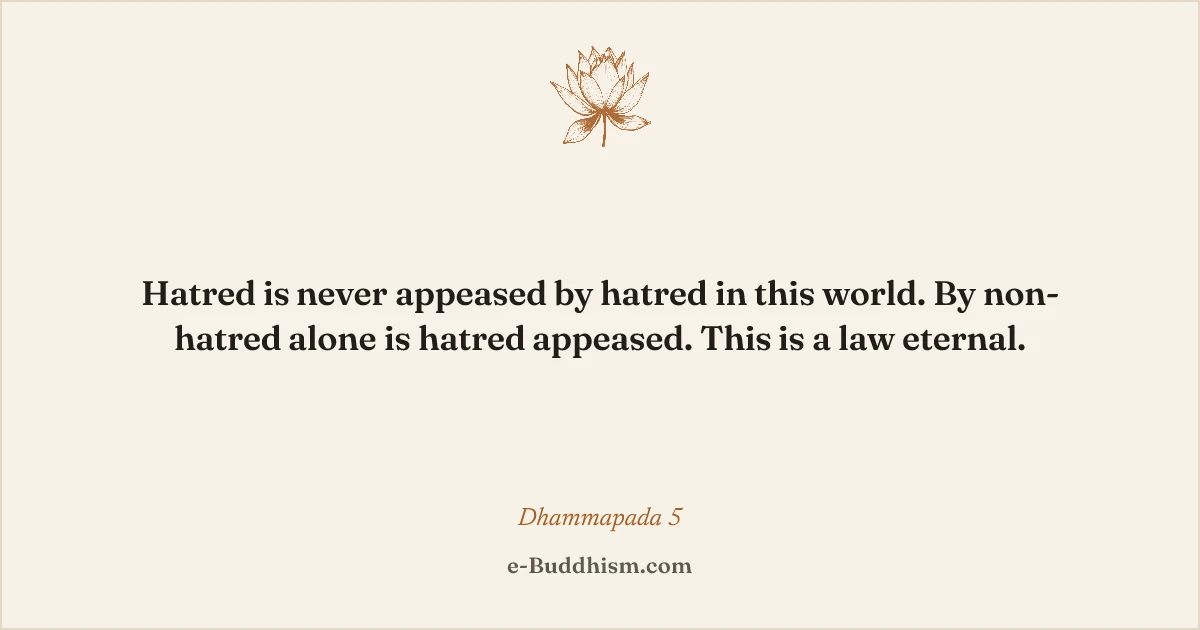
In Dhammapada 5, the Buddha states a plain law of the heart: hatred can never be ended by more hatred — only by its opposite. Returning anger for anger keeps the cycle turning; only non-hatred — patience, goodwill, the willingness to let a grievance go — can actually bring enmity to rest.
Here is the verse, where it comes from, and how to practise it.
“Hatred is never appeased by hatred in this world. By non-hatred alone is hatred appeased. This is a law eternal.” — The Buddha, Dhammapada 5 (trans. Acharya Buddharakkhita)
What ‘hatred is never appeased by hatred’ means
The verse turns on a simple observation: retaliation feeds the thing it means to defeat. When we answer an injury with an injury, we hand the other person a fresh reason to strike back — and we give ourselves one too. Each round feels justified, and so the fire is never put out; it is fed.
“By non-hatred alone” points to the only real exit. Non-hatred (Pali avera) is not weakness or mere passivity — it is the active choice not to add the next link to the chain: to absorb the blow without returning it, to wish the other person well even while protecting yourself. That is what finally lets enmity die down, because nothing is left to keep it alive.
And “a law eternal” (sanantano dhammo) means this is not a pious wish but an ancient, perennial truth — the way things actually work, in every age. It is descriptive before it is moral: hatred simply does not have the power to end hatred.
Where ‘hatred is never appeased by hatred’ comes from
The line is verse 5 of the Dhammapada, in its opening chapter, the Yamakavagga or “Chapter of Pairs” — so called because its verses come in contrasting twos. It belongs to the Pali Canon, the earliest body of Buddhist scripture, and is among the best-attested of all the Buddha’s recorded sayings.
Translations vary in their wording — where Buddharakkhita writes “non-hatred,” Sujato writes “love” — but the sense is the same: only the heart’s opposite quality can do what more hatred never can. The Pali and three translations are set side by side below.
The Pali of Dhammapada 5
The verse is four short lines. This is the Pali as printed in the Mahāsaṅgīti Tipiṭaka edition, the root text SuttaCentral uses:
Na hi verena verāni,
sammantīdha kudācanaṁ;
Averena ca sammanti,
esa dhammo sanantano.
— Dhammapada 5, Pali root text (Mahāsaṅgīti Tipiṭaka edition), SuttaCentral
Almost the whole argument sits in one pair of words: verena and averena — “by hatred” and “by non-hatred” — the same noun with and without the negative prefix a-. The two verses before it use that noun in the singular (veraṁ tesaṁ na sammati in verse 3, veraṁ tesūpasammati in verse 4 — in Bhikkhu Sujato’s rendering, “hatred is never laid to rest” and “hatred is laid to rest”), and verse 5 states the general rule those two illustrate.
The gloss below gives each word only the senses that the three translators in the next section actually use for it.
| Pali | Sense, as the translators render it |
|---|---|
| na hi … kudācanaṁ | The negative na at the start and kudācanaṁ at the end wrap the whole first half of the verse, and the translators render them together: “never” (Buddharakkhita, Sujato); “aren’t … regardless” (Ṭhānissaro). |
| verena | ”by hatred” (Buddharakkhita), “through hostility” (Ṭhānissaro), “by hate” (Sujato). The noun is vera. |
| verāni | the same noun in the plural — kept by Ṭhānissaro’s “hostilities”; Buddharakkhita and Sujato use the singular “hatred”. |
| sammanti | ”is … appeased” (Buddharakkhita), “are stilled” (Ṭhānissaro), “laid to rest” (Sujato). It appears twice, once in each half. |
| idha | ”in this world” (Buddharakkhita); the other two leave it out. It is fused with the verb as sammantīdha. |
| averena | vera with the negative prefix: “by non-hatred” (Buddharakkhita), “through non-hostility” (Ṭhānissaro), “by love” (Sujato). |
| ca | a connective; none of the three renders it as a separate word. |
| esa | ”this” (all three). |
| dhammo | ”law” (Buddharakkhita), “truth” (Ṭhānissaro), “teaching” (Sujato). |
| sanantano | ”eternal” (Buddharakkhita), “unending” (Ṭhānissaro), “ancient” (Sujato). |
How translators render it
Three widely used English versions, each copied exactly as its source prints it (Ṭhānissaro’s verse line breaks removed; Buddharakkhita’s third sentence, “This is a law eternal”, is in the full verse at the top of this page):
| Translator | Dhammapada 5 | Source |
|---|---|---|
| Acharya Buddharakkhita (Buddhist Publication Society, 1985) | “Hatred is never appeased by hatred in this world. By non-hatred alone is hatred appeased.” | Access to Insight |
| Ṭhānissaro Bhikkhu (1997) | “Hostilities aren’t stilled through hostility, regardless. Hostilities are stilled through non-hostility: this, an unending truth.” | Access to Insight |
| Bhikkhu Sujato (2021) | “For never is hatred laid to rest by hate, it’s laid to rest by love: this is an ancient teaching.” | SuttaCentral |
Where they differ:
- Hatred or hostility. Vera is “hatred” for Buddharakkhita and “hate”/“hatred” for Sujato, but “hostility” for Ṭhānissaro — and he alone keeps the Pali plural, “hostilities”, which makes the line sound less like a single emotion and more like a running feud.
- Non-hatred or love. For averena, Buddharakkhita (“non-hatred”) and Ṭhānissaro (“non-hostility”) stay with the literal negative; Sujato translates it as “love”, naming the positive quality that takes hatred’s place. The Pali says only that hatred’s opposite is what brings it to rest — how far to name that opposite is the translator’s choice.
- Law, truth or teaching. The closing esa dhammo sanantano becomes “a law eternal”, “an unending truth” and “an ancient teaching”: three weightings of dhamma, and three of sanantana, which the translators render as “eternal”, “unending” and “ancient” — old and everlasting at once.
- In this world. Only Buddharakkhita keeps idha, “in this world”; the other two drop it.
In every version the structure is the same: one noun on both sides of the line, once with the negative prefix and once without. That is the whole teaching, and it survives any choice of English. For the terms used here, see the glossary.
How to practise it
The verse is easy to admire and hard to live, so the Buddhist tradition treats it as training, not a slogan:
- Catch the urge to retaliate in the moment — the flash of “they can’t get away with that.” That flash is the first link in the chain.
- Decline to add the next link. You can still act firmly and set boundaries; non-hatred is about not feeding the enmity, not about being a doormat.
- Cultivate the opposite directly. Loving-kindness (mettā) meditation is the classic method for growing goodwill strong enough to meet ill-will — even toward someone who has wronged you.
For the fuller teaching on working with this emotion, see Buddhism and anger.

A verse it pairs with: “Overcome the angry by non-anger” (Dhammapada 223), which gives the same principle as practical instruction. The two of them sit alongside eighteen more in Buddha quotes on anger, and the verse’s avera is read again from the other direction in Buddha quotes on peace, which sets this verse in its Kosambī setting at MN 128; browse the rest in our sourced Buddhist quotes collection.
Frequently asked questions
What does 'hatred is never appeased by hatred' mean?
It means enmity cannot be ended by more enmity. Returning anger for anger only keeps the cycle of retaliation turning; the only thing that actually brings hatred to rest is its opposite — non-hatred, patience, and goodwill. The Buddha calls this a 'law eternal,' a perennial truth about how the human heart works.
Where is this quote from?
It is verse 5 of the Dhammapada, in the opening chapter called the Yamakavagga ('The Pairs'). The Dhammapada is the most beloved collection of the Buddha's sayings, part of the Pali Canon. The wording here is Acharya Buddharakkhita's translation.
Did Martin Luther King Jr. quote 'hatred is never appeased by hatred'?
Not directly. King's famous line, 'Hate cannot drive out hate; only love can do that' (Strength to Love, 1963), closely echoes the same idea, though he was writing in his own Christian context. The principle that only love ends hatred is one many traditions have arrived at; the Dhammapada is among its oldest expressions.
What is the Pali of 'hatred is never appeased by hatred'?
Dhammapada 5 reads: Na hi verena verāni, sammantīdha kudācanaṁ; averena ca sammanti, esa dhammo sanantano (Mahāsaṅgīti edition, SuttaCentral). Vera is hatred or hostility; averena, 'by non-hatred', is the same word with a negative prefix; esa dhammo sanantano is the closing line, 'This is a law eternal' in Acharya Buddharakkhita's translation.
Why do some translations say 'love' rather than 'non-hatred'?
The Pali word is avera, literally 'non-hatred'. Acharya Buddharakkhita ('non-hatred') and Ṭhānissaro Bhikkhu ('non-hostility') keep that negative form; Bhikkhu Sujato renders it 'by love', naming the positive quality left when hatred is given up. The Pali itself says only that hatred's opposite is what brings hatred to rest.