“He Who Conquers Himself”: Meaning (Dhammapada 103)
The Buddha measures victory in an unexpected way. You could defeat enormous armies, he says in Dhammapada 103, and still not have won the victory that matters — because the one real conquest is over yourself: your own greed, anger, and confusion.
It is the only triumph that harms no one and cannot be reversed. Here is the verse, its source, and how the tradition asks you to live it.
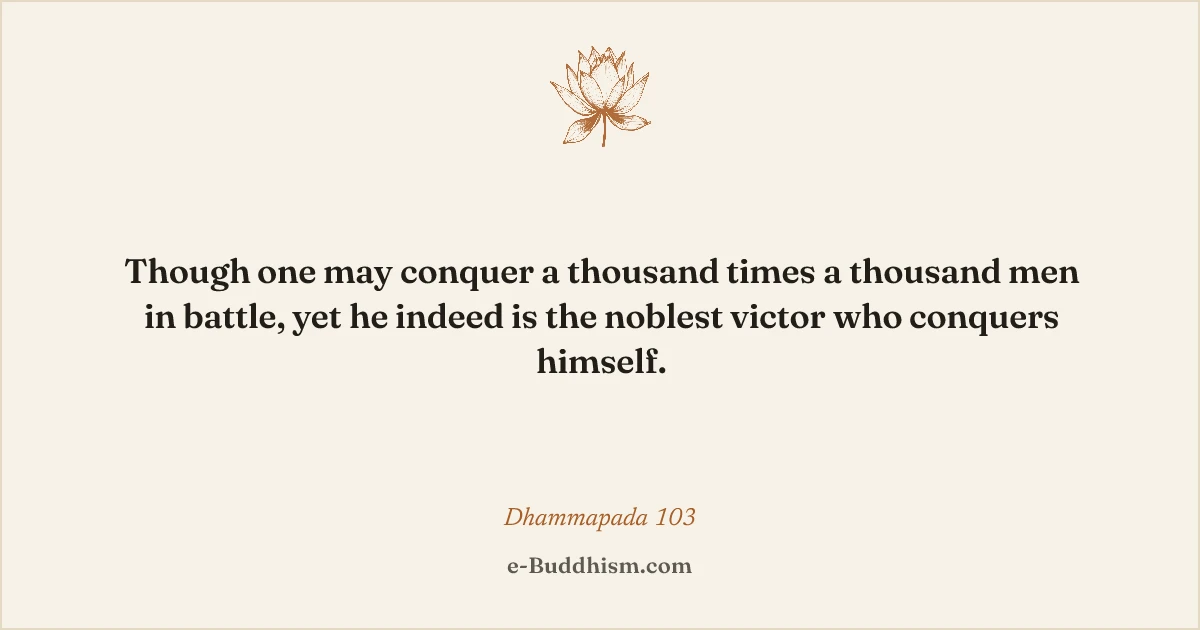
“Though one may conquer a thousand times a thousand men in battle, yet he indeed is the noblest victor who conquers himself.” — The Buddha, Dhammapada 103 (trans. Acharya Buddharakkhita)
What ‘he who conquers himself’ means
Every outward conquest, the verse suggests, is fragile and costly: it makes enemies, depends on luck, and can be lost again tomorrow. Self-conquest is different in kind. To “conquer yourself” is to stop being ruled by the three poisons — craving, aversion, and delusion — that drive most of what we do. That victory takes nothing from anyone else, and once truly won it cannot be undone.
This is why the Buddha calls it the noblest victory rather than merely a wiser one. The verses that follow press the point: such a person’s triumph “cannot be turned into defeat by anyone — not by a god, not by a tempter.” The battlefield hero is at the mercy of the next battle; the one who has mastered their own mind is not.
It is worth being clear about the word conquer. This is not self-punishment or grim repression. In Buddhist terms, you “win” over a craving not by crushing yourself but by seeing it clearly enough that it loses its grip — which is gentler, and far more durable, than force.
Where ‘he who conquers himself’ comes from
The verse is Dhammapada 103, from the Sahassavagga — the “Chapter of the Thousands,” which repeatedly contrasts vast outward quantities with one thing of inner worth (a single wise word over a thousand empty ones, one day of virtue over a hundred years without it). It belongs to the Pali Canon; the wording here is Acharya Buddharakkhita’s.
How to practise it
- Locate the real opponent. The next time you feel beaten by a situation, ask what is actually defeating you — the circumstance, or your reaction to it. The verse points to the second.
- Train where the conquest happens. Self-mastery is built in meditation and in the daily discipline of the Noble Eightfold Path, not in a single heroic effort.
- Aim for clarity, not force. Letting go of a compulsion you have seen through is the Buddhist shape of victory — release rather than struggle.

Browse more sourced lines in our sourced Buddhist quotes collection.
Frequently asked questions
What does 'conquer yourself' mean in Buddhism?
It means mastering your own mind — your greed, hatred, and delusion — rather than mastering other people or circumstances. The Buddha calls this the noblest victory because, unlike a battlefield win, it harms no one, cannot be taken back, and is the only conquest that actually ends suffering.
Where does 'he who conquers himself is the noblest victor' come from?
It is Dhammapada 103, in the Sahassavagga, the 'Chapter of the Thousands', part of the Pali Canon; the wording here is Acharya Buddharakkhita's translation. The verses that follow press the point, adding that such a victory cannot be turned into defeat by anyone, not by a god, not by a tempter.
Is it the same as 'the greatest victory is the victory over oneself'?
Not exactly. That popular phrasing is a paraphrase of this verse, not the Buddha's wording. Dhammapada 103, in Acharya Buddharakkhita's translation, contrasts conquering 'a thousand times a thousand men in battle' with conquering oneself, and calls the second the noblest victory.