The Buddha's Ascetic Years and the Middle Way
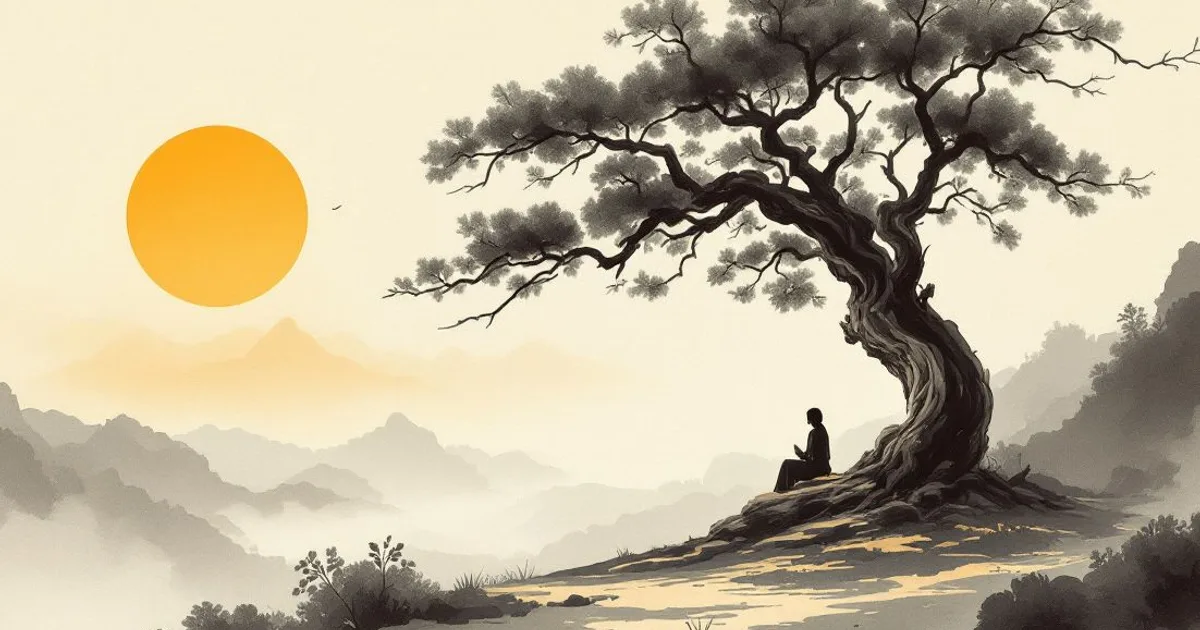
After the Great Renunciation, the Buddha spent roughly six years as a wandering seeker, trying the spiritual methods of his day to their limits. He mastered the deepest meditative states two leading teachers could offer, then drove himself through extreme self-mortification to the very edge of death — and found that neither freed him.
Out of those twin failures came his most important discovery: the Middle Way. This is the story of the hard road between leaving home and awakening.
The Two Teachers
Siddhartha began where a serious seeker would: with the best meditation masters available. The Ariyapariyesanā Sutta (MN 26) names two.
First he studied under Āḷāra Kālāma, and proved so apt a pupil that he soon attained his teacher’s highest goal — a refined meditative absorption the texts call the sphere of nothingness. Āḷāra Kālāma, astonished, offered to lead the community jointly with him. But Siddhartha was not satisfied: this exalted state, he saw, “does not lead to disenchantment, to dispassion, to cessation, to peace… but only to reappearing in the sphere of nothingness.” It was sublime, but it was not freedom. So he left.
He then trained under Uddaka Rāmaputta, and again quickly reached the highest attainment on offer — the still subtler sphere of neither-perception-nor-non-perception, the summit of the formless meditations. Again he was invited to lead; again he recognised that, however peaceful, the state did not uproot craving or end suffering. So, a second time, he set out alone. He had exhausted what the finest teachers of his age could give him, and it was not enough.
The Years of Austerity
If refined meditation was not the answer, perhaps the opposite extreme was: the harsh subjugation of the body that many seekers of the time believed could burn away defilement. With five companions who shared the project, Siddhartha threw himself into severe asceticism — and pursued it further than almost anyone.
His own description, in the Mahāsaccaka Sutta (MN 36), is harrowing. He ate so little that his body wasted to a skeleton: his ribs jutting out like the rafters of an old barn, his spine standing out like a string of beads, the skin of his belly clinging to his backbone, his eyes sunk deep in their sockets like water glittering at the bottom of a well. When he touched his stomach, the texts say, he felt his spine; when he tried to rise, he toppled over. He had pushed self-mortification to the threshold of death — and was no nearer to awakening than when he began.
The Turning Point
Lying near death, Siddhartha asked himself a hard question: Is there another way? And a memory surfaced — one that would change everything.
He remembered an afternoon in his childhood. While his father worked at a ploughing festival, the boy had sat in the cool shade of a rose-apple tree and, with no effort or technique, slipped naturally into a state of clear, wholesome happiness — the meditative absorption later called the first jhāna. Recalling it now, he thought: Could that be the path to awakening? And then a liberating realisation: there was nothing to fear in that kind of happiness, for it was wholesome, “quite secluded from sensuality,” utterly unlike the cravings he had renounced.
But such a state, he saw, was impossible for a body starved to ruin. A clear, strong mind needs a sound body to rest on. And so he made the decision that would scandalise his companions: he took solid food again. His five fellow ascetics, seeing him eat, concluded in disgust that he had given up and “reverted to luxury,” and they abandoned him. He was alone once more — but for the first time, on the right road.
The Birth of the Middle Way
In that decision lies one of the great insights of the Buddhist path. Siddhartha had now tested both extremes in his own flesh: the indulgence of his palace years, and the self-mortification of his ascetic years. Both, he saw, were dead ends — the one drowning the mind in pleasure, the other breaking the very instrument awakening required.
Between them lay a third way: the Middle Way — neither indulging the body nor torturing it, but keeping it as a steady, well-tended basis for the work of the mind. This was not a compromise or a lukewarm half-measure; it was the precise, balanced path that actually worked. He would soon make it the very first thing he taught, declaring in his first sermon that “avoiding both these extremes, the Middle Way… leads to calm, to direct knowledge, to self-awakening” (SN 56.11).
Nourished, balanced, and finally on the right path, Siddhartha sat down beneath a tree at Bodh Gaya with a settled and determined mind. What happened there is the subject of the Buddha’s enlightenment.
For what came before, see the Great Renunciation; for the balanced path that emerged from these years, the Middle Way; and for the whole life, who was the Buddha?
Frequently asked questions
What did the Buddha do during his ascetic years?
After leaving home, Siddhartha spent roughly six years as a seeker. He first mastered the deep meditative states taught by two leading teachers, Āḷāra Kālāma and Uddaka Rāmaputta, but found they did not end suffering. He then turned to extreme self-mortification — severe fasting and harsh austerities — pushing his body to the edge of death before concluding that this, too, was a dead end.
Who were the Buddha's teachers?
His two named teachers were Āḷāra Kālāma, under whom he attained the formless meditative state called 'the sphere of nothingness,' and Uddaka Rāmaputta, under whom he reached the still subtler 'sphere of neither-perception-nor-non-perception' — the highest of the formless attainments. He mastered everything they could teach, but realised these refined states, however peaceful, did not free the mind from craving, so he left to seek further.
What austerities did the Buddha practise?
According to his own account in the Mahāsaccaka Sutta (MN 36), he undertook severe fasting and harsh self-denial, eating so little that he became terribly emaciated — his ribs jutting out, his spine showing through his belly, his strength almost gone. The early texts describe him pushing self-mortification as far as it could go, to the very edge of death.
Why did the Buddha give up asceticism?
Because it did not work. Near death and no closer to liberation, he reasoned that a body so weakened could not support the clear, strong mind that awakening required. He recalled a childhood experience of natural, wholesome meditative joy and realised that the path lay not in torturing the body but in a balanced approach. So he took solid food again — and discovered the Middle Way.
How did the Buddha's ascetic years lead to the Middle Way?
Out of his failed experiments with both extremes. Siddhartha had tested indulgence in his palace years and self-mortification in his ascetic years; both were dead ends, one drowning the mind in pleasure, the other breaking the instrument awakening required. Between them lay the Middle Way, neither indulging the body nor torturing it but keeping it as a steady basis for the work of the mind. It became the first thing he taught (SN 56.11).
Sources
- Ariyapariyesanā Sutta (MN 26), 'The Noble Search' — the Buddha's training under Āḷāra Kālāma and Uddaka Rāmaputta and his leaving them — SuttaCentral; Access to Insight (trans. Ṭhānissaro Bhikkhu)
- Mahāsaccaka Sutta (MN 36) — the Buddha's own account of his extreme austerities, his near-death emaciation, and the childhood memory of jhāna that revealed the Middle Way — SuttaCentral; Access to Insight (trans. Ṭhānissaro Bhikkhu)
- Dhammacakkappavattana Sutta (SN 56.11) — the Middle Way 'avoiding both extremes' as later taught in the first sermon — Access to Insight