Buddhism in China: History and Schools
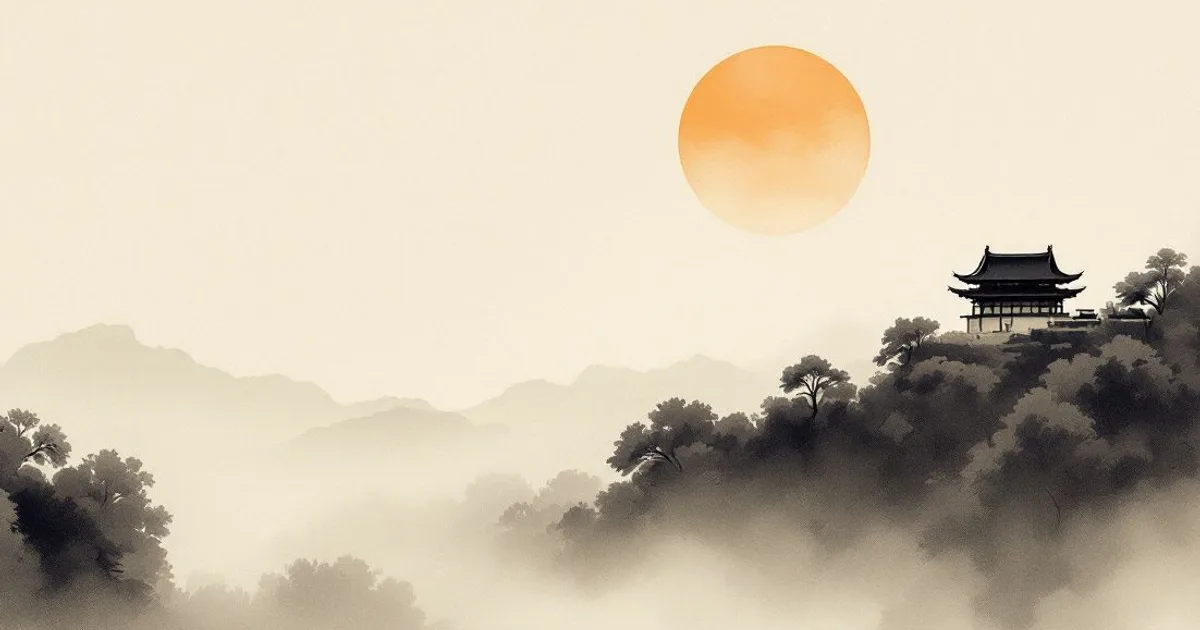
Buddhism reached China around the 1st century CE, carried along the Silk Road from India and Central Asia. Over the following centuries it was translated into Chinese, debated alongside Confucianism and Daoism, and reshaped into distinctively Chinese schools — above all Chan (the ancestor of Zen) and Pure Land — becoming one of the great forces of Chinese civilisation.
What is the history of Buddhism in China?
Chinese Buddhism is the Mahayana form of the religion as it took root, adapted, and flowered in China. According to Encyclopaedia Britannica, Buddhism reached China in the 1st century CE, “propagated in all probability by travelers who had taken the Silk Road from northern India.” It arrived as a foreign faith, was carried by an extraordinary effort of translation (the great names are Kumarajiva in the 4th–5th century and the pilgrim Xuanzang in the 7th), and over time produced four characteristic schools: Chan, Pure Land, Tiantai, and Huayan. It grew up in constant conversation — sometimes rivalry — with Confucianism and Daoism, the other two of China’s “three teachings.” It is one of the major streams within the wider branches of Buddhism, and to trace its story is to watch an Indian religion become something recognisably Chinese.
Arrival along the Silk Road
Buddhism did not reach China by a single decisive event but seeped in gradually along the trade routes of Central Asia during the Han dynasty. Merchants, monks, and travellers moving along the Silk Road brought the new teaching with them, and by the 1st century CE it had a foothold in China.
The tradition preserves a famous origin legend. It is associated with the emperor Mingdi (reigned 57–75 CE) of the Eastern Han, who, the story goes, dreamed of a golden flying deity that his advisers interpreted as a vision of the Buddha. As Britannica recounts, the emperor responded by recruiting Buddhist monks from India and erecting the first Buddhist temple at Luoyang, the Han capital. Historians treat this account as legend rather than documented fact — the real spread was slower and more diffuse — but it captures how the Chinese themselves remembered Buddhism’s arrival: as something that came from the West and was received at the very heart of the empire.
In these earliest centuries, Britannica notes, Buddhism in China “was deeply coloured with magical practices,” which made it compatible with popular Daoism. A foreign religion needs familiar clothing, and early Chinese Buddhism borrowed Daoist vocabulary and imagery to make itself understood.
The age of the great translators
The deepest obstacle was language. The Buddhist scriptures were in Indian languages, written for an Indian world; rendering them into literary Chinese — across an enormous cultural and conceptual gap — was the labour of centuries, and it shaped Chinese Buddhism more than any other single thing.
The towering early figure is Kumarajiva (344–413), whom Britannica calls “the greatest of the early translators.” Born in Central Asia and brought to the Chinese court in 401 CE, he headed a famous school of translators whose renderings were so lucid and graceful that many remain the standard versions chanted in China today. It was, Britannica says, “largely owing to his efforts and influence that Buddhist religious and philosophical ideas were disseminated in China.” Among his translations were the central texts of the Madhyamika philosophy, which became the basis of the Chinese “Three Treatise” (Sanlun) school.
Three centuries later came the most celebrated pilgrim of all, Xuanzang (602–664). Troubled by inconsistencies in the texts he had, he resolved to study Buddhism at its source. In 629 he set out overland across Central Asia, reaching India and spending years at Nalanda, the great Buddhist university, perfecting his Sanskrit and his grasp of Indian thought. He returned to the Tang capital of Chang’an in 645 after sixteen years abroad, to a tumultuous welcome, bearing scriptures and relics — and devoted the rest of his life to a vast programme of translation. His travel record became, in Britannica’s phrase, “of inestimable value to historians and archaeologists,” and his journey later inspired the classic novel Journey to the West.
The Chinese schools take shape
As the scriptures became available in Chinese, Chinese Buddhists began to organise them — to ask which teachings were central and how the many texts fit together. Out of that effort grew schools that were no longer simply Indian imports but genuinely Chinese creations. Four are especially important.
Chan — the ancestor of Zen
Chan is the meditation school, and it is the direct ancestor of Japanese Zen (the name Chan itself derives from the Sanskrit dhyana, “meditation”). By tradition it was founded when the Indian monk Bodhidharma brought a school of meditation to China; Britannica notes that the accounts of his life “are largely legendary,” with most placing his arrival around the late 5th or early 6th century, and that he later came to be honoured as the first patriarch. The most consequential later figure is Huineng (638–713), revered as the sixth patriarch, whose “Southern school” taught that awakening is sudden rather than gradual, and which became the dominant form of Chan. Chan stressed direct insight over book-learning and ritual, and it left a deep mark on Chinese painting, poetry, and the arts of the cultivated elite.
Pure Land — the most popular
Pure Land Buddhism (Chinese: Jingtu, “Pure Land”) centres not on strenuous meditation but on devotion to the Buddha Amitabha and his paradise. As Britannica explains, the practitioner “reaches salvation not by individual effort or the accumulation of merit but through faith in the grace of the buddha Amitabha,” who vowed to establish a “Pure or Happy Land (Sanskrit: Sukhavati; Chinese: Jingtu) … also known as the Western Paradise.” By calling on Amitabha’s name with faith, the devotee may be reborn there and, from that blessed realm, attain nirvana. Because it was open to everyone — literate or not, monk or layperson — Pure Land became, in Britannica’s words, “the most popular form of Buddhism” in China. You can read more in our guide to Pure Land Buddhism.
Tiantai and Huayan — the great philosophical syntheses
Two further schools were more scholarly, each organising the whole of Buddhist teaching around a single great scripture. Tiantai, founded by the monk Zhiyi in the 6th century and named after the mountain where he taught, takes the Lotus Sutra as its chief text and is known for ranking all the Buddha’s teachings into a graded whole. Huayan, also arising in the 6th century, is built on the Avatamsaka (“Flower Garland”) Sutra and is famous for its soaring vision of a universe in which every part contains and reflects every other. Both were prized for their intellectual depth, and both fed back into Chan and into the wider stream of East Asian thought.
The three teachings: Buddhism among Confucianism and Daoism
Buddhism never had China to itself. It entered a civilisation already shaped by Confucianism, the ethical and social tradition of Confucius, and Daoism, the native mystical and religious current. The relationship among the three ran the full range from borrowing to bitter rivalry. Confucian critics charged that monks, by leaving family and withholding labour and taxes, betrayed their duties to parents and state; Buddhists answered, borrowed, and adapted in turn (on the filial-piety charge and the answers to it, see Buddhism and family).
Over the long run, the three settled into a kind of coexistence. Britannica describes how Buddhism “coalesced with the Confucian … and Daoist traditions to form a complex multireligious ethos within which the ‘Three religions’ (sanjiao) were more or less comfortably encompassed.” Many Chinese came to draw on all three — Confucian in public life, Daoist and Buddhist in matters of the spirit and of death — without feeling they had to choose.
Patronage and persecution
The fortunes of Buddhism rose and fell with the state. Under sympathetic dynasties — and Buddhism flourished spectacularly under the Tang (618–907) — emperors endowed monasteries, sponsored translations, and the great cave-temple complexes were carved. But the monasteries grew wealthy and tax-exempt, and that wealth made them a target.
The gravest blow was the Huichang suppression of 845 CE, under the emperor Wuzong, a devout Daoist who moved against Buddhism partly to seize monastic wealth amid a financial crisis. The scale was staggering: according to Britannica, some 4,600 Buddhist temples and 40,000 shrines were destroyed, and 260,500 monks and nuns were forced to return to lay life. Britannica concludes that Buddhism in China “never recovered completely” from the persecution of 845. The scholarly, monastery-dependent schools such as Tiantai and Huayan were especially weakened; the less institutional Chan and Pure Land, rooted in practice and devotion rather than great libraries, proved more resilient and carried Chinese Buddhism forward.
Buddhism in modern China
The twentieth century brought fresh upheaval. A reform movement in the early 1900s sought to revitalise Chinese Buddhism, but war and revolution intervened. After the Communist establishment of 1949, and most harshly during the Cultural Revolution (1966–76), Buddhism suffered severe repression — temples and monasteries were destroyed and the religious community persecuted, as Britannica records.
Since the reforms that followed the Cultural Revolution, the government has pursued a more tolerant, if still tightly regulated, policy toward religion, and Buddhism has, in Britannica’s words, “showed new life”: temples rebuilt, monastic ordinations resumed, and lay interest revived. The numbers are now considerable. According to Pew Research Center (2020 data), China has the world’s second-largest Buddhist population by number — about 53 million people — behind Thailand’s roughly 68 million. Buddhists are a small fraction of China’s vast population, but in absolute terms China remains one of the great Buddhist countries on earth. For the global totals these country figures sit inside, see how many Buddhists are there?
Chinese Buddhism among the traditions
Chinese Buddhism belongs to the Mahayana family, and from China its schools radiated outward across East Asia: Chan became Zen in Japan, Sŏn in Korea, and Thien in Vietnam; Pure Land, Tiantai, and Huayan likewise crossed the sea and put down lasting roots. To understand Chinese Buddhism is therefore to understand the seedbed of much of East Asian religion. Its long history — arrival, translation, flowering, suppression, and revival — is one chapter in a much larger story, and you can see how it sits within the whole in our guide to Buddhism around the world and our map of the branches of Buddhism.
Frequently asked questions
When did Buddhism arrive in China?
Buddhism reached China around the 1st century CE, during the Han dynasty, carried by travellers from India and Central Asia. Encyclopaedia Britannica notes it was 'propagated in all probability by travelers who had taken the Silk Road from northern India.' Legend links it to the emperor Mingdi (reigned 57 to 75 CE), who dreamed of a golden deity understood to be the Buddha, sent for monks, and built the first Buddhist temple at Luoyang.
What are the main schools of Chinese Buddhism?
Four distinctively Chinese Mahayana schools stand out. Chan (the ancestor of Zen) centres on meditation and is traced to the Indian monk Bodhidharma. Pure Land (Jingtu) centres on devotion to the Buddha Amitabha and became, in Britannica's words, 'the most popular form of Buddhism.' Tiantai is built on the Lotus Sutra, and Huayan on the Avatamsaka (Flower Garland) Sutra. Chan and Pure Land proved the most enduring.
Who was Kumarajiva?
Kumarajiva (4th–5th century) was, as Britannica puts it, 'the greatest of the early translators' of Buddhist scripture into Chinese. Brought to the Chinese court in 401 CE, he led a famous translation bureau whose elegant renderings of key Mahayana texts shaped Chinese Buddhism for centuries. The later pilgrim-monk Xuanzang (7th century) journeyed to India, studied at Nalanda, and on his return in 645 produced another vast body of translations.
Was Buddhism ever persecuted in China?
Yes. The most severe episode was the Huichang suppression of 845 CE under the emperor Wuzong. According to Britannica, some 4,600 Buddhist temples and 40,000 shrines were destroyed and 260,500 monks and nuns were forced back to lay life; Buddhism in China 'never recovered completely' from it. Buddhism was again repressed during the Cultural Revolution (1966–76), when temples were destroyed, before a major revival in recent decades.
Does China have the largest Buddhist population in the world?
Not quite. According to Pew Research Center (2020 data), Thailand has the most Buddhists of any country at about 68 million, with China second at about 53 million. Together with Myanmar, these three nations are home to a majority of the world's Buddhists. So China has the world's second-largest Buddhist population by number, even though Buddhists make up only a small share of its overall population.
Sources
- Buddhism — Central Asia and China (entry), Encyclopædia Britannica
- Mingdi (entry), Encyclopædia Britannica
- Kumarajiva (entry), Encyclopædia Britannica
- Xuanzang (entry), Encyclopædia Britannica
- Bodhidharma (entry), Encyclopædia Britannica
- Hui-neng (entry), Encyclopædia Britannica
- Buddhism — Pure Land (entry), Encyclopædia Britannica
- Tiantai (entry), Encyclopædia Britannica
- Avatamsaka-sutra (entry), Encyclopædia Britannica
- Three Religions (entry), Encyclopædia Britannica
- Many religions are heavily concentrated in one or two countries (2025), Pew Research Center