The Dharma Wheel (Dharmachakra) Explained
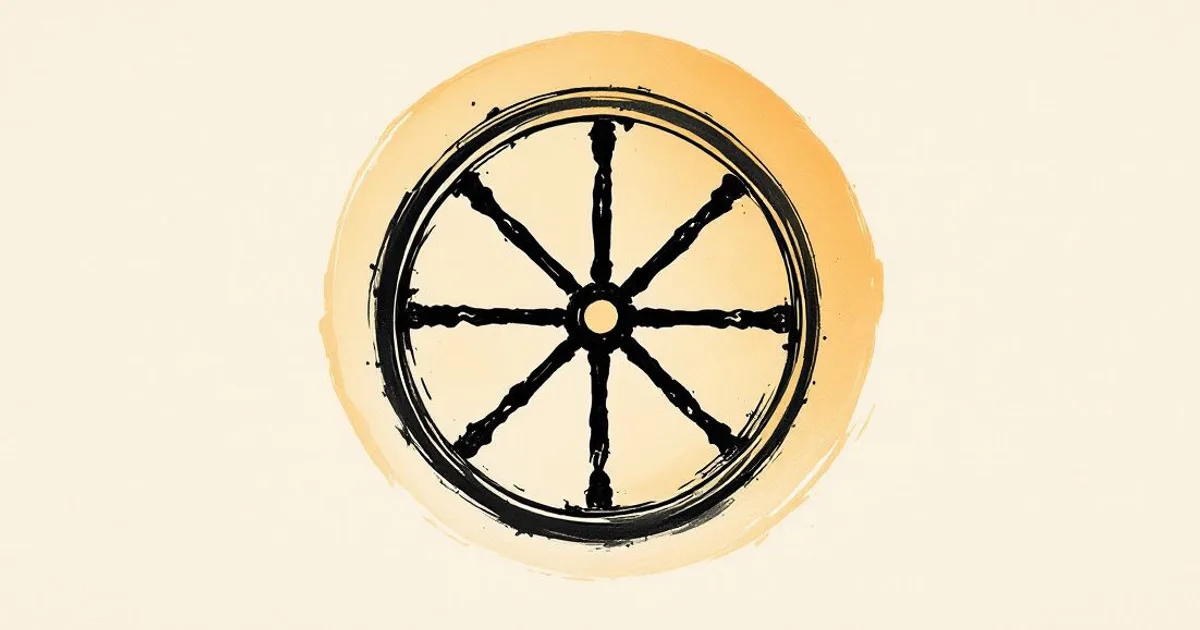
The Dharma wheel (dharmachakra) is the oldest and most important symbol of Buddhism — the emblem of the Buddha’s teaching itself. Its eight spokes stand for the Noble Eightfold Path, and to set the wheel turning, as the Buddha did in his first sermon, is to set the teaching loose in the world.
What is the Dharma wheel?
The dharmachakra — which Encyclopaedia Britannica calls “the wheel of the law” — represents the Dharma, the Buddha’s teaching, and the act of “turning” or setting it in motion. The Buddha’s very first discourse is named for it: the Dhammacakkappavattana Sutta, “Setting the Wheel of Dharma in Motion” (SN 56.11). The wheel’s parts each carry meaning — the eight spokes for the Noble Eightfold Path, the hub for moral discipline, the rim for the mindfulness that holds it all together — and because a wheel turns and rolls forward, it pictures a teaching that is whole, alive, and meant to move through the world. It is among the oldest Buddhist symbols, older than the Buddha image itself. (For the wider language of Buddhist symbols, see our overview.)
”Turning the wheel of Dharma”
The whole symbol grows from a single phrase: turning the wheel of the Dharma. When the Buddha gave his first teaching at the Deer Park near Varanasi, the tradition says he “set the wheel of Dharma in motion” — and the discourse itself is named for the act, the Dhammacakkappavattana Sutta (SN 56.11), literally “the setting-in-motion of the wheel of Dharma.” The image had deep resonance in ancient India, where a rolling chariot wheel symbolized a great king’s sovereignty extending across the land; such a monarch was a chakravartin, a “wheel-turner.” The Buddha is cast as the spiritual wheel-turner, whose dominion is not territory but truth — a wheel of Dharma rolling outward over the world. Ever since, “to turn the wheel” has simply meant to teach.

The parts of the wheel
A traditional Dharma wheel is read as a teaching in its own structure, and its three parts map neatly onto the three trainings of the Buddhist path:
- The hub — the still centre on which everything turns — represents moral discipline (sīla), the steady ethical core of a life of practice.
- The rim, the band that encircles and contains the wheel, represents meditative concentration and mindfulness, which gather and hold the whole together so that it can function.
- The spokes — most often eight of them — are the Noble Eightfold Path: right view, intention, speech, action, livelihood, effort, mindfulness, and concentration.
The lesson is built into the engineering: a wheel needs hub, spokes, and rim all at once to roll at all — and so the path needs ethics, wisdom, and meditation together, not one in isolation.
Why a wheel?
The choice of a wheel, rather than some other shape, is itself meaningful. A wheel is round and complete — an image of a whole, sufficient teaching. It turns — the Dharma is not a dead relic but something living and dynamic. It rolls forward — the teaching progresses and spreads. And it moves around a still axis, uniting motion with a calm centre, much as the path unites active effort with inner stillness. There is a deeper echo, too: Indian thought already pictured saṃsāra, the round of birth and death, as a turning wheel. The Dharma wheel is the answer to that wheel — the wheel that, rightly set in motion, carries beings out of the endless turning of suffering.
How many spokes?
It is worth knowing honestly that the number of spokes varies with context, and each count carries its own meaning:
- Eight spokes — by far the most common and most significant: the Noble Eightfold Path.
- Four spokes — sometimes used for the Four Noble Truths.
- Twelve spokes — sometimes for the twelve links of dependent origination.
- Twenty-four spokes — as on the Ashoka Chakra at the centre of the national flag of India, derived from a pillar the emperor Ashoka raised at Sarnath.
Whatever the count, the core meaning holds: this is the wheel of the teaching. The eight-spoked form is simply the one most saturated with specifically Buddhist meaning.
One of the oldest symbols
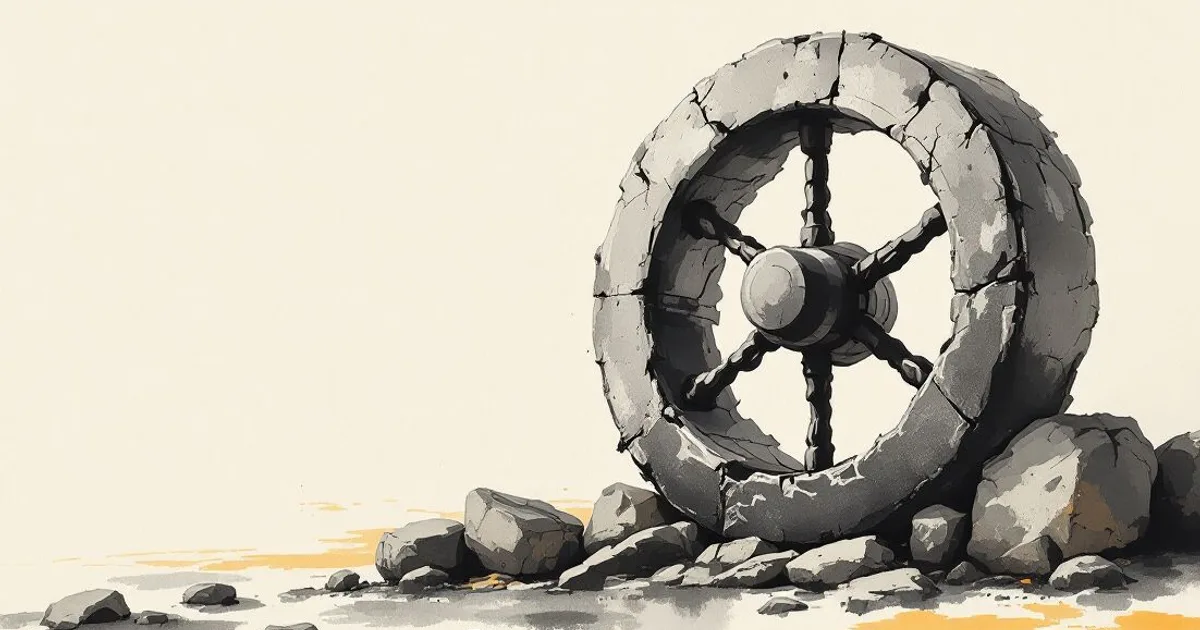
The dharmachakra is among the very oldest Buddhist symbols, used to stand for the Buddha and his teaching from the earliest period — including the aniconic centuries before the Buddha was ever depicted in human form, when a wheel on an empty throne could represent his presence and his message at once. It appears carved on the railings of ancient stupas and atop the pillars Ashoka erected across his empire — most famously the Lion Capital at Sarnath, the very site of the first sermon. That placement is no accident: it roots the symbol in the exact spot where the wheel was first turned.
The three turnings of the wheel
Mahāyāna Buddhism extends the image with the idea of three turnings of the wheel of Dharma, a way of organising the tradition’s unfolding teaching. In this scheme the first turning is the Four Noble Truths and the Eightfold Path of the early discourses; the second turning is the Perfection of Wisdom teachings on emptiness; and the third turning gathers teachings such as buddha-nature. Theravāda, by contrast, emphasises the single original turning at Sarnath. The difference is a real one, and it shows how much can ride on a single image: for the Mahāyāna, the wheel kept turning long after the first sermon.
The wheel today
The Dharma wheel remains Buddhism’s universal emblem — the one image that says Buddhism wherever it appears, on temples and flags and book covers across every tradition and every land the teaching reached. To meet it is to be reminded of the whole path it quietly encodes: a teaching that is complete, alive, and meant to keep turning — out in the world, and within your own practice. (For the path the spokes represent, see the Noble Eightfold Path; for the set it also belongs to, the eight auspicious symbols; and for the other great symbols, Buddhist symbols and their meanings.)
Frequently asked questions
What does the Dharma wheel symbolize?
The Dharma wheel (dharmachakra), which Britannica calls 'the wheel of the law,' represents the Buddha's teaching as a whole and its 'setting in motion.' Its eight spokes most commonly stand for the Noble Eightfold Path, the hub for moral discipline, and the rim for the mindfulness and concentration that hold practice together. Because it is a wheel, it suggests a living teaching meant to move out through the world.
What do the eight spokes of the Dharma wheel mean?
The eight spokes represent the eight factors of the Noble Eightfold Path: right view, right intention, right speech, right action, right livelihood, right effort, right mindfulness, and right concentration. Just as a wheel needs all its spokes to roll, the path is meant to be developed as a whole rather than one factor at a time.
Why is the Buddha's first teaching called 'turning the wheel'?
Because his first discourse is named for exactly that act. The Dhammacakkappavattana Sutta (SN 56.11) means 'Setting the Wheel of Dhamma in Motion.' In Indian imagery a rolling wheel signified a sovereign's reach extending over the land; the Buddha is the spiritual 'wheel-turner' whose wheel is truth, set rolling through the world. To teach the Dharma is to turn the wheel.
What do the hub and rim of the Dharma wheel mean?
The hub is the still centre, representing moral discipline (sila) — the steady core everything turns on. The rim represents the meditative concentration and mindfulness that bind the wheel together and let it function. With the spokes (the path itself), the three parts map the three trainings of Buddhism: ethics, meditation, and wisdom, developed together.
Why does the wheel on India's flag have 24 spokes?
That wheel is the Ashoka Chakra, derived from the Lion Capital that the emperor Ashoka erected at Sarnath — the very place where the Buddha gave his first sermon. It is a dharmachakra adopted as a national symbol of India. The number of spokes on a Dharma wheel varies with context; the eight-spoked form, standing for the Eightfold Path, is the one most charged with Buddhist meaning.
Sources
- Dharmachakra (entry), Encyclopædia Britannica
- Dhammacakkappavattana Sutta (SN 56.11), Access to Insight (trans. Ṭhānissaro Bhikkhu)