Empty Your Cup: The Zen Story of Nan-in's Tea
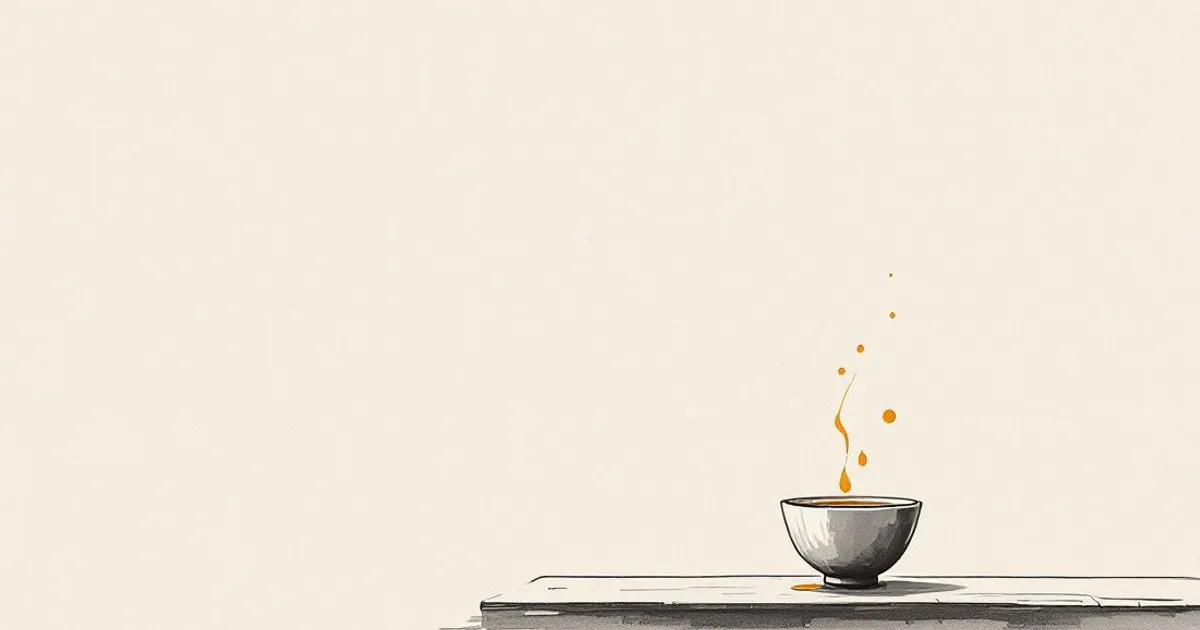
“Empty your cup” is one of the best-loved teaching stories in Zen: a learned scholar visits a master to ask about Zen, but cannot stop talking long enough to listen — so the master pours tea into his cup until it overflows across the table, and lets the mess make the point.
You cannot fill a cup that is already full. It is the classic image of beginner’s mind.
The story
A university professor, the story goes, once came to the Japanese Zen master Nan-in to inquire about Zen. But the professor was so full of his own learning and opinions that he kept lecturing the master, scarcely pausing to hear a reply.
Nan-in served tea. He poured his visitor’s cup full — and then kept pouring. The tea rose to the brim, spilled over, and ran across the table, and still he poured. The professor watched the overflow in disbelief until he could no longer contain himself: “It is overfull. No more will go in!”
Like this cup, Nan-in answered, the professor was full of his own opinions and speculations — so how could he be shown Zen until first he emptied it?
What ‘empty your cup’ means
The lesson is about a particular obstacle to learning anything real: the conviction that we already know. The professor did not lack intelligence — he had too much of one kind of it. His mind was so packed with theories, credentials, and conclusions that there was simply no room for a genuinely new understanding to enter. The tea had nowhere to go.
To “empty your cup” is to set that fullness down: to approach a teaching, a teacher, a practice — or another person, or this very moment — without the silent assumption that you have it figured out already. This open, unassuming quality of attention is what Zen calls beginner’s mind (shoshin). It is not a call to be naïve or to forget what you know; it is a call to hold your knowing lightly enough that you can still be surprised, still corrected, still taught. The expert, sure there is nothing left to learn, learns nothing. The beginner, open to everything, keeps growing.
Where ‘empty your cup’ really comes from
Here honesty matters, because this story is constantly passed around online as something “the Buddha said” — and it is not. The Buddha lived in fifth-century-BCE India; this is a Japanese Zen anecdote from more than two thousand years later.
It appears as “A Cup of Tea,” the opening piece of the 101 Zen Stories compiled by the Zen teacher Nyogen Senzaki around 1919, and it became famous worldwide through the 1957 anthology Zen Flesh, Zen Bones, edited by Paul Reps and Senzaki. The master in it, Nan-in, was a real teacher of the Meiji era (1868–1912). Whether this precise exchange ever took place as told, no one can say — like many Zen stories, it lives somewhere between history and parable. None of that lessens its value. A teaching story earns its keep by the truth it carries, not by pretending to a pedigree it doesn’t have — and a trustworthy guide should always tell you which is which.
Beginner’s mind in Zen
Although the story is modern, the principle is ancient and runs to the heart of Zen Buddhism. The most famous modern statement of it comes from Shunryu Suzuki, whose Zen Mind, Beginner’s Mind opens with the line: “In the beginner’s mind there are many possibilities, but in the expert’s there are few.” Zen prizes this fresh, unencumbered seeing because awakening, in the Zen view, is not the accumulation of more spiritual information but a direct, immediate meeting with reality — which an over-furnished mind tends to talk straight over. The teacup is simply the most memorable way anyone has put it: empty out, and you become able to receive.
(For the tradition this story belongs to, see Zen Buddhism and Zen koans; for the art of releasing what we cling to, letting go. For more stories, return to our collection of Buddhist stories.)
Frequently asked questions
What is the meaning of 'empty your cup'?
It means you cannot learn anything new while your mind is already full of opinions, assumptions, and the conviction that you already know. In the Zen story, a learned professor keeps talking over the master, who pours tea until the cup overflows to show wordlessly that no more can go in. To 'empty your cup' is to set aside what you think you know and approach a teaching with genuine openness.
Where does the 'empty your cup' story come from?
It is a Zen teaching anecdote, not a passage from the Buddha's discourses. It appears as 'A Cup of Tea,' the first of the 101 Zen Stories compiled by Nyogen Senzaki around 1919 and made famous in the West through the 1957 anthology Zen Flesh, Zen Bones. Nan-in, the master in the story, was a real Japanese Zen teacher of the Meiji era, though whether this exchange happened as told is impossible to verify.
Is 'empty your cup' a real Buddhist teaching?
Yes and no. The story itself is a modern Zen anecdote from Nyogen Senzaki's 101 Zen Stories, not a passage from the Buddha's discourses, and it is often wrongly passed around as something 'the Buddha said'. But the principle it carries is ancient and central to Zen: the fresh, assumption-free attention called 'beginner's mind' (shoshin), which Shunryu Suzuki made famous in Zen Mind, Beginner's Mind. The teacup simply pictures that old idea.
What is 'beginner's mind'?
Beginner's mind (Japanese shoshin) is the Zen practice of meeting each experience as if for the first time: open, curious, free of the expert's certainty that there is nothing left to learn. It does not mean staying ignorant; it means holding your knowledge lightly enough that reality can still surprise and teach you. The overflowing teacup is the classic illustration: a full cup, like a full mind, has no room for anything new.
Sources
- 'A Cup of Tea,' the opening story of 101 Zen Stories (compiled by Nyogen Senzaki, c. 1919; first published 1939), collected in Zen Flesh, Zen Bones, ed. Paul Reps & Nyogen Senzaki (1957) — the Meiji-era Japanese master Nan-in pours a visiting professor's teacup until it overflows, to show that a mind already full of opinions cannot receive anything new. A modern Zen teaching anecdote, not a canonical sutra.