“Contentment Is the Greatest Wealth” (Dhammapada 204)
The Buddha quietly upends our usual scoreboard. The greatest wealth, he says, is not a sum of money but contentment — being at ease with what you have. A discontented fortune is a kind of poverty; a contented modest life is genuine riches. Here is the verse, its meaning, and its source.
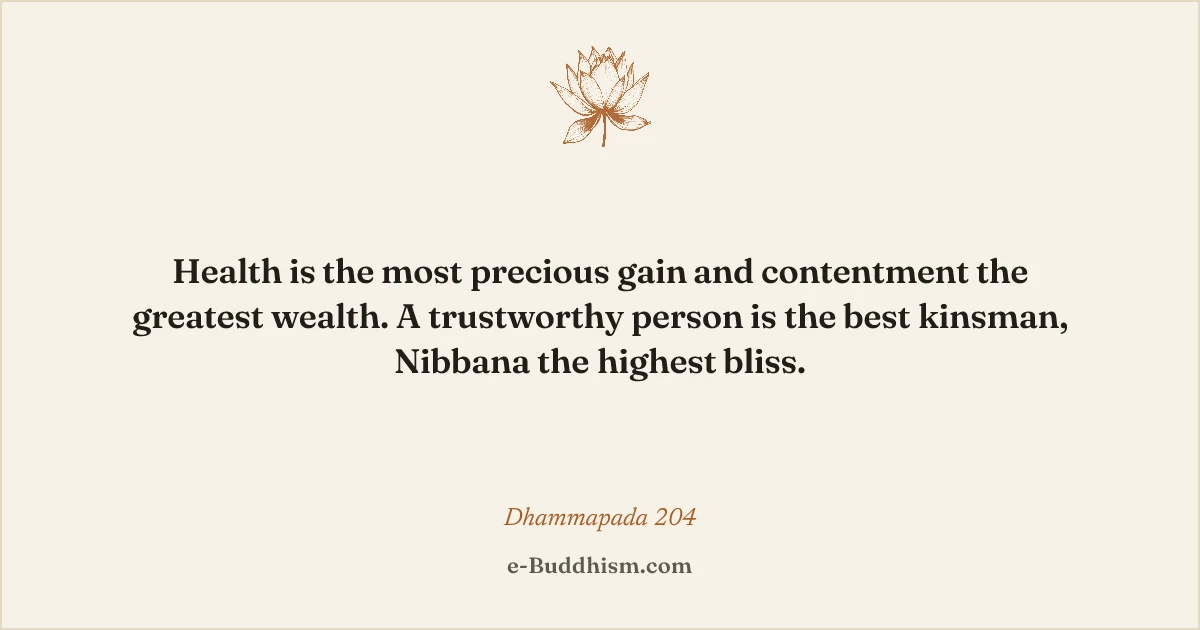
“Health is the most precious gain and contentment the greatest wealth. A trustworthy person is the best kinsman, Nibbana the highest bliss.” — The Buddha, Dhammapada 204 (trans. Acharya Buddharakkhita)
What ‘contentment is the greatest wealth’ means
The verse names the supreme form of four good things: the best gain (health), the best wealth (contentment), the best relative (a trustworthy person), and the highest happiness (Nibbāna). The one that catches everyone is the second: contentment the greatest wealth.
Why call contentment “wealth”? Because wealth is meant to free us from want — and that is exactly what contentment does, directly, without requiring the endless accumulation that money demands. The Pali word is santuṭṭhi, satisfaction with what is sufficient. Its opposite is not poverty but craving: the restless sense of not enough that can haunt a billionaire as easily as a beggar. Seen this way, the richest person is simply the one who has stopped needing more — and that is an inner abundance no market can take away.
The Buddha is not romanticising hardship; he lists health first, and elsewhere treats poverty as real suffering. The point is about where lasting security lives: not in the size of your means, but in your relationship to wanting.
A note on the wording
This verse is among the most-shared “Buddha quotes,” usually as “Health is the greatest gift, contentment the greatest wealth, faithfulness the best relationship, Nirvana the highest happiness.” That is a real and lovely rendering — but a different translator’s (often Eknath Easwaran’s), not the one above. We quote Buddharakkhita’s wording and name him; the meaning is the same.
Where ‘contentment is the greatest wealth’ comes from
Dhammapada 204, from the Sukhavagga — the chapter “on Happiness” — in the Pali Canon. It is one of twelve verses there, and the whole chapter is set out in order among our Buddha quotes on happiness.
Why ‘contentment is the greatest wealth’ matters
This single line reframes a question most of us never stop to ask: what would actually be enough? It is the seed of the Buddhist approach to money and simplicity, and a close cousin of the practice of letting go — including letting go of the quiet conviction that happiness is always one acquisition away.
Browse more sourced lines in our Buddhist quotes with their meaning collection.
Frequently asked questions
What does 'contentment is the greatest wealth' mean?
It means that true riches are not in how much you have but in being satisfied with what you have. A discontented billionaire is poor; a contented person of modest means is rich. The Buddha ranks contentment (santuṭṭhi) above material wealth because wealth without contentment only feeds more craving, while contentment is a kind of inexhaustible inner abundance.
What is the exact verse?
In Acharya Buddharakkhita's translation: 'Health is the most precious gain and contentment the greatest wealth. A trustworthy person is the best kinsman, Nibbana the highest bliss.' It is a 'best of each kind' verse, naming the supreme form of health, wealth, kinship, and happiness. The widely-shared version — 'Health is the greatest gift, contentment the greatest wealth, faithfulness the best relationship' — is a different translator's wording (often Eknath Easwaran's), not Buddharakkhita's.
Where does 'contentment is the greatest wealth' come from?
Dhammapada 204, from the Sukhavagga, the chapter 'on Happiness', in the Pali Canon. It belongs to a cluster of verses on where real happiness is and is not found. The wording quoted here is Acharya Buddharakkhita's translation.