“All Joy Comes Through Wishing Others Happy” — Shantideva
Shantideva offers one of the boldest diagnoses in Buddhist literature: trace any real joy back far enough, he says, and you find someone wishing others well; trace any misery back, and you find someone seeking pleasure for themselves. Here is the verse, what it means, and where it comes from.
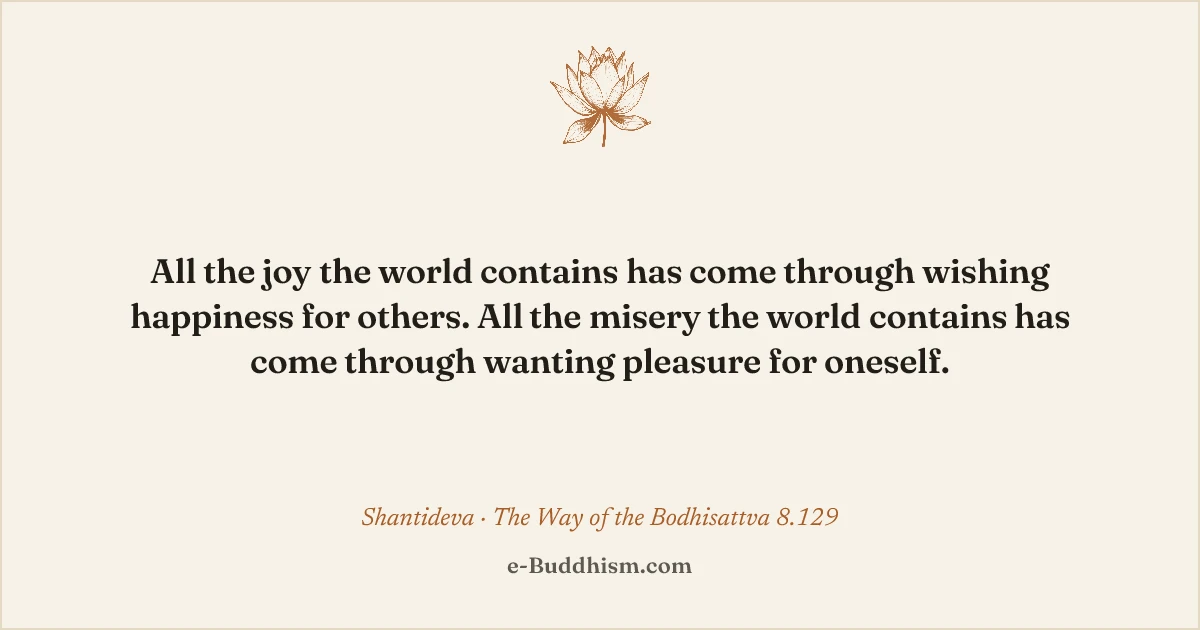
“All the joy the world contains has come through wishing happiness for others. All the misery the world contains has come through wanting pleasure for oneself.” — Shantideva, The Way of the Bodhisattva 8.129 (trans. Padmakara Translation Group)
What ‘all the joy the world contains’ means
The verse draws a single dividing line through all human experience: the direction the heart is facing. Turned outward — toward others’ wellbeing — it tends toward joy. Turned inward — clutching at pleasure and advantage for oneself — it tends toward misery. Shantideva’s claim is not that helping others is merely nice, but that self-cherishing is the actual mechanism of suffering, and other-cherishing the actual mechanism of happiness.
It is worth feeling how counter-intuitive this is. We usually assume that getting things for ourselves is the road to happiness and that attending to others is a cost. Shantideva says we have the map upside down. The self-absorbed mind — endlessly calculating its own gain — is precisely the anxious, dissatisfied mind; the mind devoted to others’ good is the spacious, contented one. He is not denying that we want to be happy. He is correcting our aim.
Where ‘all the joy the world contains’ comes from
The line is verse 8.129 of the Bodhicaryāvatāra (“The Way of the Bodhisattva”), by Shantideva, an 8th-century monk of the great monastic university of Nālandā. It comes from the chapter on meditation, in its famous section on exchanging self and other. The poem is a cornerstone of Mahāyāna ethics and one of the most studied texts in Tibetan Buddhism. The wording here is the Padmakara Translation Group’s.
Because the thought is so striking, it is sometimes shared online as the Buddha’s — it is not. It is genuinely Buddhist, but it is Shantideva’s voice. (The same author gives us the much-misattributed verse on worry, “if there’s a remedy, why be unhappy?”)
How to practise it
The verse is the seed of tonglen, “giving and taking” — a meditation in which, on the breath, you imagine taking in others’ pain and sending out your own wellbeing. Even short of formal practice, its instruction is simple and testable: in a difficult moment, gently turn the attention from what do I get? to what would help them? — and watch what happens to the quality of your mind. It is the same outward turn the Buddha taught as loving-kindness.

Browse more sourced lines in our Buddha quotes collection.
Frequently asked questions
What does Shantideva's verse mean?
It makes a bold diagnosis of where happiness and suffering actually come from. According to Shantideva, every genuine joy in the world traces back to someone wishing others well, and every misery traces back to self-seeking — the craving for pleasure for oneself. Turn the heart outward and you move toward joy; turn it in on itself and you move toward suffering.
Is 'all the joy the world contains' a Buddha quote?
No. It is Shantideva's, verse 8.129 of the Bodhicaryāvatāra ('The Way of the Bodhisattva'), by the 8th-century monk of the monastic university of Nālandā. Because the thought is so striking it is sometimes shared online as the Buddha's words. The teaching is genuinely Buddhist, a cornerstone of Mahāyāna ethics and much studied in Tibetan Buddhism, but the voice is Shantideva's.
How is it practised?
This verse is the textual root of the practice of 'exchanging self and other,' and of tonglen ('giving and taking') meditation in Tibetan Buddhism, in which one deliberately cultivates the wish to take on others' suffering and give them happiness. The aim is to loosen the grip of self-cherishing that Shantideva identifies as the engine of misery.
Sources
- Shantideva, The Way of the Bodhisattva (Bodhicaryāvatāra) 8.129, trans. Padmakara Translation Group (Shambhala, rev. ed. 2006).