Stupas and Pagodas: Meaning and Differences
A stupa is a dome-shaped Buddhist monument, originally built to house relics of the Buddha. Among the oldest forms of Buddhist sacred architecture, it serves as both a reliquary and a symbol of the Buddha’s awakened mind and his passing into final nirvana — and a focus for devotion. As Buddhism spread eastward, the stupa evolved into the towering pagoda.
What is a stupa in Buddhism?
Encyclopaedia Britannica defines a stupa as a “Buddhist commemorative monument usually housing sacred relics associated with the Buddha or other saintly persons.” Its hemispherical form, Britannica notes, “appears to have derived from pre-Buddhist burial mounds in India,” and stupas “were originally built to house the earthly remains of the historical Buddha and his associates.” The faithful honour a stupa by “walking around the monument in the clockwise direction.” Over the centuries the form travelled and changed, evolving — in Britannica’s words — into “such different-looking monuments as the bell-shaped dagaba … the terraced temple of Borobudur in Java, the variations in Tibet, and the multistoried pagodas of China, Korea, and Japan.” Stupa and pagoda, in other words, are the same sacred form in different regional dress. (For the wider language of Buddhist symbols, see our overview.)
Relics and remembrance
The stupa began as a reliquary. The earliest Buddhist texts record that after the Buddha’s passing (parinibbāna), his cremated relics were divided among competing claimants and enshrined in mound-monuments — a distribution described in the Mahāparinibbāna Sutta (DN 16). Britannica confirms that stupas “were originally built to house the earthly remains of the historical Buddha and his associates,” their rounded shape “derived from pre-Buddhist burial mounds.” Tradition holds that the emperor Ashoka, centuries later, gathered and redistributed those relics into many thousands of stupas across his empire — scattering the Buddha’s “presence,” as it were, throughout the land he had helped Buddhism reach. (We tell that story in how Buddhism spread.)
The form and its meaning
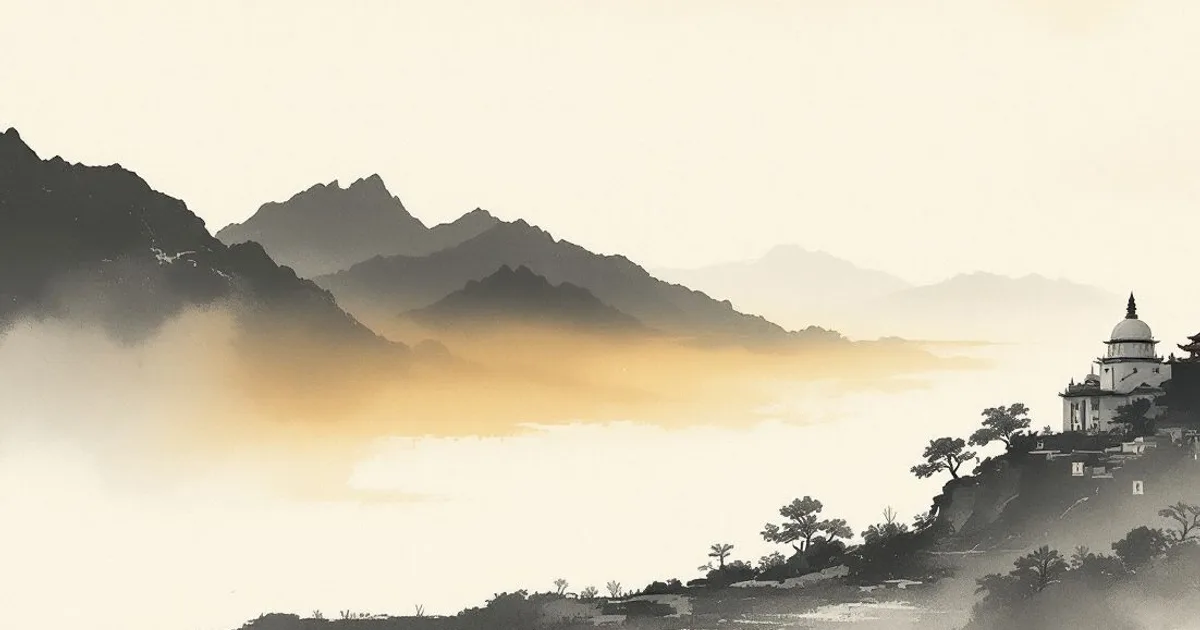
Britannica describes the classic structure: the stupa “consists of a circular base supporting a massive solid dome (the anda, ‘egg,’ or garbha, ‘womb’) from which projects an umbrella.” Notice the word solid — a stupa is generally not a building one enters but a sealed monument, the relic enclosed within like a seed. The dome, named for an egg or a womb, holds that relic; the umbrella-spire rising from its top signifies royalty and the central axis of the world. The various tiers and parts are traditionally read as the five elements and as the stages of the path to awakening, and many traditions see the whole stupa as an image of the Buddha himself seated in meditation — the dome his body, the spire his crown. To build or honour a stupa is to honour the awakened mind it represents.
Walking around: circumambulation
The characteristic way of honouring a stupa is to walk around it. “Worship of a stupa,” Britannica states, “consists in walking around the monument in the clockwise direction” — keeping it always on one’s right. This practice, called circumambulation, is among the most widespread of all Buddhist devotional acts: at once an embodied gesture of reverence and a form of walking meditation, in which one literally circles the awakening enshrined at the centre. (For meditation done on the move, see our guide to walking meditation.)
From stupa to pagoda
As Buddhism spread across Asia, the stupa took on strikingly different regional forms while keeping its essential meaning. Britannica lists the lineage: the bell-shaped dagaba of Sri Lanka, the vast terraced temple of Borobudur in Java, the variations of Tibet, and “the multistoried pagodas of China, Korea, and Japan.” In Southeast Asia the form became the tapering, gilded chedi or zedi; in East Asia, the slender umbrella-spire of the Indian stupa was, in effect, stretched upward into the stacked, eaved roofs of the pagoda tower. They look almost nothing alike — and yet a Japanese pagoda and the Great Stupa in India are the same idea, grown in different soils.
Stupa vs pagoda: the difference in brief
Because the two words confuse people, it helps to set them side by side:
- A stupa is the original South Asian type: a solid, dome- or bell-shaped mound, honoured from the outside by circumambulation, and usually not entered.
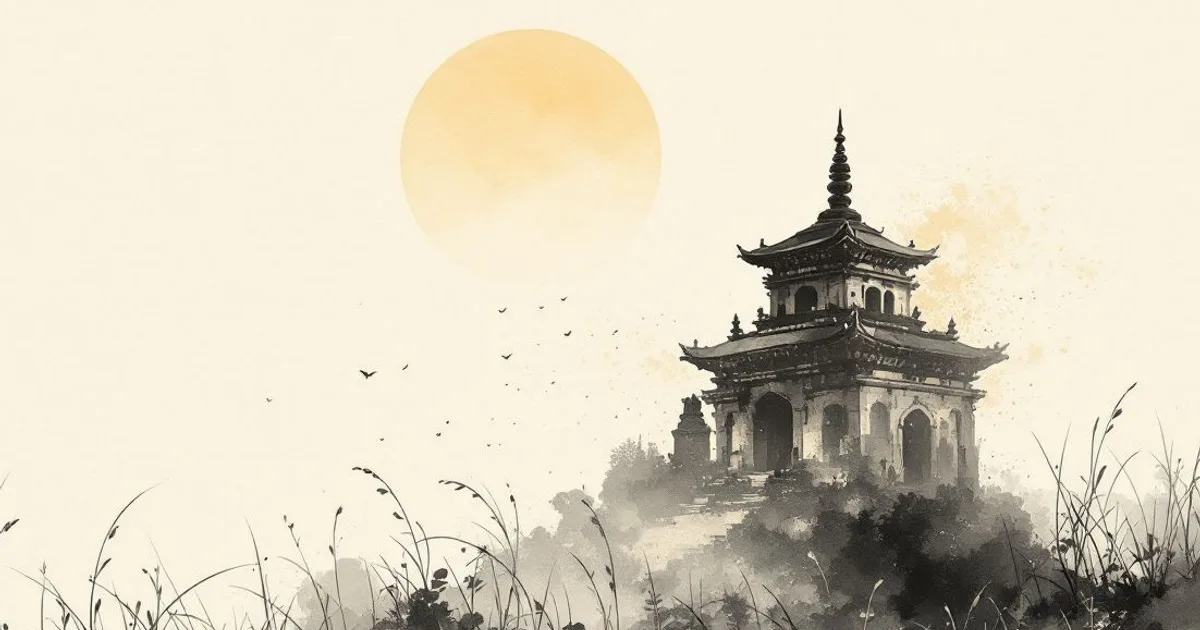
- A pagoda is its East Asian descendant: a tall, multi-tiered tower with projecting roofs, often part of a temple complex, and sometimes built to be entered or climbed.
Both enshrine relics or sacred objects, and both serve the same devotional purpose. The difference is one of form and region — dome versus tower — not of function. (Usage is loose, too: in Myanmar, for instance, a “pagoda” usually means a bell-shaped stupa.)
Famous examples
The classic ancient example is the Great Stupa at Sanchi in central India, which Britannica dates to the 2nd–1st century BCE and which preserves much of the early Buddhist monumental tradition. Borobudur in Java is a colossal terraced stupa one ascends as a symbolic journey toward enlightenment; the gleaming dagabas of Sri Lanka, the gilded zedis of Myanmar, and the wooden pagodas of China and Japan carry the same form across the whole Buddhist world. Wherever Buddhism went, it raised these monuments — silent, weather-worn reminders of the awakened one.
Why stupas matter
The stupa is the Buddha’s awakened presence rendered in earth and stone — reliquary, memorial, and teaching in a single form. To walk slowly around one, clockwise and unhurried, is to circle the awakening at its heart, which is in a quiet way what the whole path does. (For the other great forms of Buddhist sacred art, see Buddhist symbols and their meanings; for the life it commemorates, who the Buddha was.)
Frequently asked questions
What is a stupa?
Encyclopaedia Britannica defines a stupa as a 'Buddhist commemorative monument usually housing sacred relics associated with the Buddha or other saintly persons.' It is typically a solid, dome-shaped mound, originally built to enshrine relics of the Buddha, and it serves both as a reliquary and as a symbol of his awakened mind. Worshippers honour it by walking around it clockwise.
What is the difference between a stupa and a pagoda?
They are the same sacred form in different regional dress. A stupa is the original South Asian type, a solid dome or bell-shaped mound, honoured by walking around it. A pagoda is its East Asian descendant: a tall, multi-tiered tower with eaved roofs. Britannica notes that the stupa 'evolved into such different-looking monuments as … the multistoried pagodas of China, Korea, and Japan.' Both enshrine relics; the difference is form, not function.
What is inside a stupa?
Originally, the relics of the Buddha or of a revered teacher, sealed within the solid dome. The early texts record that after the Buddha's death his cremated remains were divided among claimants and enshrined in stupas (Mahaparinibbana Sutta, DN 16), and tradition holds that the emperor Ashoka later redistributed them into many thousands of stupas across his empire. Many stupas also contain scriptures and other sacred objects.
Why do Buddhists walk around stupas?
Britannica states plainly that 'worship of a stupa consists in walking around the monument in the clockwise direction.' This practice, called circumambulation, keeps the monument on one's right and is one of the most widespread of all Buddhist devotional acts — at once an embodied act of reverence and a kind of walking meditation, circling the awakening enshrined at the centre.
What does a stupa symbolize?
Beyond housing relics, the stupa symbolizes the Buddha's awakened mind and his passing into final nirvana. Its parts are traditionally read as the five elements and as the stages of the path to enlightenment, and the whole monument is often understood as the Buddha himself seated in meditation — the dome his body, the spire his crown.
Sources
- Stupa (entry), Encyclopædia Britannica
- Mahāparinibbāna Sutta (DN 16), Access to Insight (trans. Sister Vajirā & Francis Story)