Tenzin Palmo: 12 Years in a Cave & a Fight for Nuns
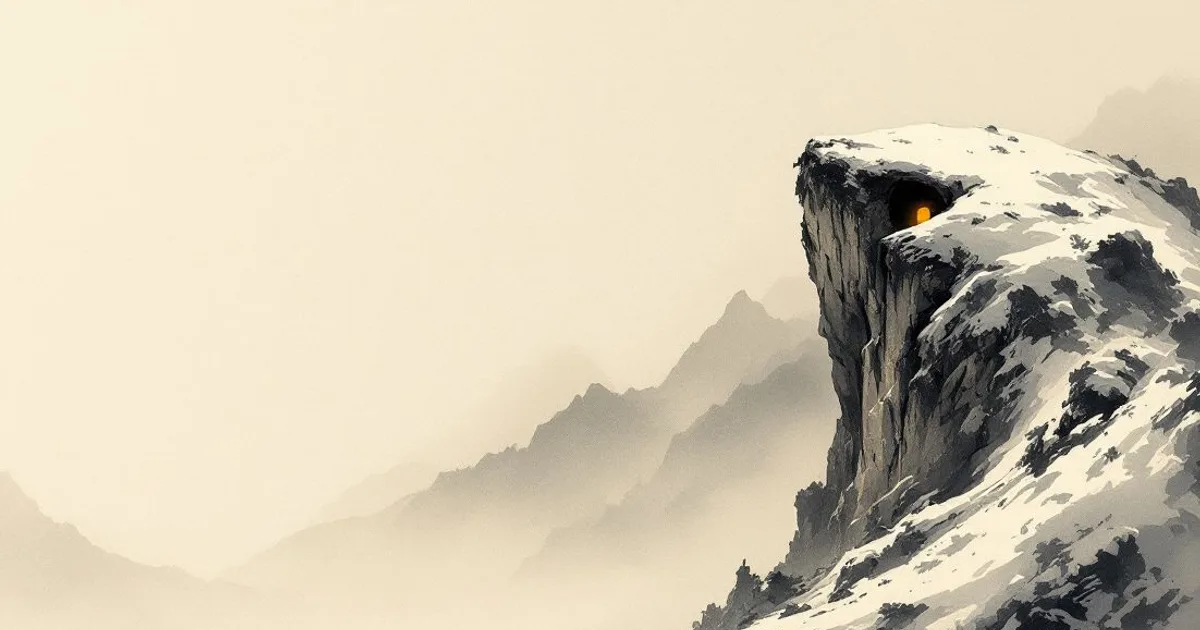
Tenzin Palmo is one of the most remarkable figures in modern Buddhism: a London shop-worker’s daughter who became a Tibetan Buddhist nun, spent some twelve years meditating in a cave in the Himalayas, and then came down the mountain to fight for the women who would come after her.
Her life joins deep practice to public advocacy, and it belongs squarely in the story of female Buddhist figures.
From London to the Himalayas
She was born Diane Perry in London in 1943, and raised by her mother in Bethnal Green after her father died when she was two. Her own account of how she found the path is disarmingly ordinary: at eighteen, reading John Walters’ book The Mind Unshaken, she realised she was a Buddhist. She worked as a librarian — at Hackney Public Library, then at SOAS — until she had saved the fare, and in 1964 she sailed for India.
She went north to Dalhousie, in Himachal Pradesh, to work with Freda Bedi, the Englishwoman who had opened a school there for young reincarnated lamas among the Tibetan refugee community. On her twenty-first birthday, in June 1964, the school had a visitor: the eighth Khamtrul Rinpoche, a lama of the Drukpa Kagyu lineage. She recognised him at once as her teacher and asked him to ordain her — which he did, three months after she had arrived in India, making her one of the first Westerners ordained as a Tibetan Buddhist monastic. She was named Drubgyu Tenzin Palmo. In 1967 she received the novice (śrāmaṇerikā) ordination at Rumtek Monastery in Sikkim from the sixteenth Karmapa.
For six years she lived in Khamtrul Rinpoche’s community — first in Dalhousie, then at the monastery of Tashi Jong near Palampur — usually as the only nun among a great many monks. It was a first-hand education in exactly the obstacles women faced.
The ordination her own tradition could not give her
Here is the fact that explains much of what followed. Novice vows were as far as the Tibetan tradition could take her: as her official biography puts it, full ordination “is not yet available for women in the Tibetan tradition.” So in 1973 she travelled to Hong Kong and took the full bhikṣuṇī ordination at Miu Fat Temple, in the East-Asian Mahāyāna tradition that had kept the women’s ordination line unbroken — the same tradition from which the Theravāda revival was later drawn. Her own site still describes her as a bhikṣuṇī, and she is a founding member of the Committee for Bhiksuni Ordination. Why that lineage lapsed, and where each tradition now stands, is the subject of our page on bhikkhunī ordination.
The vow, and what caused it
The most-quoted thing about Tenzin Palmo is her vow to reach enlightenment in a female body. The vow had a cause, and the cause is the point.
In her teacher’s lineage the togden are the realised yogi-practitioners, formed by many years of retreat. Tenzin Palmo asked to train as a togdenma — the female counterpart. By her own account Khamtrul Rinpoche was delighted, and said he had been praying that someone would re-establish that order. The monks were not delighted. When they heard of the plan, she recalls, they declared that “a woman is not going to live with the Togden,” and she had to give it up. She was at the time the only nun among about a hundred monks.
I made the vow to be reborn in the feminine form until I attained enlightenment.
It is worth noticing what the vow is not. It is not an argument about who can become a Buddha — the Tibetan tradition already had Tārā, who is said to have vowed to reach enlightenment in female form, and we weigh that question in full on its own page, can a woman become a Buddha?. It is an answer to a door being shut. Almost everything she built afterwards follows from it.
Twelve years in a cave
The cave did not come first. In 1970 Khamtrul Rinpoche sent her to the Himalayan valley of Lahaul for more intensive practice, and for six years she lived at Tayul Gompa, a small Lahauli monastery, staying in retreat through the long winters. Only in 1976, wanting more seclusion still, did she find the cave — a couple of hours’ walk above Tayul, at 13,200 feet. Walls were built across its mouth to enclose a living space of about six feet square. Supplies came up from Keylong in summer; she grew turnips and potatoes nearby and stockpiled for the months when the cave was snowbound. She slept and meditated upright in a meditation box.
She lived there twelve years, from the age of thirty-three to forty-five. One distinction is worth keeping: for the first nine years she occasionally had visitors or went down from the cave, and it was the final three years that were strict retreat. It ended in the summer of 1988, after twenty-four years in India.
The hardships were specific rather than picturesque. One winter, after seven days of driving blizzard, she found the snow had sealed the cave’s openings and she was shut in. She dug her way out with saucepan lids — and found the air inside had not gone stale: caves and snow, she concluded, breathe. What she says about the years themselves is level rather than heroic.
I was extremely happy in the cave and very grateful to be there. It was a rare opportunity.
She is also unimpressed by the awe the retreat attracts. Asked in that interview about doubt and fear, she said she finds talking about the cave “extremely boring; it was a lifetime ago,” and pointed out that hundreds of thousands of hermits through the ages have done exactly the same thing.
The story of those years, told in Vicki Mackenzie’s widely read biography Cave in the Snow, made Tenzin Palmo something of a legend — a living demonstration that the most rigorous contemplative path was open to a Western woman who would simply do the work.
The nunnery and the cause of ordination
When she emerged, Tenzin Palmo did not retreat into private accomplishment. Khamtrul Rinpoche had asked her, several times before his death in 1980, to start a nunnery; in 1993 his successor, the ninth Khamtrul Rinpoche, together with the lamas of Khampagar Monastery, made the request again — and this time she took it on. Land was found near Tashi Jong, and the success of Cave in the Snow from 1998 gave her the profile to raise the money on annual international teaching tours. The first nuns arrived in January 2000; building at the permanent site began in 2001. Khamtrul Rinpoche gave the place its name: Dongyu Gatsal Ling, “Garden of the Authentic Lineage.”
What the nunnery actually does
Dongyu Gatsal Ling now has over a hundred nuns, drawn from Tibet, Ladakh, Kinnaur, Lahaul, Bhutan, Arunachal and Nepal. They work through a twelve-year study programme — Tibetan language first, then Buddhist philosophy — and debate every day, which the nunnery describes as strengthening the nuns’ self-confidence as much as their understanding. The day opens with Tārā puja and meditation and closes with Mahākāla puja and the chöd ritual, with four longer ceremonies each lunar month. Four nuns hold the title Khenmo — Professor of Philosophy — and graduate nuns now teach there themselves.
And the togdenma line was re-established: not as an aspiration but as an accomplished fact. After the first six years of study a nun may enter long-term retreat, and fifteen are in retreat now, some of them thirteen years in. In November 2024 four DGL nuns received the red and white robes after sixteen years of retreat and were formally recognised as togdenma. Their own site puts it plainly — “the lost Togdenma tradition has been reestablished at DGL Nunnery.” The training Tenzin Palmo was refused in her twenties is now being given, in her own community, to women who will carry it on.
Speaking for the nuns
Alongside the nunnery she became one of Buddhism’s most candid public voices on the position of women. She has served as president of Sakyadhita, the international association of Buddhist women; she is an honorary advisor to the International Network of Engaged Buddhists, and one of the presidents of the International Buddhist Confederation.
She is also precise about who the recent gains have reached. Himalayan nuns, she has said, were long neglected and are at last being noticed and supported; the ones left out are the non-Himalayan nuns — Western nuns, and nuns from Taiwan, Vietnam and elsewhere who joined the Tibetan movement — who often keep Dharma centres running abroad with no income and nothing behind them. She founded the Alliance of Non-Himalayan Nuns so that they would at least not be isolated.
Some of her reforms are smaller and sharper than an institution. Tibetan nuns were commonly addressed as ani, “aunt”, or chomo, “woman of the house”; she proposed tsunma, a word with dignity in it, and the nuns took it up among themselves — she noticed the Karmapa using it when he visited the nunnery in 2014.
In February 2008 the twelfth Gyalwang Drukpa, head of the Drukpa Kagyu lineage, gave her the rare title Jetsunma — “Venerable Master” — for her practice as a nun and for her work on the status of women. Her first instinct was to refuse it. She accepted, she has said, once the emails came in: the title had less to do with her than with women in general.
What she teaches
Tenzin Palmo’s public teaching is as plain and bracing as her life, and notably free of mystique. She is unimpressed by the idea that practice waits on good conditions: it is really very impressive, she told Tricycle, how many excuses we can invent for why we are not sitting, and conditions will never be perfect, because this is saṃsāra. From the same interview comes her most portable line — call a thing an obstacle and it is an obstacle; call it an opportunity and it is an opportunity.
The point of all our practice is not to come up with the answer to a question, like a quiz. The point is to experience the answer.
She is equally direct about the emotional life. Many people come to her wanting to be rid of anger, she observes, and very rarely does anyone ask how to be rid of desire — though what keeps us on the wheel, she says, citing the Buddha, is greed rather than anger. And she draws a hard line between love and attachment: “Love says, ‘I want you to be happy.’ Attachment says, ‘I want you to make me happy.’” On the position of women she is unsentimental about the obstacles, and equally clear-eyed that they are obstacles of circumstance and structure, not of spiritual capacity.
Her books — and who wrote Cave in the Snow
One mix-up is worth clearing up, because it is the commonest thing people get wrong about her: Cave in the Snow is not her book. It is Vicki Mackenzie’s biography of her, first published in 1998 and issued by Bloomsbury. Her own titles, as listed on her site, are Reflections on a Mountain Lake, a collection of Dharma teachings on the concerns common to practitioners of every tradition; Into the Heart of Life; The Heroic Heart, on bodhicitta and the bodhisattva path; the self-published 3 Teachings; and Change Your Mind, Change Your Life (2026), a commentary on lojong, Tibetan mind training, and the seven-point slogans of Geshe Chekawa Yeshe Dorje (1102–76).
Where she is now
Since April 2022 she has retired from travelling and from giving talks, in person and online, after more than two decades of annual international teaching tours; her recorded teachings are being gathered into an archive on her website. She remains Founding Director of Dongyu Gatsal Ling, lives there for most of the year, and still sees visitors to the nunnery by appointment made in advance.
Tenzin Palmo’s life answers a quiet question with a loud example: what can a woman accomplish on the Buddhist path, given the chance and the determination? She gave her own answer to Lion’s Roar, talking about how far the Himalayan nuns had come — “From now on, there is nothing you cannot accomplish in a woman’s body.” (For her tradition, see Tibetan Buddhism; for contemporaries in the Theravāda world, the lay master Dīpā Ma and the German nun Ayya Khema; for the wider story, women in Buddhism and the life of a Buddhist nun; for others who shaped the tradition, famous Buddhist teachers.)
Frequently asked questions
Who is Tenzin Palmo?
Tenzin Palmo (born Diane Perry in London in 1943) is a nun in the Drukpa Kagyu lineage of Tibetan Buddhism, best known for spending some twelve years in a remote Himalayan cave — three of them in strict solitary retreat — and for founding Dongyu Gatsal Ling Nunnery in India. She is one of the most prominent Western Buddhist nuns and an outspoken advocate for women's equal access to training and full ordination.
How long did Tenzin Palmo live in a cave?
About twelve years, from 1976 to the summer of 1988, in a cave 13,200 feet up in the Lahaul region of the Indian Himalayas, in a living space roughly six feet square. For the first nine years she occasionally had visitors or went down from the cave; the final three years were strict retreat. She grew turnips and potatoes, and slept and meditated upright in a meditation box.
What is Dongyu Gatsal Ling?
Dongyu Gatsal Ling is the nunnery Tenzin Palmo founded in Himachal Pradesh, India, whose first nuns arrived in January 2000. It gives Himalayan women the rigorous training long reserved for monks: a twelve-year study programme, daily debate, and long retreat. In November 2024 four of its nuns were recognised as togdenma, the female counterpart of the realised togden yogis, after sixteen years of retreat.
Why is Tenzin Palmo important for women in Buddhism?
Because she joined the deepest personal practice to public advocacy. Refused training as a togdenma because she was a woman, she vowed to be reborn in female form until enlightenment, went to Hong Kong in 1973 for the full ordination her own tradition could not give her, founded a nunnery where the togdenma lineage has since been re-established, and helped found the Committee for Bhiksuni Ordination.
Did Tenzin Palmo write Cave in the Snow?
No. Cave in the Snow is a biography of her, written by the journalist Vicki Mackenzie and first published in 1998. The books Tenzin Palmo wrote herself are Reflections on a Mountain Lake, Into the Heart of Life, The Heroic Heart, 3 Teachings, and Change Your Mind, Change Your Life, a 2026 guide to the Tibetan mind-training practice of lojong.
Is Tenzin Palmo still teaching?
No. Since April 2022 she has retired from travelling and from giving talks, in person and online, after more than two decades of annual teaching tours. She remains Founding Director of Dongyu Gatsal Ling Nunnery and lives there for most of the year, and visitors to the nunnery can still arrange to meet her by appointment.
Sources
- 'Jetsunma Tenzin Palmo's Biography', tenzinpalmo.com (her official site) — for her birth and early life, the 1964 and 1967 ordinations, the 1973 bhikshuni ordination at Miu Fat Temple in Hong Kong, the six years at Tayul Gompa, the cave years, the founding of Dongyu Gatsal Ling, the title Jetsunma (February 2008), and her roles and retirement
- 'The Nuns of Dongyu Gatsal Ling', Dongyu Gatsal Ling Nunnery (dglnunnery.com) — for the number of nuns, the twelve-year study programme, the Khenmo title, the nuns in long-term retreat, and the recognition of four togdenma in November 2024
- 'Publications', tenzinpalmo.com — for the books she wrote, and for Cave in the Snow being Vicki Mackenzie's
- 'Tenzin Palmo: There Is Nothing a Woman Can't Accomplish', interview by Dominique Butet and Olivier Adam, Lion's Roar — for the togdenma refusal and the vow in her own words, the Alliance of Non-Himalayan Nuns, the word tsunma, and her response to the title Jetsunma
- 'No Excuses', interview with Jetsunma Tenzin Palmo by Lucy Powell, Tricycle, Winter 2009 — for her own words on the cave and on practice
- 'Jetsunma Tenzin Palmo' (home page), tenzinpalmo.com — for her retirement from travelling and talks since April 2022, the teaching archive, and her own words on practice
- Vicki Mackenzie, 'Cave in the Snow: A Western Woman's Quest for Enlightenment' (Bloomsbury, 1998) — the biography of Tenzin Palmo's twelve years of retreat