“The Middle Way”: the Buddha's First Teaching (SN 56.11)
The first thing the Buddha taught, in his very first sermon, was a path between extremes. Not the chasing of pleasure, not the punishing of the body — but a Middle Way between them that “leads to calm… to Unbinding.” Here is the line, its meaning, and its source.
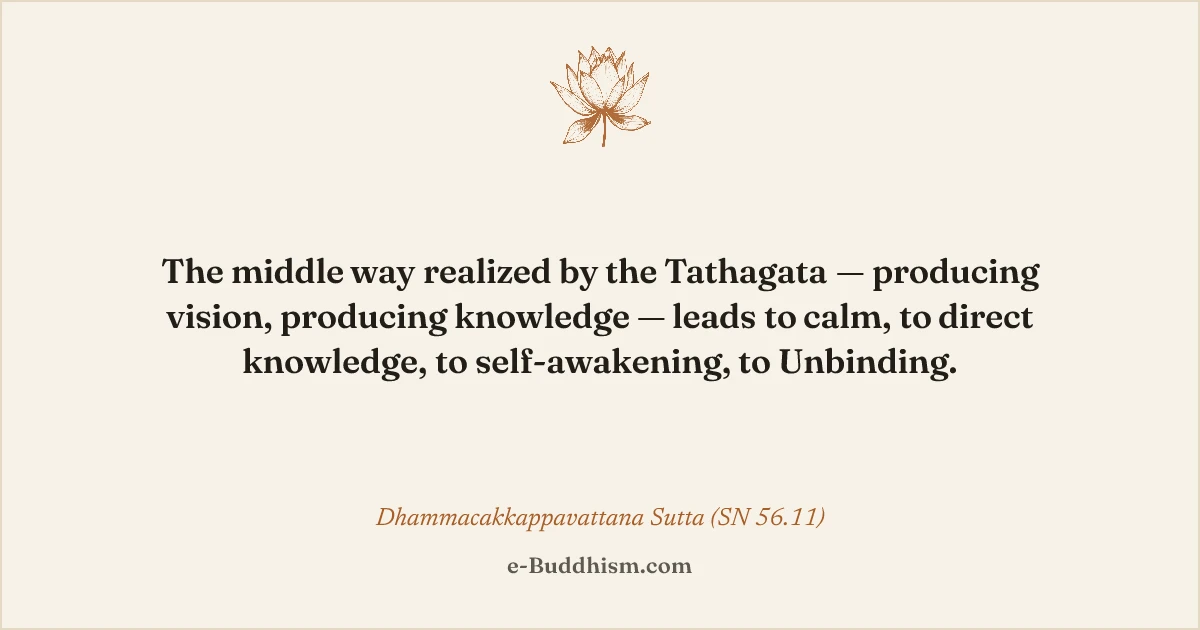
“The middle way realized by the Tathagata — producing vision, producing knowledge — leads to calm, to direct knowledge, to self-awakening, to Unbinding.” — The Buddha, Dhammacakkappavattana Sutta (SN 56.11), trans. Thanissaro Bhikkhu
What the Buddha’s Middle Way means
The Buddha had tried both extremes himself. As a prince he had known every sensual indulgence; as an ascetic he had nearly starved his body to death. Neither, he found, led to freedom — one drowns the mind in craving, the other in pain. So he opens his teaching by setting both aside and announcing a third way: the Middle Way (majjhimā paṭipadā).
It is easy to mistake “middle” for “lukewarm” — a comfortable compromise, half-committed. It is the opposite. The Middle Way is a precise and demanding path; what it avoids is not effort but the two dead ends of self-indulgence and self-torture. In practice, this Middle Way is the Noble Eightfold Path — the discourse goes on to name it.
And notice where it leads. The Buddha lists the fruits like a rising staircase: it produces vision and knowledge, and leads “to calm, to direct knowledge, to self-awakening, to Unbinding” — Thanissaro’s rendering of Nibbāna, the going-out of the flame of craving. This is not a path to a more comfortable life; it is a path to liberation.
Where the Middle Way quote comes from
The line is from the Dhammacakkappavattana Sutta (“Setting the Wheel of Dhamma in Motion,” SN 56.11) — the Buddha’s first sermon — in the Pali Canon, translated by Thanissaro Bhikkhu.
Why the Middle Way matters
This is the founding gesture of the whole tradition: every later teaching unfolds from this Middle Way. We explore the idea in full in our deep-dive on the Middle Way, and it is the path of practice mapped by the Four Noble Truths the same sermon sets out.
Browse more sourced lines in our Buddhist quotes with their meaning collection.
Frequently asked questions
What is the Middle Way?
It is the path the Buddha announced at the very start of his teaching, avoiding two extremes: the pursuit of sensual indulgence on one side and harsh self-mortification on the other. Having tried both as a young seeker, he found that neither led to freedom. The Middle Way between them is the Noble Eightfold Path, and it 'leads,' he says, 'to calm… to Unbinding.'
What does 'Unbinding' mean?
Unbinding is Thanissaro Bhikkhu's translation of Nibbāna (Nirvana) — literally the 'going out' of a flame, the unbinding of the mind from craving. The Middle Way is described as producing 'vision' and 'knowledge' and leading toward calm, direct insight, awakening, and finally that complete release.
Where does the Buddha's Middle Way quote come from?
The Dhammacakkappavattana Sutta ('Setting the Wheel of Dhamma in Motion', SN 56.11), the Buddha's first sermon, in the Pali Canon, translated by Thanissaro Bhikkhu. He opens the discourse by setting aside the two extremes of sensual indulgence and self-mortification and announcing the Middle Way.