The Buddhist Prodigal Son (Lotus Sutra Parable)
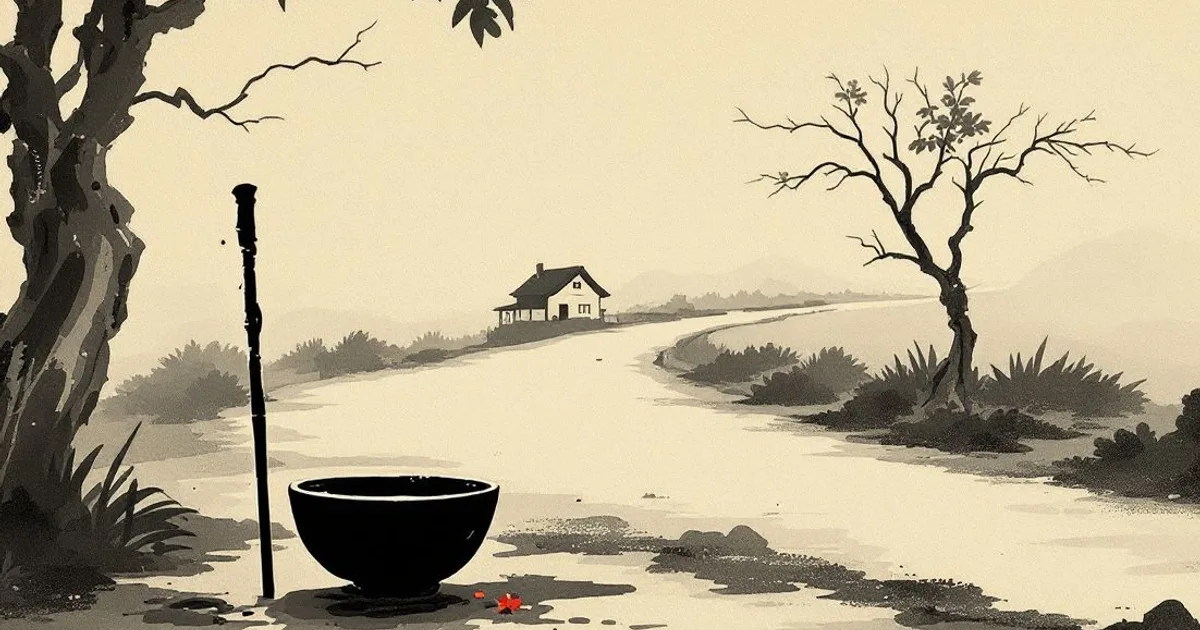
The Buddhist prodigal son — properly, the parable of the poor son — is the second great story of the Lotus Sutra. A boy leaves home and wanders for fifty years in poverty; his father grows rich and never stops searching for him.
When the ragged son finally stumbles onto his father’s estate, he is too frightened to stay — and the father must win him back, patiently and in disguise, to an inheritance the son cannot believe is his.
The story
In Chapter 4 of the Lotus Sutra, four of the Buddha’s most senior disciples tell this parable to show that they have at last understood his purpose.
A young man, they say, left his father and ran away, living for a long time — ten, twenty, fifty years — in another land, growing ever poorer, scraping for food and clothing. His father, meanwhile, had searched for him without success, settled in a far city, and become immensely wealthy, with storehouses of gold and grain, servants and elephants and retainers. But in all his riches the old man grieved constantly for the son he had lost, with no heir to receive what he had built.
By pure chance, the wandering son came at last to the city where his father lived, and to the gate of a great mansion — not knowing it was his father’s. Seeing the splendour within, the rich man on his lion-seat surrounded by attendants, the poor son was seized with terror. This must be a king or a lord, he thought; a place like this will only seize me and put me to work. And he fled.
But the father had recognised his son in an instant, with a leap of joy. He sent servants to bring him — and the poor son, certain he was about to be arrested or killed, fainted in fear. So the father changed his approach. He let the son go, then quietly sent two shabby workmen to offer him an ordinary job for a double wage: clearing away dung and refuse. This the son could accept. And so, for twenty years, the father drew him in by degrees — working alongside him in dirty clothes, praising him, trusting him with more and more, raising him from labourer to steward of the entire estate — never once saying, I am your father. Only at the very end, dying, did he gather his kinsmen and the king and declare before them all: This is my own son. Everything I have is his. And the son, who had once begged in the streets, received an inheritance beyond his wildest reckoning.
What the Buddhist prodigal son parable means
The disciples explain the meaning as their own story. The father is the Buddha; the lost son is the disciple — is, in truth, every one of us. The inheritance is the boundless wealth of Buddhahood, which was always ours and which the Buddha longs to give. But we, impoverished in spirit and unable to imagine such a thing belongs to us, would flee in fear if it were offered all at once.
So the Buddha does what the father does: he meets us where we are. He gives us “lowly” work we can actually accept — simpler teachings, manageable practices, the gradual path — and raises our confidence by stages, until we are at last able to receive what was ours all along. It is a portrait of skilful means (upaya) joined to a deep truth of Mahayana Buddhism — that Buddha-nature, the capacity for full awakening, is the birthright we have simply forgotten.
How it differs from the Bible’s prodigal son
Because the name is borrowed from Christianity, it helps to be clear about the difference — the two stories share an image but teach almost opposite lessons.
| Lotus Sutra (poor son) | Gospel of Luke (prodigal son) | |
|---|---|---|
| Does the son return knowingly? | No — he stumbles there by chance and does not recognise his father | Yes — he decides to go home and confess |
| What moves the son? | Fear, then twenty years of patient, gradual coaxing | Repentance and remembered love |
| The father’s role | Pursues in disguise; hides the truth until the son can bear it | Runs out to embrace him at once |
| The central lesson | Skilful means; the gradual path; an inheritance always ours | Repentance, mercy, and forgiveness |
The Buddhist version is not about a sinner forgiven. It is about a teacher’s patience and a student’s slow ripening into a truth too great to be handed over in a single moment.
Where the Buddhist prodigal son parable comes from
The parable is told in Chapter 4 of the Lotus Sutra, “Belief and Understanding,” by the senior disciples Mahakashyapa, Subhuti, Mahakatyayana, and Mahamaudgalyayana — their joyful response to the teaching of the one vehicle in the chapter before. It is the second of the Lotus Sutra’s seven parables, the companion to the burning house, and one of the most loved stories in Mahayana Buddhism.
(For its sibling parable and the meaning of skilful means, see the burning house; for the inheritance it describes, Buddha-nature. For more stories, return to Buddhist parables and their meaning.)
Frequently asked questions
What is the Buddhist parable of the prodigal son?
It is the Lotus Sutra's parable of the poor son, told in Chapter 4. A boy leaves home and wanders in poverty for fifty years while his father grows enormously wealthy. By chance the ragged son reaches his father's mansion but, terrified, flees without recognising him. The father patiently draws him back by stages, employing him in humble work for twenty years, until he finally reveals that this labourer is his son and heir.
What does the poor son parable mean?
The father is the Buddha and the lost son is every disciple. The vast inheritance is Buddhahood itself, which was always ours though we cannot believe it. Because the son could not bear the truth all at once, the father gave him lowly, manageable work and raised his confidence by degrees. So the Buddha leads beings gradually, through simpler teachings first, until they can accept their full inheritance: a parable of skilful means.
How is the Lotus Sutra's poor son parable different from the Bible's prodigal son?
They share an image but teach different things. In the Gospel of Luke, the son knowingly returns and repents, and the father runs to welcome him home. In the Lotus Sutra, the son does not know the rich man is his father and is too frightened to stay, so the father pursues him in disguise, leading him back over twenty years. The Buddhist version emphasises patient skilful means and gradual ripening, not repentance.
Who tells the parable of the poor son?
Unusually, the Buddha does not tell this one. It is spoken by four of his senior disciples — Mahakashyapa, Subhuti, Mahakatyayana, and Mahamaudgalyayana — to show that they have finally understood the Buddha's deeper purpose. Having heard, in the previous chapter, that the paths they followed were leading to the one great vehicle, they offer this story as their own joyful confession of belief and understanding, which is the title of Chapter 4.
Sources
- Lotus Sutra (Saddharmapuṇḍarīka Sūtra), Chapter 4, 'Belief and Understanding' — the parable of the poor son, told by the senior disciples (Mahākāśyapa, Subhūti, Mahākātyāyana, and Mahāmaudgalyāyana): a son leaves home young and wanders in poverty for fifty years; his father grows immensely rich; the son comes by chance to the father's estate, is terrified, and flees; the father has him gradually employed (beginning with clearing dung), raised over twenty years, and finally, near death, declares him his true heir. Trans. Burton Watson (Columbia University Press) and the BDK English Tripiṭaka; also at 84000.co