“Unshaken Like a Rock”: Praise & Blame (Dhammapada 81)
Few things rule us as quietly as the craving to be praised and the fear of being blamed. The Buddha offers an image of freedom from both: a great rock, unmoved whether the storm rages or not. “Even so,” he says, “the wise are not affected by praise or blame.” Here is the verse, its meaning, and its source.
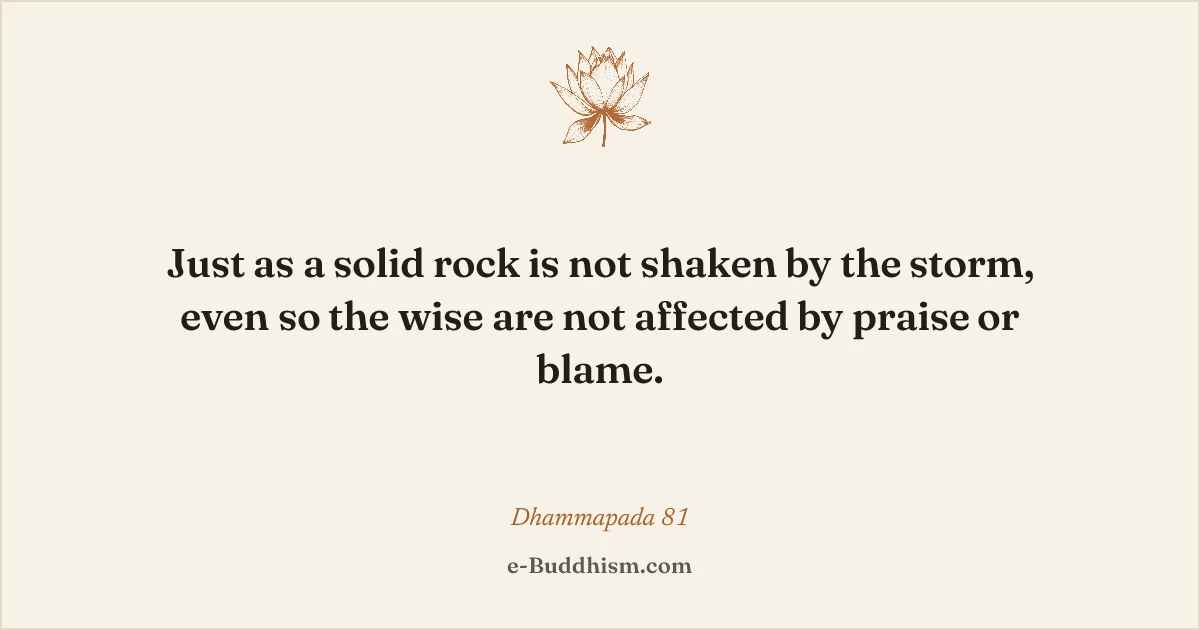
“Just as a solid rock is not shaken by the storm, even so the wise are not affected by praise or blame.” — The Buddha, Dhammapada 81 (trans. Acharya Buddharakkhita)
What “unshaken like a rock” means
The simile is precise. A rock does not resist the storm with effort; it simply has a stability the wind cannot reach. So too the wise: their steadiness is not a clenched refusal to feel, but a settledness that approval and disapproval no longer penetrate to the core.
This speaks to one of the most universal forms of unfreedom. Most of us are, without noticing, on a string — lifted by a compliment, dropped by a criticism, our mood and even our sense of self handed over to whoever is talking about us. The verse points to a mind that has taken that string back.
The Pali discourses list eight worldly conditions (lokadhammā), the eight worldly winds of Chinese Buddhist idiom: gain and loss, fame and disgrace, blame and praise, pleasure and pain (AN 8.5). We spend enormous energy chasing the pleasant four and fleeing the unpleasant four. To be “unshaken” is not to stop caring about others, but to stop being blown around by their verdicts — which leaves you, paradoxically, far more able to listen to honest feedback, because you are no longer defending yourself against it.
Where “unshaken like a rock” comes from
The verse is Dhammapada 81, from the Panditavagga — the chapter “on the Wise” — in the Pali Canon, in Acharya Buddharakkhita’s translation.
How to practise it
Watch, over a single day, how often your inner weather shifts with a word of praise or criticism — an email, a comment, a look. Simply seeing the string is the start of loosening it. The steadiness the verse describes is grown in meditation, and it is close kin to the art of letting go of what was never really in your control — including other people’s opinions.

Browse more sourced lines in our Buddha quotes collection.
Frequently asked questions
What does Dhammapada 81 mean?
It compares a wise person to a great rock that storms cannot move: just as the rock stays put whether the wind blows or not, the wise stay inwardly steady whether they are praised or criticised. The point is not indifference to others, but freedom from being jerked up and down by approval and disapproval.
How does Dhammapada 81 relate to the eight worldly winds?
Dhammapada 81 names one of the eight pairs, praise and blame, and compares the wise to a solid rock that the storm does not shake. The full list of eight worldly conditions is in AN 8.5 and AN 8.6: gain and loss, fame and disgrace, blame and praise, pleasure and pain. The name eight winds comes from Chinese Buddhist texts.
Does staying 'unshaken' mean not caring what anyone thinks?
No. It is not arrogance or numbness. The wise still listen to fair criticism and learn from it; what changes is that their inner stability no longer rises and falls with every compliment or insult. They can take in feedback without being elated or crushed by it — steady, like the rock.