The Seven Offering Bowls (Tibetan Water Bowls)
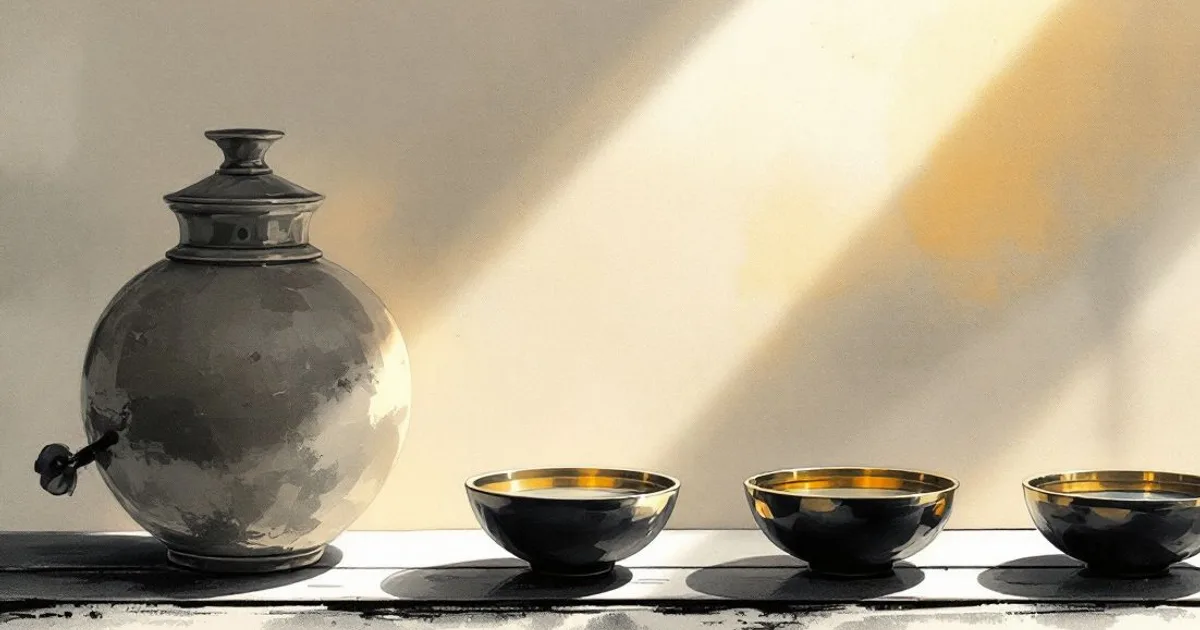
The seven offering bowls are a Tibetan Buddhist practice — a row of bowls, usually filled with clean water, set out fresh each morning on the shrine. The seven stand for the gifts one would offer an honoured guest arriving at one’s home, now offered to the Buddhas: an everyday act of generosity, hospitality, and merit.
Simple, beautiful, and quietly demanding of care, it is one of the most characteristic of Tibetan devotions — and, importantly, a specifically Tibetan one, not a pan-Buddhist rule.
What they are
Imagine a beloved and revered guest arriving at your door. By the old customs of India, you would offer them, in order, water to drink, water to wash the dust of the road from their feet, flowers, sweet incense, lamplight, cool scented water, fine food — and music to delight them. The seven (or eight) offering bowls re-enact exactly this welcome, offered now to the Buddhas and bodhisattvas as the most honoured guests of all. Most practitioners simply fill each bowl with clean water, which stands in for every gift; the beauty of the practice is its humility and ease.
The seven (and eighth) offerings
The traditional set of offerings, in order, is:
- Water for drinking (argham)
- Water for washing the feet (padyam)
- Flowers (pushpe)
- Incense (dhupe)
- Light — a lamp or candle (aloke)
- Perfume or scented water (gandhe)
- Food (naivedya)
To these an eighth is often added — music (shabda) — completing the classic eight offerings. In a row of seven bowls, the eighth is usually not a bowl at all; music is offered instead through a ritual instrument such as a bell or conch. FPMT’s practice booklet puts it simply: where there are only seven bowls, music “is left off as a symbolic offering and is offered with the chanting of prayers and playing of musical instruments during prayers.”
The Sanskrit names are not ornamental. They are said aloud, in that order, as the offering is made, and the whole sequence sits inside ordinary Tibetan liturgies as a single line. Khenpo Munsel’s short meditation on Akṣobhya, for instance, instructs the practitioner, “After the session, make offerings with:”
oṃ vajra akṣobhya saparivāra arghaṃ pādyaṃ puṣpe dhūpe āloke gandhe naivedye śabda pratīcchaya svāhā
The line names Akṣobhya, then runs straight through the eight offerings in the order they stand on the shrine. Learn the row and you have learned the liturgy.
Why seven?
Two answers are given, and they are not the same answer.
The plain one is arithmetical: there are eight offerings, and music is not something you can put in a bowl — so seven bowls, with a bell or a chanted verse for the eighth.
The other makes the number itself meaningful. Lama Zopa Rinpoche, relaying an explanation he received from Serkong Tsenshab Rinpoche, says: “The significance of offering seven water bowls is to create the cause to achieve the seven limbs, or aspects, or qualities of the Vajradhara state – enlightenment.” On that reading the row is not a place-setting at all but seven causes, laid out each morning.
Either way, seven is a custom, not a rule — and the tradition says so itself. Lama Zopa is emphatic that offering more is not “some kind of interference,” and that having few bowls “does not matter.” He recalls the ascetic meditators who used their own wooden food bowl — one of them, he thinks Je Drukhangpa, a lam-rim lineage lama living in a cave, who took his bowl down from the altar to eat, then “cleaned it well and filled it with water and offered it at the altar.” A reader with one clean bowl and a jug has enough to begin.
Why water, and what it trains
There is a lovely logic to filling the bowls with plain water. Water is clean, abundant, and effortless to give — so one can offer it generously and often, without a flicker of attachment or calculation. That is exactly the point: the practice trains the mind in giving without grasping, the pure generosity the whole path aims at. To offer something precious can quietly feed the ego (“look what I gave”); to offer clean water, freely and daily, cannot. The simplest offering turns out to be the most refined.
And, as with every Buddhist offering, this is not the feeding or flattering of a god. The Buddhas do not drink the water. The offering honours them and, above all, works on the one who makes it — cultivating hospitality, generosity, and reverence, one quiet morning at a time. (For the wider practice, see making offerings and dāna.)
The care of the practice
Part of what makes the water bowls a practice rather than a decoration is the care with which they are kept — a discipline of attentiveness in itself. The instructions are unusually exact, and each of them carries a reason; the exactness is the practice, which is doing an ordinary thing beautifully, every day, for its own sake and for others’.
Setting them out
The bowls are wiped clean, passed through incense smoke, and stacked. Water goes into the top bowl of the stack; most of it is tipped into the second, a little left behind, and the first bowl set down on the shrine; then most of the second into the third, and the second set down beside it — on along the row, so that every bowl arrives already holding a swallow of water. FPMT’s practice booklet calls this “seeding” the bowls, and notes that the pouring from one to the next is sometimes read as an image of the teachings being handed down a lineage, teacher to disciple.
Only then does one go back along the row with the pitcher and fill each bowl properly. Even the stream is described: thin at first, fuller in the middle, tapering off at the end — “the shape of a wheat grain” — poured quietly and neatly, the booklet says, “like a maiden offering tea to a king.” It also suggests covering the mouth with a khata scarf or a face mask, “as it is important not to breathe on the offerings as one is making them”; Ven. Thubten Chodron’s version for lay practitioners is simply to stand back a little and try not to breathe on the bowls.
Which way along the row
The row is filled starting from the shrine’s own right — which is your left as you stand facing it — and worked across. In the evening the direction reverses: you begin at “the opposite end from where you started to fill it,” as Ven. Thubten Chodron puts it, and empty back the way you came.
This is why published instructions can look as though they contradict each other. The Samye Institute’s guide has you start placing the bowls “from the right,” and then explains itself: the direction is “said from the perspective of the shrine itself, for instance, the shrine’s right being one’s own left when facing the shrine.” FPMT’s booklet, speaking from where the practitioner stands, puts the first bowl “towards the left-hand side” and, at the end of the day, empties them “one by one (from right to left).” Same row, same movement, opposite vocabulary.
How far apart, and how full
Close together but never touching, and never far apart: bowls set wide apart are said to augur being distant from one’s teacher, bowls that touch a dull mind without sharp intelligence. The gap is measured in a single grain — and here the sources genuinely differ on which grain. FPMT’s booklet says a grain of wheat in its set-up instructions and a grain of rice where it relays Lama Zopa Rinpoche’s own advice; Ven. Thubten Chodron was taught rice; the Samye Institute’s guide says barley. Her answer to the discrepancy is the honest one: “They didn’t specify if it was short-grain rice or long-grain rice, so you can decide that for yourself.” The same grain measures the fill — up to about a grain’s depth below the rim, on the reasoning that bowls left too shallow augur incomplete wisdom and bowls filled to overflowing augur unstable wisdom.
The water itself need not be special. Ven. Thubten Chodron tells her students they can use tap water, or filtered water if they have a filter. Where it can be had, FPMT’s booklet suggests tinting the water with saffron — which is what gives the row on a Tibetan altar its colour, though the booklet notes that teachers differ on the shade, from “the color of a fine champagne” to a more vibrant yellow.
Never an empty bowl
The rule stated most emphatically is that a bowl never goes onto the shrine dry — “as this represents offering nothing,” says the FPMT booklet. Ven. Thubten Chodron gives the domestic reason: it “would be like inviting somebody to your house for dinner and then serving them an empty plate.”
Behind the plainness lies a habit that runs through the whole set of instructions: the details of an offering are read as signs — what FPMT’s booklet calls their “dependent arising,” and what put the omens above on the spacing of the bowls and the height of the water. The Tibetan life of Milarepa turns that habit into a story. In his early years under Marpa the Translator, the young Milarepa went begging through the Lhobrak valley for 420 measures of barley and spent 280 of them on “a big copper vessel, free from speck or flaw inside and outside, and having four handles” — which he then emptied and offered. Long afterwards, at his initiation, Marpa read back to him what each detail of that offering had set in motion: the four handles, the flawless metal, and the emptiness.
The offering of thy vessel empty, predicted that when thou meditatest hereafter thou wilt suffer from want. But so that thou mightest enjoy plenty in thine old age, and that thy followers and disciples might be filled with the Elixir of Spiritual Truths, I filled thy vessel with melted butter for altar-lamps.
Marpa’s remedy was to fill the vessel himself, with butter for the altar lamps. The water-bowl manuals state their rule without invoking Milarepa, so the story is not its source; read alongside it, though, it becomes hard to set an empty bowl on a shrine casually.
Where the water goes
Having been offered in the morning, the bowls are emptied and dried the same day — traditionally in the late afternoon or early evening, before dark — and stored upside-down until they are set out again; nothing is left standing overnight. The water is not simply tipped down the sink. Because it has been offered it belongs to the shrine, and it is returned carefully — to house plants, to the garden, or somewhere outside where it will not be stepped over. “You don’t put it down your drain or down your toilet,” Ven. Thubten Chodron tells her students: a small instruction that holds the whole attitude of the practice in place.
For the other great Tibetan ritual pairing, see the vajra and bell; for the offering of light, butter lamps; for offerings across the traditions, making offerings; and for the tradition itself, Tibetan Buddhism.
How to Set Up the Seven Offering Bowls
- Clean the bowls and surface.Wipe the shrine surface and clean the seven bowls. Traditionally one does not place empty bowls on the shrine, so pour a little water into each before arranging them.
- Arrange them in a straight row.Set the bowls in a single, perfectly straight horizontal line across the front of the shrine, working from the shrine's own right — which is your left as you face it — across to the far end.
- Leave an even, small gap.Space the bowls about a single grain's width apart — the instructions variously name barley, wheat and rice — not touching one another (said to augur mental dullness), and not far apart (said to augur separation from one's teacher).
- Fill with clean water.Fill each bowl with clean water to about that same grain's width below the rim — neither overflowing nor too low, offered generously but with care.
- Offer, then empty by evening.Make the offering in the morning. In the evening, empty the bowls the other way along the row, starting from the end you finished on; pour the water onto plants or clean ground rather than down the drain, wipe each bowl dry, and store them upside-down until the next day.
Frequently asked questions
What are the seven offering bowls?
They are a row of seven bowls, usually filled with clean water, set out fresh each morning on a Tibetan Buddhist shrine. The seven represent the offerings one would traditionally present to an honoured guest arriving at one's home — drinking water, water for washing, flowers, incense, light, perfume, and food. Offering them to the Buddhas is a daily act of generosity, hospitality, and merit.
Are the seven offering bowls a general Buddhist practice?
No — this is specifically a Tibetan (Vajrayana) practice, and it should not be presented as pan-Buddhist. Theravada and East Asian traditions make offerings in their own ways. The water-bowl offering, with its row of bowls representing the eight traditional offerings, belongs to the Tibetan tradition.
Why are the bowls usually filled with water?
Water is chosen precisely because it is clean, abundant, and easy to give without grasping — so offering it trains the mind in generosity free of attachment. Filled with pure water, each bowl stands in for one of the traditional offerings. Alternatively, the actual substances may be used, in which case the first two bowls (for drinking and washing) are still water, and the others hold flowers, incense, a lamp, scented water, and food.
What are the eight offerings?
The traditional set is: (1) water for drinking, (2) water for washing, (3) flowers, (4) incense, (5) light, (6) perfume or scented water, (7) food, and (8) music. In a seven-bowl arrangement the eighth, music, is usually not a bowl but is represented by a ritual instrument such as a bell or conch. The Sanskrit names — argham, padyam, pushpe, dhupe, aloke, gandhe, naivedya, shabda — are recited in the offering.
Which way do you fill and empty the offering bowls?
Fill from the shrine's own right — your left as you face it — and work across the row. In the evening, reverse it: begin at the opposite end, the one you finished filling on, and empty back the way you came. Instructions that look contradictory — 'left to right' in one book, 'right to left' in another — usually describe the same movement from opposite sides of the altar.
Do you have to use exactly seven bowls?
No — seven is the custom, not a rule. Lama Zopa Rinpoche says plainly that offering more is no kind of interference, and that having few bowls does not matter: he recalls ascetic meditators who offered the single wooden bowl they ate from. Seven is usually explained as the eight offerings minus music, which is offered with a bell or with chanting rather than in a bowl.
Sources
- Lama Yeshe Wisdom Archive, 'Water Bowl Offerings' — the seven (or eight) offerings, their symbolism as the welcome given to an honoured guest, and the practice of offering water as a training in non-attachment
- Samye Institute, 'Offering Water Bowls' — the setup conventions: a straight row, roughly a barley-grain's spacing and fill level, filling right to left, and emptying and drying the bowls the same day
- Robert Beer, 'The Handbook of Tibetan Buddhist Symbols' — the traditional set of offerings (drinking water, washing water, flowers, incense, light, perfume, food, and music) and their meanings; a Tibetan / Vajrayāna practice
- 'The Preliminary Practice of Altar Set-up & Water Bowl Offerings', with instructions by Lama Zopa Rinpoche (FPMT Inc., 2003/2007/2008) — the seven or eight offerings and what is done when only seven bowls are used; 'seeding' the stacked bowls; the grain-width spacing and fill level; saffron water; covering the mouth; emptying the row from right to left; and Serkong Tsenshab Rinpoche's explanation of the number seven
- Ven. Thubten Chodron, 'Water bowl offering' (Setting up your altar, part 2), Sravasti Abbey — why water is offered, never placing an empty bowl on the shrine, filling from your left across the row, the rice-grain gap and fill level, not breathing on the offerings, and using ordinary tap or filtered water
- Ven. Thubten Chodron, 'Taking down offerings' (Setting up your altar, part 3), Sravasti Abbey — emptying from the opposite end to the one you began filling from, drying and storing the bowls, and returning the offered water to plants or clean ground rather than the drain
- 'Tibet's Great Yogi Milarepa: A Biography from the Tibetan, being the Jetsün-Kahbum', according to the late Lama Kazi Dawa-Samdup's English rendering, ed. W. Y. Evans-Wentz (Oxford University Press, 1928), Internet Archive — chapter V for the purchase and empty offering of the four-handled copper vessel, chapter VI ('The Initiation') for Marpa's reading of it
- Khenpo Munsel, 'Meditation on Akṣobhya', Lotsawa House (trans. Sean Price, 2023) — the eight offerings recited as one line: arghaṃ, pādyaṃ, puṣpe, dhūpe, āloke, gandhe, naivedye, śabda