Uppalavanna: The Nun Foremost in Psychic Power
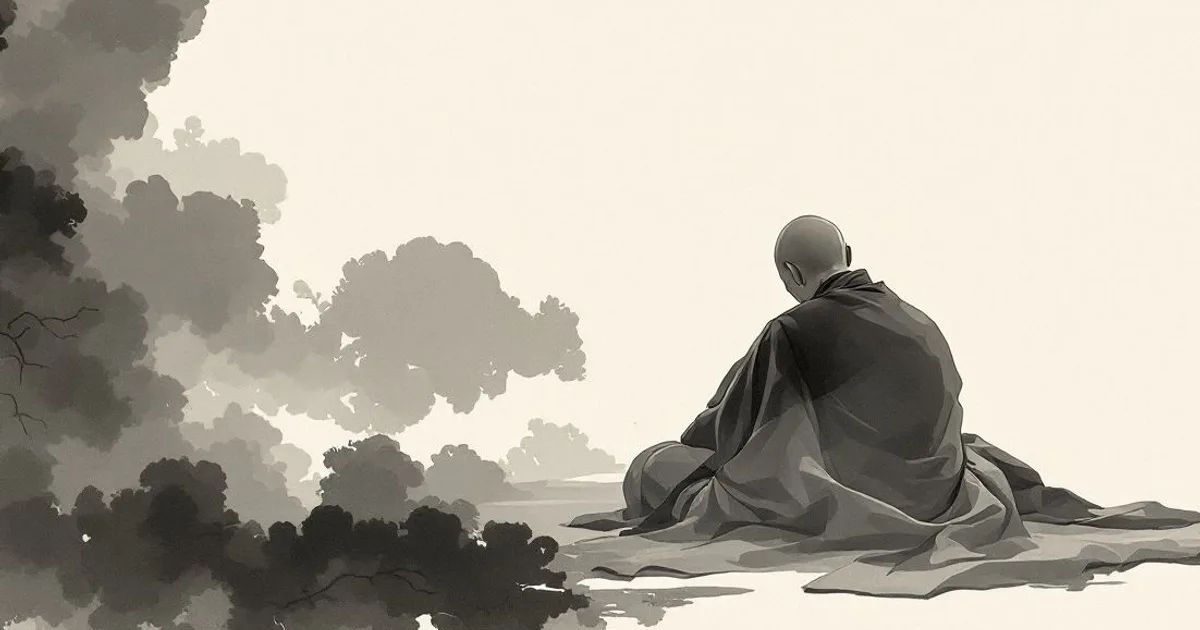
Uppalavaṇṇā was one of the Buddha’s two chief women disciples — the nun he named foremost in psychic power, as Mahāmoggallāna was among the monks. If you have met her name, it was almost certainly beside Khemā’s: the Buddha told his nuns to measure themselves against the pair of them.
She belongs at the centre of the story of women in Buddhism, and an unusual amount of what we know about her is canonical — discourse, verse and monastic law, not later legend.
Her name, and the little the canon says of her life
Uppalavaṇṇā means, literally, “the complexion of a water lily” — uppala, the blue water lily, and vaṇṇa, colour. The name is a description of her appearance, and, as we will see, it is the thing Māra chose to attack her with.
The early texts are sparing about her biography. Her own verses say she “went forth in Rājagaha from the lay life to homelessness” and that she reached the ending of the defilements (Therīgāthā 11.1, trans. Bhikkhu Sujato) — she was an arahant, fully awakened. That is nearly all the discourses offer about her life before ordination. The fuller life story that most retellings follow is commentarial: the Dhammapada commentary carries one such account, written down centuries after the canon, and it should be read as what it is.
Foremost in psychic power
The Buddha’s roll of foremost disciples — the etadagga list — gives the nuns thirteen entries, one woman to a quality. Hers is a single elliptical line: ”… with psychic power is Uppalavaṇṇā” (Aṅguttara Nikāya 1.237, trans. Bhikkhu Sujato). The matching line for the monks names Mahāmoggallāna (AN 1.190). Same words, same title, one for each community.
It is worth being exact about what iddhi means here, because “psychic power” invites the wrong picture. In the early texts these are the reputed by-products of very deep meditative concentration — knowledge of others’ minds, memory of past lives, movement through space — and they are not themselves what liberates. In the list her own verses recite, the psychic powers come fifth of six; the ending of the defilements comes last. A person can have the powers and remain unfree. What makes Uppalavaṇṇā remarkable is not the powers on their own; it is that the texts credit her with both the powers and the awakening.
”A standard and a measure”: the two chief nuns
Three separate places in the canon pair her with Khemā exactly as Sāriputta is paired with Moggallāna. A faithful nun should rightly aspire to be like the nuns Khemā and Uppalavaṇṇā, because they are “a standard and a measure for my nun disciples” (Aṅguttara Nikāya 2.131, and again at AN 4.176). The third instance is the most human of the three: the Buddha imagines a laywoman giving advice to a beloved only daughter.
‘But my darling, if you go forth from the lay life to homelessness, please be like the nuns Khemā and Uppalavaṇṇā.’ These are a standard and a measure for my nun disciples, that is, the nuns Khemā and Uppalavaṇṇā.
The structure of these passages is worth pausing on. Each one names a pair for monks, a pair for nuns, a pair for laymen and a pair for laywomen. The women are not an afterthought appended to the men’s list; they have their own benchmark, named by the Buddha himself, and Uppalavaṇṇā is half of it.
Her own verses in the Therīgāthā
The Therīgāthā preserves a set of verses under her name (Thig 11.1), and they open with something startling.
”The two of us were co-wives, though we were mother and daughter. I was struck with a sense of urgency, so astonishing and hair-raising! … Seeing the danger in sensual pleasures, seeing renunciation as sanctuary, I went forth in Rājagaha from the lay life to homelessness.”
The poem does not explain how that situation came about. It states it, calls it hair-raising, and turns to what she did about it — which is the shape of a great many of these verses: a life named in one line, and then the way out of it. Readers who want the back-story will find one in the commentaries; they will not find it in the canon.
What follows in her verses is a plain first-person inventory of attainment.
”I know my past lives; my clairvoyance is clarified; I encompass the minds of others; my clairaudience is purified; I’ve realized the psychic powers, and attained the ending of defilements. … I created a four-horsed chariot using my psychic powers. Then I bowed at the feet of the Buddha, the glorious protector of the world.”
Notice what the chariot verse actually does. It is a canonical, first-person description of a display of psychic power — and the display ends in a bow. The power is not the point of the verse; the reverence is.
Her answer to Māra
Uppalavaṇṇā has a short discourse of her own in the Bhikkhunī Saṁyutta (SN 5.5), the set of ten suttas in which ten named nuns are approached by Māra and send him away. She has gone out for alms near Sāvatthī and is standing at the root of a sal tree in full flower. Māra arrives wanting, in the text’s own phrase, to make her “feel fear, terror, and goosebumps” — and taunts her for standing alone at the tree’s root with a beauty “second to none”, asking whether she is not afraid of “rascals”. Her reply is not a plea for protection.
”Even if 100,000 rascals like you were to come here, I’d stir not a hair nor panic. I’m not scared of you, Māra, even alone. … I’m the master of my own mind, I’ve developed the bases of psychic power well. I’m free from all bonds, and I’m not afraid of you, sir!”
Two things are worth noticing. The first is the content of the answer: not I am guarded but I am beyond your reach — a threat of violence met with mastery of mind, and with the very attainment she is famous for. The second is textual. A close parallel of this exchange also sits inside her Therīgāthā verses (Thig 11.1, verses 7–10), and it is a parallel rather than a copy: eight of the sixteen lines the two versions share differ in wording, and the Therīgāthā carries two further verses the discourse does not have. The difference that matters most is one line of Māra’s taunt — where SN 5.5 has him say her beauty is second to none, Thig 11.1 has him say she has no male companion with her. Bhikkhu Sujato flags that line in his notes and argues the Saṁyutta wording looks the older of the two, since its unusual phrase (vaṇṇadhātu, “the element of beauty”) appears to play on her name. One encounter, two lines of transmission — worth knowing before anyone quotes either as the wording.
The bandit, the meat, and the robe she lost
One of the fullest scenes involving her is not in the discourses at all but in the Vinaya, the monastic law. She is sitting for the day’s meditation at the foot of a tree in the Blind Men’s Grove outside Sāvatthī. A gang of cattle-thieves comes through with stolen meat. Their leader sees her and thinks that if his sons and brothers see her they will harass her — so he takes a different path, and afterwards hangs the best of the meat from a tree near her, saying aloud that whatever ascetic or brahmin sees the gift should take it.
She takes it. The next morning she wraps it in her upper robe, rises into the air, and lands in the Bamboo Grove to give it to the Buddha. He is out on almsround; the monk Udāyī, left behind minding the dwellings, offers to pass it on — for a price. He wants her sarong.
”It’s hard for women to get material support, and this is one of my five robes. I don’t have another. I can’t give it away.”
Pressed, she gave it to him anyway. The other nuns complained, the monks complained, and the matter reached the Buddha, who laid down a training rule: a monk who receives a robe directly from an unrelated nun commits an offence — later amended to allow a fair exchange. The story is usually retold for the flight in the middle of it. It is at least as interesting for the sentence she says to Udāyī, which is a piece of hard evidence about what the life of a Buddhist nun actually cost: five robes, no spare, and a rule made because a monk could take one.
The hardest thing in her record — and which layer it belongs to
One episode in her story is usually either sensationalised or quietly dropped. It belongs here, stated once and plainly, because it is not a legend. It is in the monastic law itself.
In the list of cases attached to the first pārājika rule, the Vinaya records that a young brahmin who had fallen in love with Uppalavaṇṇā hid in her hut while she was away on almsround and raped her. She told the other nuns; the nuns told the monks; the matter reached the Buddha. His ruling is a single line.
”There’s no offense for one who doesn’t consent.”
That line is the substance of the episode, and it is why it is in the law book at all: in the earliest stratum of Buddhist monastic law, the person who does not consent bears no offence. The Vinaya records it, rules on it, and moves to the next case.
Two clarifications, because both mistakes are common. First, the layer. This is canonical — Vinaya, the same body of text that carries the monastic rules — not a commentarial story. Second, the man. The Vinaya gives him no name and no identity beyond “a young brahmin”. The later Dhammapada commentary tells the episode differently, naming him as Nanda, a son of her uncle, and adding a scene of punishment; that version is commentarial, centuries later, and it does not agree with the canonical account. Neither version identifies him with Ānanda, the Buddha’s attendant and cousin, who has nothing to do with this story.
Placing this beside SN 5.5, where she faces down Māra without a tremor, is genuinely difficult, and honest translators say so rather than smoothing it over: Sujato, in his note to that discourse, suggests the Vinaya incident may belong to an earlier point in her life, before her attainment. That is a translator’s conjecture, offered as one, and the texts themselves give no chronology.
She taught, too
The canon does not leave her as a solitary adept. The closing verses of Therīgāthā 13.5 praise Subhā, the smith’s daughter — awakened eight days after going forth — as “guided by Uppalavaṇṇā”. And the Cullavagga records a nun who was a pupil of Uppalavaṇṇā following the Buddha for seven years in order to learn the monastic law. Between the two, she appears in the record as a preceptor and a teacher of nuns, not only as a virtuoso.
Why she matters
Uppalavaṇṇā is the answer to a question people still ask about early Buddhism: were the awakened women of the canon exceptions, tolerated at the edges? The texts say otherwise about her, repeatedly and in the Buddha’s own voice. She holds a title identical to a chief male disciple’s. She is half of the benchmark every nun was told to aim at. She has her own discourse, her own verses, her own pupils, and her own scenes in the law book — and her record includes the worst thing that happened to her, ruled on plainly rather than hidden.
For the woman who opened the order she joined, see Mahāpajāpatī Gotamī; for her counterpart in wisdom, Khemā and Dhammadinnā; for the collection that preserves her verses, the Therīgāthā; for the question her life keeps answering, can a woman become a Buddha?; and for where that history stands today, bhikkhunī ordination and women in Buddhism.
Frequently asked questions
Who was Uppalavanna?
She was one of the Buddha's two chief women disciples, alongside Khemā — the nun he declared foremost in psychic power (AN 1.237), and an arahant. Her verses survive in the Therīgāthā, she has a discourse of her own in the Saṁyutta Nikāya, and she appears repeatedly in the monastic law. Her name means, literally, the complexion of a blue water lily.
What was Uppalavanna foremost in?
Psychic power (iddhi). The Buddha's roll of foremost disciples gives it in one line: '… with psychic power is Uppalavaṇṇā' (AN 1.237). It is the exact title he gave Mahāmoggallāna among the monks (AN 1.190). Her own verses in the Therīgāthā claim the six direct knowledges, including the psychic powers and the ending of the defilements.
Who were the Buddha's two chief women disciples?
Khemā and Uppalavaṇṇā. Three passages pair them exactly as Sāriputta is paired with Moggallāna: a faithful nun should aspire to be like them, because they are 'a standard and a measure for my nun disciples' (AN 2.131, AN 4.176, SN 17.24). Khemā stands for wisdom, Uppalavaṇṇā for meditative mastery.
Does the canon really record that Uppalavanna was assaulted?
Yes, and it is canonical rather than legendary. The Vinaya's case list under the first pārājika rule records that an unnamed young brahmin infatuated with her hid in her hut and raped her. The Buddha's ruling is a single line: 'There's no offense for one who doesn't consent.' A later commentary tells the episode differently; neither version identifies the man as Ānanda, the Buddha's attendant.
What do Uppalavanna's own verses say?
Therīgāthā 11.1 opens with a startling line — that she and her own daughter had been co-wives — and turns from there to renunciation: she went forth at Rājagaha, realised the six direct knowledges, and ended the defilements. One verse describes her creating a four-horsed chariot by psychic power in order to bow at the Buddha's feet. The poem never explains the co-wives line.
Are Uppalavanna's psychic powers in the suttas or only in the commentaries?
In the suttas and the monastic law. Her title is canonical (AN 1.237), her claim to the psychic powers is in her own canonical verses (Thig 11.1), and the Vinaya narrates her rising into the air to carry almsfood to the Buddha (Bu NP 5). What is commentarial is most of her biography — her early life, her family, and the fuller story of the assault.
Sources
- Aṅguttara Nikāya 1.235–247 (Etadagga-vagga, Chapter Five) — the Buddha's roll of the thirteen foremost nun disciples; AN 1.237 names Uppalavaṇṇā foremost 'with psychic power'; SuttaCentral (trans. Bhikkhu Sujato)
- Aṅguttara Nikāya 1.188–197 (Etadagga-vagga, Chapter One) — AN 1.190 names Mahāmoggallāna foremost among the monks 'with psychic power', the matching title; SuttaCentral (trans. Bhikkhu Sujato)
- Aṅguttara Nikāya 2.130–140 (The Chapter on Aspiration) — AN 2.131, Khemā and Uppalavaṇṇā as 'a standard and a measure' for the Buddha's nun disciples; the same formula for monks at AN 2.130 names Sāriputta and Moggallāna; SuttaCentral (trans. Bhikkhu Sujato)
- Aṅguttara Nikāya 4.176 (Aspiration) — the same pairing of Khemā and Uppalavaṇṇā; SuttaCentral (trans. Bhikkhu Sujato)
- Saṁyutta Nikāya 17.24 (An Only Daughter) — the laywoman advising her only daughter to be like the nuns Khemā and Uppalavaṇṇā if she goes forth; SuttaCentral (trans. Bhikkhu Sujato)
- Saṁyutta Nikāya 5.5 (With Uppalavaṇṇā) — her encounter with Māra at the foot of a flowering sal tree, and the translator's notes on the parallel verse and on the Vinaya incident; SuttaCentral (trans. Bhikkhu Sujato)
- Therīgāthā 11.1 (Uppalavaṇṇā) — her own verses: the mother-and-daughter co-wives, going forth at Rājagaha, the six direct knowledges, the four-horsed chariot, and the parallel Māra exchange; SuttaCentral (trans. Bhikkhu Sujato)
- Therīgāthā 13.5 (Subhā, the Smith's Daughter) — the closing verses praising Subhā as 'guided by Uppalavaṇṇā'; SuttaCentral (trans. Bhikkhu Sujato)
- Theravāda Collection on Monastic Law, Bu NP 5 ('Receiving a robe from a nun') — the bandit's gift of meat in the Blind Men's Grove, Uppalavaṇṇā's flight to the Bamboo Grove, Udāyī's demand for her sarong, and the resulting training rule; SuttaCentral (trans. Bhikkhu Brahmali)
- Theravāda Collection on Monastic Law, Bu Pj 1 (case list at 10.5) — the canonical record that Uppalavaṇṇā was raped by an unnamed young brahmin, and the Buddha's ruling that there is no offence for one who does not consent; SuttaCentral (trans. Bhikkhu Brahmali)
- Theravāda Collection on Monastic Law, Kd 20 (Cullavagga X), 8.1.1 — a nun who was a pupil of Uppalavaṇṇā followed the Buddha for seven years to learn the monastic law; SuttaCentral (trans. Bhikkhu Brahmali)
- Dictionary of Pāli Proper Names, s.v. Uppalavaṇṇā — 'one of the two chief women disciples of the Buddha, and the chief of the women possessed of psychic power'; SuttaCentral
- Digital Pāḷi Dictionary, s.v. uppalavaṇṇā — 'name of an arahant nun; lit. complexion of a water lily (uppala + vaṇṇa + ā)'; consulted via SuttaCentral's dictionary lookup
- 'The Dhammapada: Verses and Stories', trans. Daw Mya Tin, M.A., ed. Editorial Committee, Burma Tipitaka Association, Rangoon, 1986 — the commentarial story attached to Dhammapada verse 69, which names the man as Nanda, the son of Uppalavaṇṇā's uncle. Commentarial, not canonical.