Wabi-Sabi: Beauty in Imperfection
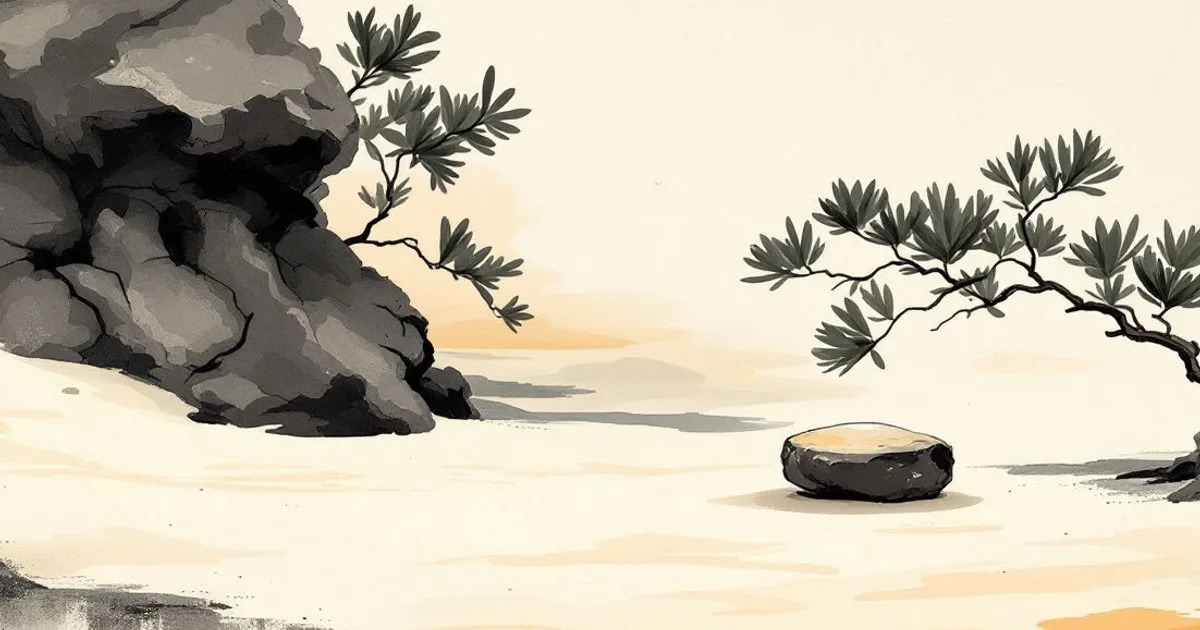
Wabi-sabi is a Japanese aesthetic worldview that finds beauty in imperfection, impermanence, and incompleteness — the weathered, the asymmetrical, the humble and rustic. One honest line to keep in mind: it is not a Buddhist doctrine, but it is deeply shaped by Zen and by the Buddhist sense that all things pass.
It is best described as Zen-influenced aesthetics, not “Buddhism.”
What is wabi-sabi?
Wabi-sabi names a way of seeing. Where a glossy, modern ideal prizes the new, the flawless, and the permanent, wabi-sabi turns toward the opposite: the cracked teacup, the moss on an old stone, the asymmetry of a hand-thrown bowl, the quiet dignity of something worn by use and time. As one standard reference puts it, it is the appreciation of beauty that is “imperfect, impermanent, and incomplete.”
Two old words sit inside it. Wabi points to a subdued, understated, rustic simplicity — a beauty found in plainness and restraint (the word once carried a darker note of loneliness and austerity). Sabi points to the beauty that age and wear bring: the patina on metal, the fading of cloth, the grace of things that have weathered. Put together, they describe finding the deepest beauty not in spite of transience and flaw, but because of them.
This outlook belongs to the family of Eastern wisdom ideas that the West has embraced — and, as with several of them, it is important to be precise about what it actually is.
Is wabi-sabi actually Buddhist?
This is the crucial question, and the honest answer is layered.
No — it is not a Buddhist doctrine. Wabi-sabi is a Japanese cultural and aesthetic ideal. You will not find it preached as a teaching of the Buddha, listed among Buddhist doctrines, or set out in the Pali Canon. It is a sensibility about beauty, art, and design, not a path to awakening or a claim about the nature of reality in the way Buddhist teachings are.
But yes — it is deeply influenced by Zen Buddhism, and it grows out of a Buddhist insight. Wabi-sabi took shape inside a culture saturated by Zen, and it draws directly on the Buddhist understanding of impermanence — mujō, the Japanese reading of the Pali anicca, the teaching that everything that arises also passes away. The aesthetic is often connected to the Buddhist three marks of existence (impermanence, suffering, and non-self): wabi-sabi can be understood as what it looks like to feel at home in a world of constant change rather than to fight it.
So the accurate label is “Zen-influenced aesthetics.” To call wabi-sabi “Buddhism” would flatten a real distinction; to deny its Zen roots would miss what gives it depth. It sits in the space between the two — a cultural flowering of a religious sensibility, much as Gothic cathedrals are shaped by Christianity without each pointed arch being a doctrine.
Where wabi-sabi comes from
The tea ceremony and Sen no Rikyū
The sensibility we now call wabi-sabi crystallised above all in the Japanese tea ceremony (chanoyu) during the 15th and 16th centuries. In the medieval period, tea gatherings among the elite often showcased expensive, imported Chinese utensils — a display of wealth and status. A counter-current emerged that prized the opposite: simplicity, rusticity, and quiet restraint. This came to be called wabi-cha, “wabi tea.”
The tradition runs through a lineage of tea masters. Murata Jukō (also read Shukō, 1423–1502) is credited with first turning toward coarse, simple, locally made wares in place of the fashionable Chinese luxury. His successor Takeno Jōō developed the wabi style further. And it was Sen no Rikyū (1522–1591) — historically the single most important figure in the Japanese tea ceremony — who brought it to its fullest expression.
Rikyū deliberately preferred simple, rustic, locally made objects to costly imported ones. He had tea bowls made by a local tile-maker (the origin of Raku ware), and in his later years he built tiny, plain, grass-thatched tea rooms — so small and so humble that the famous low entrance, the nijiriguchi, forced every guest, however highly ranked, to bow and crawl in. Honesty requires a careful word here: Rikyū did not invent the philosophy of finding beauty in the very simple. But he is, more than anyone, responsible for shaping it, deepening it, and weaving it into Japanese culture.
The Zen connection, precisely
Why does Zen matter so much to this story? Because the tea ceremony itself grew up in close contact with Zen monasticism. The values Rikyū prized — spare simplicity, presence in the moment, restraint, the beauty of the unadorned — are the same values cultivated in Zen practice. The Stanford Encyclopedia of Philosophy notes that wabi developed in the context of Zen, and that the tea masters drew on sensibilities cultivated in Zen monasteries. Wabi-sabi is, in effect, a Zen aesthetic — Zen’s spirit of simplicity and impermanence translated into how one makes a bowl, lays out a garden, or pours a cup of tea.
That same spirit shows up across a whole family of Japanese arts touched by Zen: dry-landscape gardens, ink painting, calligraphy, the compressed stillness of haiku. In each, the aim is less to display polish than to let an unforced, unselfconscious naturalness appear — beauty in restraint, perfection in the imperfect and impermanent.
A modern word for an old feeling
One more piece of honesty matters here. Although the feeling is centuries old, the compound term “wabi-sabi” is largely a 20th-century coinage. For most of their history, wabi and sabi were used as separate aesthetic words, often more or less interchangeably. Their pairing into a single phrase became common only in the modern era. Its arrival in the wider Western imagination owes a great deal to the designer Leonard Koren, whose 1994 book Wabi-Sabi for Artists, Designers, Poets & Philosophers introduced — and effectively cemented — the term in English.
So when contemporary design blogs describe “the ancient Japanese philosophy of wabi-sabi,” the truth is gently more interesting: the underlying sensibility is genuinely old and genuinely rooted in Zen, but the tidy two-word package is recent.
What wabi-sabi feels like in practice
Strip away the labels and wabi-sabi describes a recognisable set of qualities. Scholars list among its hallmarks asymmetry, roughness, simplicity, economy, austerity, modesty, intimacy, and an appreciation for the natural integrity of things as they age and wear. A few concrete examples:
- A tea bowl that is slightly uneven, with a glaze that pooled and crackled — valued more, not less, for not being machine-perfect.
- A wooden beam or floor worn smooth and darkened by generations of hands and feet.
- A garden of moss, stone, and raked gravel rather than bright symmetrical flowerbeds.
- A pot mended with visible gold seams — the practice of kintsugi, which makes a repaired crack into the most beautiful part of the object.
There is an emotional cousin worth naming: mono no aware, the bittersweet, tender awareness of the transience of things. Where mono no aware is the gentle sadness of passing beauty, wabi-sabi is closer to the acceptance and even quiet delight found in imperfection and age. They are neighbours in the same landscape of feeling.
Why it resonates today
Wabi-sabi has travelled far beyond tea rooms — into interior design, ceramics, photography, and the broader conversation about living more simply. Its appeal in a polished, filtered, fast-replaced world is clear: it offers permission to value what is humble, weathered, and unfinished, and to stop measuring everything against an impossible standard of flawless permanence.
Used well, that is genuinely close to the Buddhist insight underneath it — that clinging to a glossy, unchanging ideal is a recipe for suffering, and that there is peace in accepting things as they actually are: arising, ageing, passing. Used loosely, “wabi-sabi” can shrink into a marketing word for rustic décor. The point of this page is to hold the honest middle: wabi-sabi is not Buddhism, but it is one of the most beautiful things that Buddhism’s encounter with Japanese culture ever produced.
For more concepts that the West has bundled under “Eastern wisdom” — some genuinely Buddhist, some not — see our overview of Eastern wisdom traditions. For the teaching at wabi-sabi’s root, see impermanence (anicca); and for the tradition that shaped its spirit, Zen Buddhism.
Frequently asked questions
What does wabi-sabi mean?
Wabi-sabi is a Japanese aesthetic worldview that finds beauty in things that are imperfect, impermanent, and incomplete — the weathered, the asymmetrical, the humble and rustic. 'Wabi' connotes a quiet, understated, rustic simplicity (and once carried a sense of lonely austerity); 'sabi' is the beauty that comes with age, wear, and the passage of time. Together they name a way of seeing that accepts transience rather than resisting it.
Is wabi-sabi Buddhist?
Not exactly. Wabi-sabi is a Japanese cultural and aesthetic ideal, not a Buddhist doctrine or a teaching of the Buddha. But it is deeply shaped by Zen Buddhism — especially through the tea ceremony — and it grows directly out of the Buddhist sense of impermanence (mujō, the Japanese reading of anicca). The honest description is 'Zen-influenced aesthetics,' not 'Buddhism.'
Where does wabi-sabi come from?
Its sensibility took shape in late-medieval Japan, above all in the world of the tea ceremony (chanoyu). Tea masters such as Murata Jukō (1423–1502), Takeno Jōō, and especially Sen no Rikyū (1522–1591) developed a 'wabi' style of tea — wabi-cha — that prized simple, rustic, locally made utensils over costly imported luxury. Rikyū did not invent the philosophy, but he is most responsible for shaping and popularising it.
What is the difference between 'wabi' and 'sabi'?
They began as two separate words. 'Wabi' originally suggested the loneliness and austerity of living simply, apart from society, and came to mean a subdued, unpretentious beauty in simplicity. 'Sabi' carried a sense of the withered and the aged — the patina, rust, and quiet beauty that time leaves on things. The compound 'wabi-sabi' only became common in the 20th century.
How is wabi-sabi different from kintsugi?
Wabi-sabi is the broad aesthetic outlook — beauty in imperfection and impermanence. Kintsugi is one specific practice that expresses it: repairing broken pottery with lacquer and gold so the cracks are highlighted rather than hidden. Kintsugi is a concrete craft; wabi-sabi is the wider way of seeing it embodies.
Sources
- Wabi-sabi (entry), Wikipedia
- Japanese Aesthetics (entry), Stanford Encyclopedia of Philosophy
- Sen no Rikyū (entry), Wikipedia
- Leonard Koren, Wabi-Sabi for Artists, Designers, Poets & Philosophers (1994)