Buddhism in Bhutan: The Vajrayana Kingdom
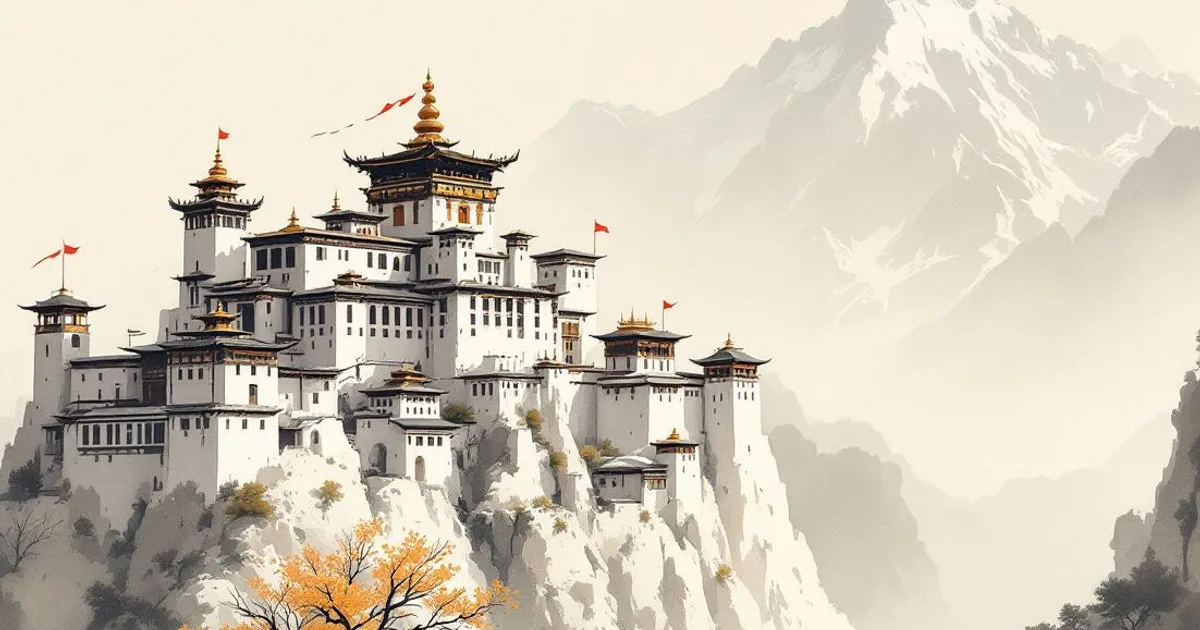
Buddhism in Bhutan is Vajrayana Buddhism of the Tibetan family, and about three in four Bhutanese follow it: the Pew Research Center puts the Buddhist share at 74.7% in 2020. The state monk body belongs to the Drukpa Kagyu, the school of Zhabdrung Ngawang Namgyal, the Tibetan lama who founded the Bhutanese state in the 17th century. The older Nyingma school is strong too, and the 2008 Constitution calls Buddhism “the spiritual heritage of Bhutan”.
What kind of Buddhism does Bhutan follow?
Bhutan’s Buddhism is the Vajrayana of Tibetan Buddhism, carried by its own institutions. Two of the four Tibetan schools matter most: the Drukpa, a branch of the Kagyu, which runs the state’s Central Monk Body, and the Nyingma, with deep roots in central and eastern Bhutan. The Constitution names them both: the orange half of the national flag, says its first schedule, symbolises “the flourishing of the Buddhist teachings in general and that of the Kagyu and Nyingma traditions in particular.”
Bhutan is not wholly Buddhist. Pew counts 22.5% of its people as Hindu in 2020, and Article 7 of the Constitution guarantees every citizen “the right to freedom of thought, conscience and religion.”
How Buddhism came to Bhutan: the tradition’s account
Bhutan’s own accounts give Buddhism two beginnings. The first is the Tibetan king Songtsen Gampo. The Bumthang district administration says its Jambay Lhakhang is “said to be one of the 108 temples built by Tibetan King Songtsen Gampo in 659 CE on a single day”, to pin down a demoness who “was causing obstruction to the spread of Buddhism”. Kyichu Lhakhang in Paro, Ariana Maki writes for Himalayan Art Resources, is likewise “said to be” one of his temples: “Kyichu pins down her left foot.”
The second beginning is Padmasambhava, known as Guru Rinpoche, who, the same Bumthang page says, visited Jambay Lhakhang. The historian John Ardussi, writing for the Rubin Museum in 2023, calls him “the legendary Indian master”, dates him to the “eighth–ninth century”, and notes that the earliest text on his life is the twelfth-century Copper Island Biography. The accounts of his journeys into Bhutan are the tradition’s own.
At Kurje in Bumthang, the district administration’s page tells his story “according to legend”: the ruler of Bumthang, Sindhuraja, fell gravely ill after angering a local deity, Shelging Karpo, and Padmasambhava meditated in a cave there, leaving an imprint of his body. At Taktsang, the Tiger’s Nest above the Paro valley, the popular story, as Ardussi reports it, is that he flew to the cliff on the back of a tiger, in his fierce form as Dorje Drolo.
Zhabdrung Ngawang Namgyal and the Drukpa state
Zhabdrung Ngawang Namgyal (1594–1651) was the installed hierarch of the Drukpa monastery of Ralung in Tibet when a rival was put forward as the rebirth of the Drukpa master Pema Karpo. Ordered by a Tibetan court to surrender a sacred image of Avalokiteśvara believed to confirm the true rebirth, he refused, and in 1616, Ardussi writes, he “decided to take refuge with his patrons in what is now the state of Bhutan, bringing the prophetic image with him.” The Drukpa were not newcomers there: more than a dozen branch monasteries of Ralung stood in western Bhutan before 1600. Much earlier, Phajo Drugom Zhigpo (1184–1251), in Ariana Maki’s words for Himalayan Art Resources, “made great advances in establishing the Drukpa Kagyu Buddhist tradition in what is now western Bhutan.”
The founding of the state came later. His original intent, “the evidence suggests,” Ardussi writes, “was to win his court case and return to Tibet.” In 1623, with the case unresolved, he entered a three-year retreat in a cave north of Thimphu, and in the Wood-Ox year, 1625/26, he came out and announced a new government. Building the great fortress-monasteries, the dzongs, at Paro, Wangdue Phodrang, Trongsa, Punakha and Thimphu took about twenty-five years.
The Zhabdrung created two offices beneath himself. A regent, the Druk Desi, was “appointed to exercise political power”, the legal scholar Richard Whitecross writes, while a chief abbot, the Je Khenpo, “was entrusted with the spiritual and administrative leadership of the Drukpa Kagyu religious institutions”; together they made up the Dual System (chhoe-sid-nyi). Whitecross warns that it is “tempting” to read this as a separation of religion and politics, and notes an ambiguity in the concept that is “particularly relevant to Bhutan”: “The Desi and Je Khenpo were below the Zhabdrung, who embodied both secular and spiritual power in his function as ‘the Wheel of the Dual System.’” He also marks a difference from Tibet: “Unlike in Tibet, where lay officials dealt with secular matters, and monks dealt with religious affairs, in Bhutan, government officials were ordained.”
His only son died young, so the office never became hereditary. His death in 1651 “was kept a secret for more than fifty years,” Ardussi writes; Whitecross dates its announcement to 1705, after which several lines of incarnations emerged, held in the tradition to embody his Body, Speech and Mind. A three-verse prayer to him, which Lotsawa House says is “said to have been composed by” his father, Mipham Tenpai Nyima, begins:
Amidst the waves of the Lord of the World’s compassion
Blossoms a thousand-petalled lotus of all the buddhas’ wisdom and love,
Radiating the sweet fragrance of benefit and happiness—
Ngawang Namgyal, at your feet I pray.
“The Lord of the World”, the translator notes, is an epithet of Avalokiteśvara.
The Nyingma in Bhutan and Pema Lingpa
Before the Zhabdrung, Ardussi writes, “the predominant religion” in central and eastern Bhutan “was Nyingmapa Buddhism”, except at Merak in the far east, which was allied to the Gelugpa monasteries of Tibet. The Zhabdrung expelled many opponents, but “these expulsions did not include the Nyingmapa”: in Ardussi’s judgement the Drukpa “have always accommodated the powerful, local Nyingmapa establishment, both spiritually and as a key element of their political success.”
Among Bhutan’s own Nyingma masters, Pema Lingpa (1450–1521) was a tertön, or revealer of hidden treasure teachings. The scholar Karma Phuntsho calls him “the foremost spiritual figure Bhutan produced”, and many statues and ritual objects are “believed to have been revealed by him.” During the drafting of the 2008 Constitution, Whitecross records, Punakha’s representative said the two schools “are just like different paths leading to the same destination.”
Taktsang, the Tiger’s Nest
“The early history of Taktsang is clouded in legend,” Ardussi writes. Its earliest datable monasteries stand not on the cliff face but on the ridge above, founded in the sixteenth century by Nyingma and Katok monks from eastern Tibet. The cliff temple “was originally constructed in 1692–1694 by the Fourth Druk Desi or civil ruler of Bhutan, Tenzin Rabgye (r. 1680–1694)”, whom Ardussi calls “a nephew” of the Zhabdrung.
Ardussi writes that “as reflected in its artworks and legendary history, Taktsang represents a fusion in Bhutan of Kagyu and Nyingma sectarian traditions that continues to this day.” Its standing with UNESCO (it is not an inscribed World Heritage Site) is covered in the greatest Buddhist monuments.
Buddhism in the 2008 Constitution
Bhutan’s Constitution was adopted on 18 July 2008. Its preamble begins “WE, the people of Bhutan: BLESSED by the Triple Gem”, Buddhism’s three jewels, and Article 3, headed “Spiritual Heritage”, sets out the place of religion:
1. Buddhism is the spiritual heritage of Bhutan, which promotes the principles and values of peace, non-violence, compassion and tolerance. 2. The Druk Gyalpo is the protector of all religions in Bhutan. 3. It shall be the responsibility of religious institutions and personalities to promote the spiritual heritage of the country while also ensuring that religion remains separate from politics in Bhutan. Religious institutions and personalities shall remain above politics.
Other articles bind state and Buddhism more closely. Article 2 unifies the dual system in the king, “who, as a Buddhist, shall be the upholder of the Chhoe-sid”, and has each heir receive a scarf from the Machhen, the holy relic of the Zhabdrung, at Punakha Dzong. Article 9 asks the state to strive for a society “rooted in Buddhist ethos and universal human values.”
The text never calls Buddhism the state religion. Whitecross reports that the drafters’ intention, “after debate”, was “not to declare Buddhism, or a particular Vajrayāna school of Buddhism, to be the state religion”; he adds that “scholars interpret Article 3, and the Constitution in general, as promoting Buddhism as the state religion.” The same Constitution, he notes, removed the Central Monk Body’s representatives from the National Assembly.
The Je Khenpo and the Central Monk Body
The state monastic order is the Zhung Dratshang, literally “State Monk Body” (Whitecross), usually called the Central Monk Body. An account by Lopen Gembo Dorji, an adviser to the monk body who has served as its Secretary General, dates it to 1620, when the Zhabdrung “instituted the Sangha at Cheri”, and says it moved in 1637 to Punakha Dzong, still its winter seat, with Tashichhoedzong in Thimphu as its summer seat. That is the monk body’s own dating. In the same undated article he counts 7,373 monks, “with the numbers increasing when district Dzongs were completed in other parts of the country”, along with 275 nuns and 461 gomchens (lay practitioners, in Whitecross’s gloss) “registered with the Central Monk Body.”
Gembo Dorji, citing the Constitution, describes the monk body as “an autonomous institution, financed by an annual grant from the Royal Government”. Article 3 of the Constitution says only that the Zhung Dratshang and the Rabdeys, the monastic bodies in the other dzongs, “shall continue to receive adequate funds and other facilities from the State.”
At its head is the Je Khenpo, “the Chief Abbot of the Central Monastic Body of Bhutan” in the Constitution’s glossary. The king appoints him on the recommendation of the Five Lopons, choosing “a learned and respected monk ordained in accordance with the Druk-lu”, the Drukpa Kagyu tradition. The present Je Khenpo, Trulku Jigme Choedra, was enthroned as the 70th in 1996; when he turned 70 in 2025, the Bhutan Broadcasting Service called him “the longest-serving Je Khenpo”.
Tshechu festivals and masked dances
Bhutan’s tshechus (often spelled tsechu) are religious festivals dedicated to Guru Rinpoche, Padmasambhava. “Called Tshechu, or ‘tenth day,’ the festival corresponds to an important date in the life of the master,” writes the scholar Françoise Pommaret: his festivals fall on the tenth day of a lunar month. They are the setting for cham, ritual dances performed by monks or laymen, which can involve masks.
According to Ardussi, as Pommaret reports, it was Tenzin Rabgye (1638–1696) who brought the tshechu and its dance to the Drukpa Kagyu monasteries of western Bhutan in the late seventeenth century. The dances are held to bring “liberation through seeing” (tongdrol), so watching is itself a blessing. The mask dance of the drums from Drametse, in eastern Bhutan, performed in honour of Padmasambhava, was proclaimed by UNESCO in 2005 and inscribed on its Representative List of the Intangible Cultural Heritage of Humanity in 2008.
Gross National Happiness, in Bhutan’s own words
Article 9 of the Constitution directs the state to “promote those conditions that will enable the pursuit of Gross National Happiness” (GNH). The Centre for Bhutan Studies, in its 2012 guide to the GNH Index, says the term “was first coined by the 4th King of Bhutan”, and that “In 1972, the 4th King declared Gross National Happiness to be more important than GNP”. That is the Centre’s summary, not a quotation of the King.
The Centre traces the idea to “the 1729 legal code”, which declared that “if the Government cannot create happiness (dekid) for its people, there is no purpose for the Government to exist”, and attributes that code to the tenth Desi, building on the Zhabdrung’s earlier work.
The Centre says that from 1972 Bhutan oriented its “national policy and development plans” towards GNH, and that “there is no single official definition” of it; its index weights nine domains equally. Buddhism enters most directly through the spirituality indicator, whose questions ask people to rate their own spirituality and how often they consider karma, recite prayers and meditate; in the 2010 GNH survey 53 per cent were “adequate” on it. The values indicator asks whether killing, stealing, lying, creating disharmony and sexual misconduct are justifiable; in “a society influenced by good values, e.g., by Buddhism”, the guide says, people are “expected to tame themselves” with respect to these “five destructive actions”. For what Buddhist texts say about happiness, see Buddhism and happiness.
Bhutan among the Buddhist countries
Pew’s 2025 report estimates Bhutan’s population at 770,000 in 2020, 74.7% of it Buddhist, the same share as in 2010. That makes Bhutan one of seven Buddhist-majority countries in Pew’s count, and, with Mongolia, one of the two whose Buddhism belongs to the Tibetan family; the full table is in how many Buddhists are there in the world. Pew warns that its Buddhist estimates “exclude people who do not formally consider themselves Buddhist”.
For Bhutan’s Himalayan neighbours, see Buddhism in Tibet and Buddhism in Nepal; to place it among the other traditions, see Buddhism around the world and the branches of Buddhism.
Frequently asked questions
What kind of Buddhism is practised in Bhutan?
Vajrayana Buddhism of the Tibetan family, in two main schools. The state monk body follows the Drukpa Kagyu, the school of Zhabdrung Ngawang Namgyal, the lama who founded the Bhutanese state in the 17th century. The Nyingma, the school that looks to Padmasambhava and to the Bhutanese treasure-revealer Pema Lingpa, has long been strong, above all in central and eastern Bhutan. The Constitution says the national flag stands for both.
Who brought Buddhism to Bhutan?
Bhutanese tradition gives two beginnings: the Tibetan king Songtsen Gampo, said to have built Jambay Lhakhang in Bumthang and Kyichu Lhakhang in Paro in the 7th century, and Padmasambhava (Guru Rinpoche), whose visits are told at Kurje and Taktsang. Both are the tradition's accounts. Phajo Drugom Zhigpo (1184-1251) did much to establish the Drukpa Kagyu in western Bhutan, and Zhabdrung Ngawang Namgyal, who arrived from Tibet in 1616, founded the Drukpa state.
Is Buddhism the state religion of Bhutan?
Not in so many words. The 2008 Constitution calls Buddhism 'the spiritual heritage of Bhutan' and makes the king 'the protector of all religions'. The legal scholar Richard Whitecross writes that the drafters intended, after debate, not to declare a state religion, but that scholars read Article 3 as promoting Buddhism as one. The state funds the monk body, and the king upholds the dual system 'as a Buddhist'.
Who was Zhabdrung Ngawang Namgyal?
A Drukpa Kagyu lama (1594-1651) who founded the Bhutanese state. After a dispute in Tibet over whether he was the rebirth of the master Pema Karpo, he left for Bhutan in 1616. The historian John Ardussi dates the founding of his government to 1625/26, after a three-year retreat. He created the offices of civil regent and chief abbot beneath himself, and his death in 1651 was kept secret for decades.
Who is the Je Khenpo of Bhutan?
The Je Khenpo is the Chief Abbot of Bhutan's Central Monk Body. The Constitution has the king appoint him on the recommendation of the Five Lopons, from monks ordained in the Drukpa Kagyu tradition. The present holder, Trulku Jigme Choedra, was enthroned as the 70th Je Khenpo in 1996; the Bhutan Broadcasting Service called him the longest-serving when he turned 70 in 2025.
What is a tshechu in Bhutan?
A religious festival dedicated to Padmasambhava, or Guru Rinpoche, often spelled tsechu. The name means 'tenth day', because his festivals fall on the tenth day of a lunar month. Monks or laymen perform cham, ritual dances that can involve masks, and watching is held to bring 'liberation through seeing'. The historian John Ardussi credits the ruler Tenzin Rabgye with bringing the festival to western Bhutan's Drukpa monasteries.
Sources
- Constitution of the Kingdom of Bhutan (adopted 18 July 2008), official English text as reproduced by the Comparative Constitutions Project: the Preamble, Articles 2, 3, 7 and 9, Schedule 1 and the glossary
- Richard W. Whitecross, 'The Zhabdrung's Legacy: Buddhism and Constitutional Transformation in Bhutan', in Tom Ginsburg and Benjamin Schonthal (eds), Buddhism and Comparative Constitutional Law (Cambridge University Press, 2022), pp. 73-98
- John Ardussi, 'Formation of the State of Bhutan ('Brug gzhung) in the 17th Century and its Tibetan Antecedents', Journal of Bhutan Studies 11 (2004), pp. 10-32: the Zhabdrung's flight in 1616, the founding of his state, and the Nyingmapa
- John A. Ardussi, 'Taktsang Monastery: Bhutan's Most Acclaimed Religious Sanctuary', Project Himalayan Art, Rubin Museum of Art, 2023
- Francoise Pommaret, 'Ritual Dance Mask of Guru Dorje Drolo', Project Himalayan Art, Rubin Museum of Art, 2023: tshechu, cham and 'liberation through seeing'
- Karma Phuntsho, 'Dorje Discovered by Dorje Lingpa', Project Himalayan Art, Rubin Museum of Art, 2023: Pema Lingpa (1450-1521)
- Lopen Gembo Dorji (Advisor to the Central Monk Body, who has served as its Secretary General), 'Zhung Dratshang: The Central Monk Body of Bhutan', The Druk Journal (undated): the founding dates, seats, registered numbers and funding
- Bhutan Broadcasting Service, 'Celebrating 70 years of His Holiness the Je Khenpo Trulku Jigme Choedra' (2025)
- Bumthang Dzongkhag Administration, Royal Government of Bhutan, 'Jambay Lhakhang': Songtsen Gampo's temples and Padmasambhava's visit, as the district tells them
- Bumthang Dzongkhag Administration, Royal Government of Bhutan, 'Kurjay Lhakhang': the district's account of Padmasambhava and Sindhuraja
- Ariana Maki, 'Paro Kyichu' (2012), Himalayan Art Resources
- Ariana Maki, 'Chang Gangkha Lhakhang' (2012), Himalayan Art Resources: Phajo Drugom Zhigpo (1184-1251)
- UNESCO Intangible Cultural Heritage, 'Mask dance of the drums from Drametse' (Bhutan): proclaimed 2005, inscribed on the Representative List 2008
- Karma Ura, Sabina Alkire and Tshoki Zangmo, GNH and GNH Index: A Short Guide to Gross National Happiness Index (Thimphu: The Centre for Bhutan Studies, 2012), pp. 4-12
- Pew Research Center, 'How the Global Religious Landscape Changed From 2010 to 2020' (9 June 2025), Appendix B: Bhutan 2020, Buddhist 74.7%, Hindu 22.5%
- Pew Research Center, 'Countries with the most Buddhists and global Buddhist population change, 2010-2020' (9 June 2025): the seven Buddhist-majority countries and the limits of the count
- Yabchen Mipham Tenpai Nyima (attributed), 'Prayer to Zhabdrung Ngawang Namgyal', trans. Adam Pearcey (2023), Lotsawa House, CC BY-NC 4.0