Dhammakaya Meditation: The Method and the Movement
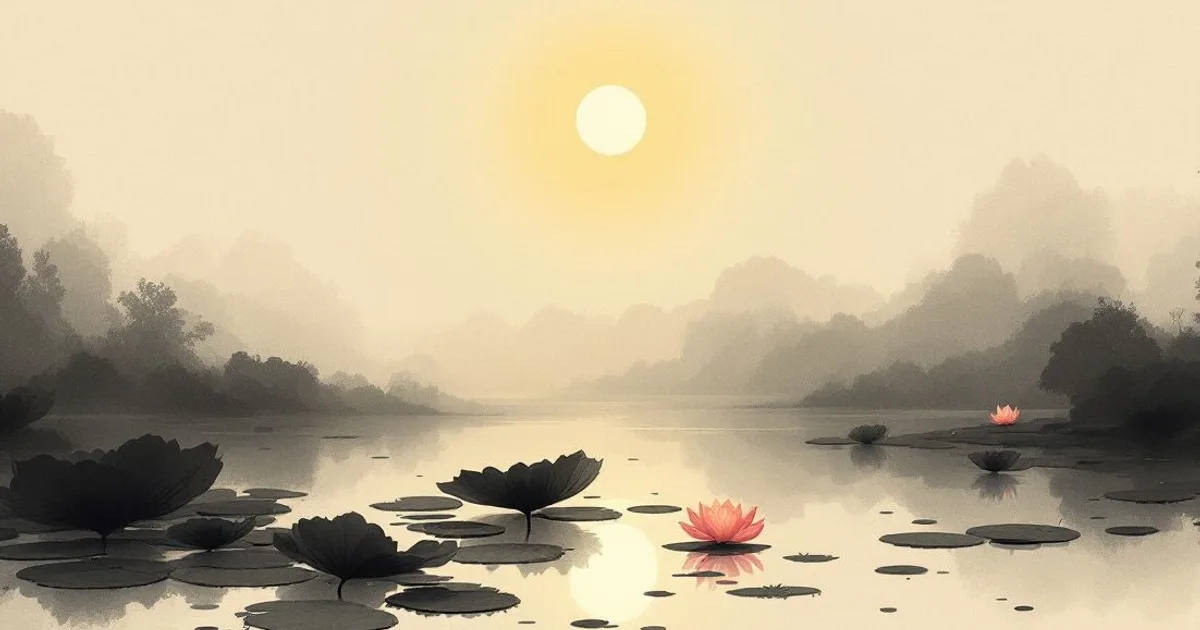
Dhammakaya meditation is the method of a Thai meditation lineage traced to Luang Pu Sodh Candasaro, abbot of Wat Paknam in Bangkok. As Wat Phra Dhammakaya and the Dhammakaya Foundation teach it, you rest the mind at the “centre of the body”, two finger-breadths above the navel, gently imagining a bright sphere and silently repeating the words Samma Arahang. What the practice is said to lead to is the movement’s own claim.
The movement also calls it Vijja Dhammakaya (Something You’ve Been Searching For, p. 176); the scholar Potprecha Cholvijarn, in a 2020 doctoral thesis, calls it Sammā Arahaṃ meditation, after its mantra.
- Also called
- Vijja Dhammakaya; Sammā Arahaṃ meditation.
- Traced to
- Luang Pu Sodh Candasaro (Phramongkolthepmuni), 1884-1959, abbot of Wat Paknam Bhasicharoen (the Foundation’s dates).
- Focus and mantra
- A bright object at the “seventh base”, two finger-breadths above the navel; the words Samma Arahang (Start Meditation Today, pp. 26-35).
- Lineage centres
- Wat Phra Dhammakaya and the Dhammakaya Foundation (Pathum Thani); Wat Paknam (Bangkok); Wat Luang Phor Sodh Dhammakayaram (Ratchaburi).
- Contested
- Its teaching about the Dhammakaya and the self; the temple’s fundraising; the case against its former abbot.
Where Dhammakaya meditation comes from
In the movement’s telling, Sodh Mikaewnoi was born in Suphanburi province in 1884 and ordained in 1906 as Candasaro. After eleven years of meditation practice he vowed to sit until he reached the Dhamma the Buddha had reached. The Foundation dates that night to the full moon of the tenth lunar month of 1917, at Wat Bote-bon in Bangkuvieng, Nonthaburi: a bright sphere arose at the centre of his body, then a series of inner bodies, then the Dhammakaya. Mano Mettanando Laohavanich, one of the temple’s founding members, who later left it, became an academic and, as the AP notes, a critic of the temple, dates the night to 1916, at the main shrine hall of “Wat Bangkhuvien” (2012, p. 489). Arnaud Dubus follows him on the year, and a 2026 Siam Society listing for a Cholvijarn lecture also gives 1916.
Luang Pu was abbot of Wat Paknam Bhasicharoen, a Bangkok wat, from 1920 until his death in 1959. Rachelle M. Scott calls him “the late founder of the meditation method used at the Temple” (Nirvana for Sale?, 2009, p. 2).
One of his students, the mae chi (Thai Buddhist nun) Chand Khonnokyoong (1909-2000), known as Khun Yai, went on teaching at Wat Paknam after his death. There Chaiyaboon Suddhipol, a Kasetsart University student, learned from her; he was ordained in 1969 as Dhammajayo. The Foundation dates a new meditation centre in Pathum Thani, north of Bangkok, to 20 February 1970, and calls Khun Yai the founder of Wat Phra Dhammakaya, with Dhammajayo and a lay supporter later ordained as Luang Por Dattajeevo beside her; it took its present name in 1981, a date Laohavanich also gives. See also Buddhism in Thailand.
How the Dhammakaya Foundation teaches the method
Start Meditation Today (3rd edition, 2016) is the Foundation’s beginners’ manual. It aims at a mind “free of thought” that can “come to a standstill at the center of the body” (p. 10).
Posture and the seven bases
The ideal posture is the half-lotus, right leg over left, though beginners may use a chair (pp. 20-21; see meditation posture). The meditator imagines a fingertip-sized bright object and moves it inward through seven “bases of the mind”: the nostril, a spot inside the nose, level with the eye’s inner corner, the centre of the head, the roof of the mouth, the throat, the centre of the body at navel level, and a point two finger-breadths above that, “the very center of the body” (p. 35). The mantra is repeated three times at each of the first six bases and continuously at the seventh. Beginners are told: “Knowledge of the seventh base alone is sufficient” (p. 30).
The bright object and the words Samma Arahang
The object may be a sun, full moon, star or crystal ball, imagined “without the use of the eyes”; a footnote allows other bright, pure objects, such as a cross for a Christian (p. 26). The book glosses Samma Arahang as “the purest state attainable by a human, attained the correct way” (p. 27); the Foundation’s website gives “Right Enlightenment of the Lord Buddha”, and the manual gives the pronunciation as “sam-ma-ara-hang”. The two words echo the classic recollection of the Buddha, arahaṁ sammāsambuddho (AN 6.10; see the ten recollections). The mantra is there because the mind “cannot focus on two things at once”; another positive phrase may replace it (p. 27), and it may fade once thoughts stop (p. 45). The image itself is only a “raft”, to be left behind (p. 40).
Thoughts, effort and the later stages
Effort should be light: too much brings tension, too little brings daydreaming or sleep (pp. 43-44). On stray thoughts it quotes a saying: “a bird may land on your head, but there is no need to let it build a nest there” (p. 50). Over ten weeks it moves through five methods, from 20 to 40 minutes a day (p. 12): the seven bases, visualising at the centre, visualising without the mantra, simply observing whatever appears there, which it calls “the ideal” (p. 20), and observation followed by loving-kindness, with the mind expanding as a sphere from the room out to the cosmos (pp. 63-65).
What practitioners are told they will see
These are the movement’s claims. Beginners may see only darkness at first (Start Meditation Today, p. 54). With stillness comes “a succession of increasingly refined experiences of purity, brightness and wisdom” (p. 37). Something You’ve Been Searching For, Phra Dhammajayo’s talks from the 2003 rains retreat, adds a sequence of spheres and inner bodies, “and eventually the Dhammakaya” (p. 169). It counts eighteen bodies, in coarse and refined pairs from the ordinary human body inward: human, celestial, form-Brahma and formless-Brahma bodies, then five Dhammakayas, four of them named for the four stages of awakening (pp. 176, 178, 233). The Dhammakaya, it says, looks the same for everyone, with a lotus bud on its crown (pp. 59-60, 171), and a 1993 talk printed at the end of the book says the inner bodies “are real” (p. 233). A dated saying collected in the manual (30 March 1992) calls even a brief flash of inner brightness “a glimpse of Nibbana” (p. 113).
The manual says the method can be learned without a teacher, given three checks: stay aware, never let the feeling turn unpleasant, keep attention inside the body; it still advises talking experiences over with qualified teachers (pp. 22-23). The manual’s opening also makes health claims (pp. 6-7), which we do not repeat. If meditation stirs up distress, see meditation problems.
How it differs from other Buddhist meditation
Calm or insight? The Foundation describes the method both ways: one page calls it a “Vipassana technique”, another says the temple emphasises “especially samatha meditation”. One object held steadily has the shape of the calm practices on our samatha meditation page; see also samatha vs vipassana.
The forest tradition. Ajaan Lee Dhammadharo also lists “resting spots” in the body, from the tip of the nose down to “the navel (or a point just above it)”, but as places to settle awareness of the breath, chosen by comfort (Keeping the Breath in Mind, p. 21). Dhammakaya practice uses an image and one fixed point. See the Thai forest tradition.
Tibetan visualisation and mantra. Tibetan deity yoga also joins image and mantra, but the meditator identifies with a deity and needs empowerment from a teacher (visualization meditation, mantra meditation). Tony Scott summarises Kate Crosby’s view that the older Theravada system below resembles Tibetan tantra not through shared texts or contact but through “common Indic methods of material transformation” (2021, p. 207).
How scholars place it: borān kammaṭṭhāna
Crosby calls that older Theravada system borān kammaṭṭhāna, which Laurence Cox glosses as “traditional meditation practice”. Reviewing her 2013 book, Cox describes it as “an esoteric and somatic form of Theravada meditation” in which images are drawn in through the nostrils, placed at centres in the body and combined, “constructing an internal Buddha” (2014, p. 95). He writes that the Dhammakaya Foundation “follows an adapted and modernised form of this same tradition, derived from practices previously taught at Wat Paknam” (p. 94). Cholvijarn’s thesis, by its abstract, “confirms” that Luang Pu Sodh “has taken and adapted aspects” of his teachers’ and other Thai traditions’ practices, and examines the link to the “so-called borān kammaṭṭhāna tradition”. The movement itself speaks of rediscovery, not inheritance: its site says the method “was developed as a technique by the Lord Buddha” and that it “can be freely practiced by everyone without conflict due to race, creed or religion”.
Rory Mackenzie, as Pattana Kitiarsa summarises him, places Wat Phra Dhammakaya within “the highly progressive fundamentalist and millenarian typologies of new religious movement” (Kitiarsa 2007, p. 95); Dubus says it “has all the appearances” of a new religious movement and that the temple rejects the label (2018, paras 1-2). Laohavanich says the elementary teaching “does not contain anything contradictory to the conventional Buddhism of Thailand”, but that members who have gained sufficient faith in the temple’s leadership are later introduced to a higher, esoteric level of teaching (p. 488).
The word Dhammakaya and the dispute over self
The word is canonical, as an epithet. In the Aggañña Sutta the Buddha gives “dhammakāya” as a term for the Realized One:
For these are terms for the Realized One: ‘the embodiment of principle’, and ‘the embodiment of divinity’, and ‘the manifestation of principle’, and ‘the manifestation of divinity’.
In Mahāyāna the dharmakāya is one of a buddha’s three bodies, a separate doctrine (see types of Buddhas). The Foundation’s own page on the Dhammakaya opens with a saying it attributes to the Buddha, “He who sees the Dhammakaya, is he who gets in touch with me, Thatagata”, without naming a text. A similar line is in the Vakkali Sutta (SN 22.87), where the Buddha tells a gravely ill monk, “One who sees the teaching sees me” (trans. Sujato), then teaches the five aggregates as not-self.
The movement reads the word as an inner body in every person. Something You’ve Been Searching For says the Dhammakaya “exists inside every human being” and that nibbāna “exists within one’s self” but is hidden by defilements (p. 89). It calls the Dhammakaya “eternal”, set against everything governed by impermanence and “the absence of true selfhood” (pp. 226-227), and “above and beyond the Three Characteristics” (p. 162). Laohavanich reports that Luang Pu taught the innermost Dhammakaya as “the True Self of individuals” and nibbāna as an abode (p. 489).
Arnaud Dubus calls nipphan pen atta, “nibbāna is the essential self”, “the temple’s controversial claim” (para 14). He reports that P. A. Payutto’s The Dhammakaya Case examined it and found “no trace of such a teaching” in the Tipiṭaka. In 1999 the Supreme Patriarch accused Dhammajayo of distorting Buddhist teachings and of keeping donated land in his own name (para 15). When the Sangha Supreme Council cleared him in 2015 it ruled on the land; its spokesman “did not mention the second topic”, the Bangkok Post reported. On the land, the Foundation says the donors intended the gift for Dhammajayo personally and that the title deed shows it was for religious purposes (FAQ). It answers doctrinal criticism generally, saying its publications “consistently refer to the Four Noble Truths” and other core teachings (FAQ).
For the mainstream teaching, see anattā and what nirvana is; for a Mahāyāna debate of similar shape, buddha-nature.
The temple and its controversies
In 1998 the temple publicised a reported miracle, an image of Luang Pu Sodh in place of the sun (Scott, p. 2). Scott writes that the controversy over its wealth, its great chedi and the miracle “literally dominated the headlines” from November 1998 to August 1999 (p. 3), and its fundraising was criticised (Dubus, paras 12-13; see Buddhism and consumerism). The Foundation calls the charge that it teaches people can donate their way to nibbāna “a mischaracterization of the temple’s teachings” (FAQ). Dhammajayo was charged with embezzlement in 1999; the case was withdrawn in 2006 (para 16).
A second case grew out of embezzlement at the Klongchan Credit Union Cooperative. Police said 1.4 billion baht embezzled by its head had been donated to the temple, and Dhammajayo was charged with money-laundering and receiving stolen property (and, the Bangkok Post adds, forest encroachment); the temple said he did not know the money was tainted (AP, 2017). With temple representatives citing ill health, he did not appear, and a warrant followed in 2016. In February 2017 the military government used Section 44 of the interim constitution to search the temple for 23 days without finding him (Bangkok Post, 30 March 2026), and in March 2017 the king removed his honorific monastic title (Dubus, para 34). The Foundation says the temple “has nothing to do with” the embezzlement and that followers repaid the full amount (FAQ); the Bangkok Post, reporting the Department of Special Investigation, says the temple returned 1.458 billion baht to the cooperative (30 March 2026). In March 2026 the Department of Special Investigation dropped the case, “without a trial”, because the statute of limitations had expired; he has not been seen publicly since, the Bangkok Post reported (27 and 30 March 2026). The temple’s abbot today, the Foundation says, is Phrakhrupaladrattanaveerawat (October 2026).
Where Dhammakaya meditation is taught
Wat Phra Dhammakaya, in Khlong Luang, Pathum Thani, says it keeps three meditation halls open to the public at varying days and hours and offers tours and events free of charge (FAQ). The Foundation lists Middle Way Meditation retreats for international beginners, branch centres in the Americas, the United Kingdom and Europe, Asia, Africa and Oceania, and Zoom sessions on its memorial days. Wat Paknam, which Laohavanich calls the lineage’s mother monastery, and Wat Luang Phor Sodh Dhammakayaram in Ratchaburi, founded in 1982, stand in the same lineage (p. 486). Listing them is not an endorsement. For retreats and meditation centres in general, see Buddhist retreats and Buddhist meditation centers; for the wider map, our guide to Buddhist meditation.
Frequently asked questions
What does Samma Arahang mean?
It is the mantra of Dhammakaya meditation, repeated silently while the mind rests at the centre of the body. The Foundation's manual Start Meditation Today glosses it as the purest state attainable by a human, attained the correct way; the Foundation's website gives Right Enlightenment of the Lord Buddha. The two Pali words echo the opening of the classic recollection of the Buddha, araham sammasambuddho (AN 6.10).
Where is the centre of the body in Dhammakaya meditation?
Two finger-breadths above the navel, inside the abdomen. The Foundation's manual calls it the seventh base of the mind, the point where the mind can come to a standstill. Beginners reach it by moving a visualised bright object in from the nostril through six other points, but the book says knowing the seventh base alone is enough, and that anywhere in the stomach area will do at first.
Is Dhammakaya meditation Theravada?
Yes, by origin: it comes from Thai Theravada monasteries, Wat Paknam and Wat Phra Dhammakaya. Kate Crosby, as Laurence Cox summarises her work, links it to an older Theravada system called boran kammatthana. Its teaching about the Dhammakaya and the self is contested within Thai Theravada, notably by the scholar monk P. A. Payutto.
Is Wat Phra Dhammakaya the same as Wat Paknam?
No. Wat Paknam Bhasicharoen in Bangkok is where Luang Pu Sodh taught the method until his death in 1959. Wat Phra Dhammakaya, in Pathum Thani north of Bangkok, was started by the nun Khun Yai Chand and her students, among them Phra Dhammajayo, and took its present name in 1981. Laohavanich calls it one of Wat Paknam's offshoots.
Is Dhammakaya a cult?
The writers cited here use a different label: new religious movement, which the temple rejects, Arnaud Dubus reports. Rory Mackenzie, as Pattana Kitiarsa summarises him, classes it so for its strong focus on meditation and some members' belief in their leader as a saviour figure. Laohavanich, a founding member who left, says its beginners' teaching contains nothing contrary to conventional Thai Buddhism, but committed members later learn esoteric doctrines.
What happened to Phra Dhammajayo?
He was charged with money-laundering and receiving stolen property over money from the Klongchan Credit Union Cooperative, but he did not answer summonses, and a warrant was issued in 2016. In March 2026 the case was dropped without a trial because the statute of limitations had expired, so there was no conviction. The temple says it had nothing to do with the embezzlement. He has not been seen publicly since, the Bangkok Post reported.
Sources
- Dhammakaya Foundation, Start Meditation Today, 3rd ed. (Pathum Thani: Dhammakaya Foundation, 2016; 1st ed. 2001), ISBN 974-87855-4-8, pp. 6-7, 10, 12, 20-23, 26-27, 30, 35, 37, 40, 43-45, 50, 54, 63-65, 113 (printed page numbers; all rights reserved, quoted briefly)
- Dhammajayo Bhikkhu, Something You've Been Searching For, trans. Anunya Methmanus (Pathum Thani: Dhammakaya Foundation, 2017), ISBN 978-616-8188-04-0, pp. 4, 59-60, 89, 162, 169, 171, 176, 178, 226-227, 233 (printed page numbers; all rights reserved, quoted briefly)
- Dhammakaya Foundation, 'Memorial Day for the Rediscovery of Dhammakaya Knowledge' (the movement's account of Luang Pu Sodh's vow at Wat Bote-bon in 1917, his teaching of Samma Arahang at Wat Paknam, and its Zoom sessions)
- Dhammakaya Foundation, 'Phramongkolthepmuni (Sodh Candasaro)' (born 1884, ordained 1906, the 1917 rains retreat at Wat Bote-bon in Bangkuvieng, Nonthaburi, abbot of Wat Paknam from 1920, died 1959)
- Dhammakaya Foundation, 'Dhammakaya: The Body of Enlightenment' (the saying it attributes to the Buddha; the term in Theravada and Mahayana scriptures)
- Dhammakaya Foundation, 'Masters' (Khun Yai Chand Khonnokyoong, born 1909, called the founder of Wat Phra Dhammakaya)
- Dhammakaya Foundation, 'The Master Nun (Khun Yai)' (teaching at Wat Paknam after 1959; the meditation centre begun on Magha Puja Day, 20 February 1970; died 2000)
- Dhammakaya Foundation, 'Wat Phra Dhammakaya' (temple history: the centre begun in 1970, named Wat Phra Dhammakaya on 29 April 1981)
- Dhammakaya Foundation, 'Luang Por Dhammajayo' (born Chaiyaboon Suddhipol in 1944, ordained at Wat Paknam in 1969; the temple's emphasis on samatha meditation)
- Dhammakaya Foundation, 'Frequently Asked Questions' (visiting, meditation halls, responses to doctrinal critiques, to the land allegation and to the Credit Union case)
- Dhammakaya Foundation, 'The abbot of Wat Phra Dhammakaya pays a call on Most Venerable Somdet Phrawachirarattanamoli', 22 October 2026 (names Phrakhrupaladrattanaveerawat as the temple's abbot)
- Dhammakaya Foundation, 'Meditation Retreat Programs' (Middle Way Meditation retreats)
- Dhammakaya Foundation, 'Branches' (centres listed by region)
- Laurence Cox, review of Kate Crosby, Traditional Theravada Meditation and its Modern-Era Suppression (2013), Journal of Global Buddhism 15 (2014): 93-97, pp. 94-95
- Tony Scott, review of Kate Crosby, Esoteric Theravada: The Story of the Forgotten Meditation Tradition of Southeast Asia (Shambhala, 2020), Canadian Journal of Buddhist Studies 16 (2021): 199-209, p. 207
- Kate Crosby, Traditional Theravada Meditation and its Modern-Era Suppression (Hong Kong: Buddha Dharma Centre of Hong Kong, 2013) and Esoteric Theravada (Boulder: Shambhala, 2020), cited here only as summarised in the Cox and Scott reviews
- Potprecha Cholvijarn, The Origins and Development of Samma Araham Meditation: From Phra Mongkhon Thepmuni (Sot Candasaro) to Phra Thep Yan Mongkhon (Sermchai Jayamangalo), PhD thesis, University of Bristol, 2020 (record and abstract)
- The Siam Society, 'Systems of Inner Bodies in Thai Meditation', lecture by Potprecha Cholvijarn, 12 February 2026 (event listing: Samma Araham, also known as Vijja Dhammakaya, developed in 1916)
- Mano Mettanando Laohavanich, 'Esoteric Teaching of Wat Phra Dhammakaya', Journal of Buddhist Ethics 19 (2012): 483-513, pp. 485-489 (by one of the temple's founding members)
- Rachelle M. Scott, Nirvana for Sale? Buddhism, Wealth, and the Dhammakaya Temple in Contemporary Thailand (SUNY Press, 2009), Introduction, pp. 2-3, 15 (publisher's excerpt)
- Pattana Kitiarsa, review of Rory Mackenzie, New Buddhist Movements in Thailand: Towards an Understanding of Wat Phra Dhammakaya and Santi Asoke (Routledge, 2007), Suranaree Journal of Social Science 1:2 (2007): 95-97
- Arnaud Dubus, 'Monastic activism and the case of Wat Phra Dhammakaya', in Buddhism and Politics in Thailand (Bangkok: IRASEC, 2018), paragraphs 1-2, 12-16, 34 and Box 6
- P. A. Payutto (Phra Prayudh Payutto), Korani Thammakai (The Dhammakaya Case), in Thai; not consulted directly, cited only as summarised by Dubus 2018, paragraph 14
- Associated Press (Dake Kang), 'AP Explains: What's behind conflict at sprawling Thai temple', 22 March 2017
- Bangkok Post, 'Sangha Council clears Dhammachayo', 20 February 2015 (Supreme Sangha Council ruling on the 1999 land case)
- Bangkok Post, 'Dhammajayo case dropped as statute of limitations expires', 27 March 2026
- Bangkok Post, 'DSI drops Phra Dhammajayo case', 30 March 2026
- Bangkok Post, 'DSI clarifies stance on case of missing ex-abbot', 30 March 2026
- Ajaan Lee Dhammadharo, Keeping the Breath in Mind, trans. Thanissaro Bhikkhu, 7th ed. (2017), Method 2, p. 21 (CC BY-NC 4.0)
- Aggañña Sutta (DN 27), 'What Came First', trans. Bhikkhu Sujato, SuttaCentral (CC0)
- Vakkali Sutta (SN 22.87), 'With Vakkali', trans. Bhikkhu Sujato, SuttaCentral (CC0)
- Mahānāma Sutta (AN 6.10), trans. Bhikkhu Sujato, SuttaCentral (CC0)