What Is a Wat? The Buddhist Temple of Thailand and Laos
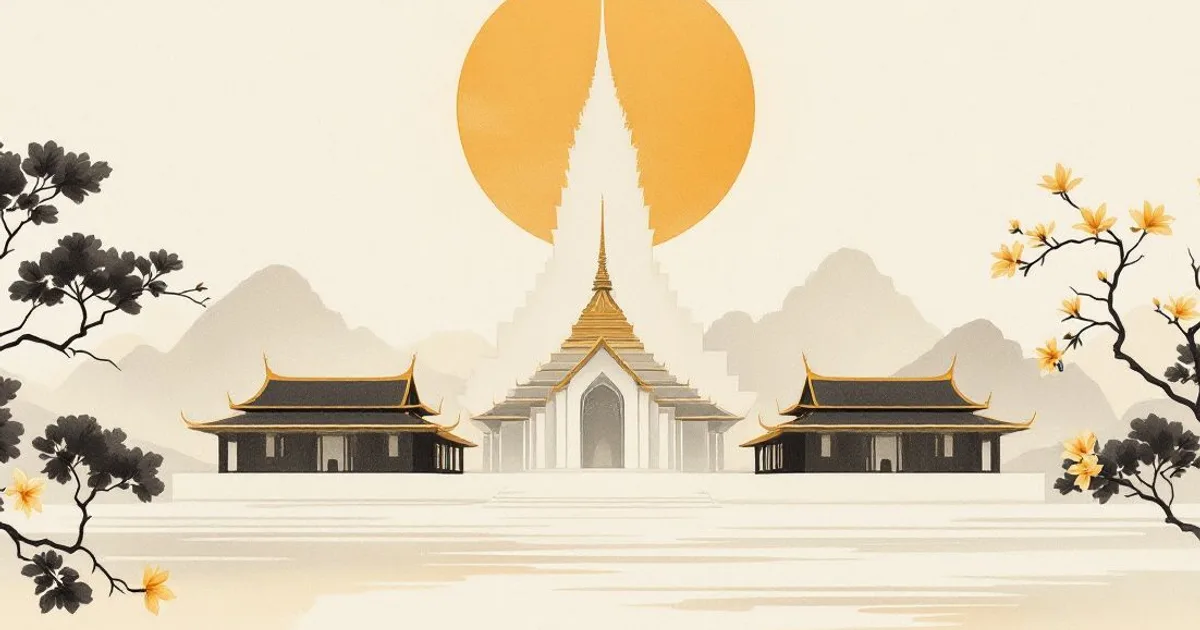
What is a wat? In Thailand, Laos and Cambodia it is a Buddhist temple and a monastery in one compound. It holds a consecrated hall where the monks carry out their formal acts, halls where lay people worship and hear sermons, often a stupa, and the dwellings of the monks and novices who live there under an abbot. In village life it has long doubled as school, festival ground and the place to make merit.
Buddhists have no single kind of place of worship: they gather at temples and monasteries (a vihara, a wat, a Chinese or Japanese temple, a Tibetan gompa), walk around stupas and pagodas, and keep a home altar; Buddhist temples covers them all. Even within Theravada Buddhism the words differ: Burmese kyaung means a monastery and also a school (Myanmar Language Commission dictionary), and a Sinhala pansala, literally “leaf-hall”, is a monk’s house attached to a temple (Carter’s dictionary, 1924). This page is about the wat of Thailand, Laos and Cambodia and their temples abroad.
What the word wat means
Thailand’s official Royal Institute Dictionary defines วัด broadly: “a religious place, usually having an ordination hall (bot), a vihara and dwellings of monks or other renunciants” (our translation of the 2011 edition). The definition says religious, not Buddhist: a 2025 Ramkhamhaeng University study calls Bangkok’s Wat Phra Si Maha Uma Thewi (Wat Khaek Silom) “a wat of the Hindu religion” (our translation). English is narrower: “A Buddhist temple in Thailand or Cambodia” (American Heritage Dictionary). Lao has the same word, ວັດ (“wat, temple, monastery” in Allen Kerr’s 1972 dictionary), and Khmer has វត្ត. How Theravada reached these lands is told in the history of Buddhism.
Where the word comes from is not settled. The American Heritage Dictionary derives English wat from Thai, and the Thai from Sanskrit vāṭa, “enclosure”. The Pali Text Society’s dictionary glosses Pali vāṭa the same way, citing a passage of the Vinaya, the monastic rule, where goats were harming the saplings in unenclosed monasteries and the Buddha allowed “enclosures of bamboo, enclosures of thorny branches, and trenches” (Kd 16:3.10, trans. Bhikkhu Brahmali).
Khmer dictionaries point another way. Robert Headley’s Cambodian-English Dictionary (1977) gives the monastery as the second sense of voat, whose first sense, practice or discipline, it traces to Pali vatta, “that which is done”. Chuon Nath’s Khmer Dictionary (5th edition, 1967) explains a vat as a place where vatta, religious observance, is kept, and puts a question mark after its own explanation. Thailand’s dictionary gives no derivation, so “wat means enclosure” is one reading, not a settled fact.
Chuon Nath glosses Angkor Wat as Nokor Vat, “the vat of the great city”, and Headley gives angkor as “city, capital city”. Britannica says the temple “was dedicated to the god Vishnu” and that Angkor Wat later “became a Buddhist shrine”; that history is told among the great Buddhist monuments.
What stands inside a wat
A wat is a compound. In brief: the ubosot or bot, where, in the Thai dictionary’s words, monks meet for the formal acts of the Sangha, such as reciting the Pātimokkha and ordination; the wihan (vihara), where monks and lay people gather before Buddha images; the chedi, or stupa; open pavilions (sala); the monks’ dwellings (kuti); and the ho trai, a hall for keeping the Tipiṭaka. Buddhist temples walks through each. Two of them are worth a closer look here.
The first is the boundary. The bot stands inside a sīmā, a zone the monks establish themselves, an idea that goes back to the Vinaya. When the monks asked how far a single monastery extends, the Buddha said: “I allow you to establish a monastery zone. … First you should announce the zone markers: a hill, a rock, a forest grove, a tree, a path, an anthill, a river, a lake.” The zone defined “who belongs to the same community and who should do the observance-day ceremony together” (Kd 2:6.1, trans. Bhikkhu Brahmali). There it covers a whole monastery; how far Thai practice, with its boundary around the ordination hall, goes beyond what the texts strictly require is discussed on Buddhist temples. In Thailand the markers (Pali nimitta) are the luk nimit, round stones about the size of an alms bowl, buried to mark the bounds of the ordination hall, which carved slabs (bai sema) mark as well. The ceremony that fixes the boundary is phuk phatthasima, and the area must hold at least twenty-one seated monks; wisungkhamasima is land the king grants to the Sangha as the site of an ordination hall (Royal Institute Dictionary).
The second is the preaching hall, sala kan parian, which the Thai dictionary defines as the wat’s hall for monks to preach the Dhamma. Even the royal chapel in the Grand Palace has twelve sala where the faithful hear sermons on Buddhist holy days (Bureau of the Royal Household).
Who lives in a wat
A wat is governed by its abbot, the chao awat. Around him live fully ordained monks (bhikkhus) and novices, samanen or nen, who live in the form of a monk but keep ten precepts. Two lay offices run its practical life: the waiyawatchakon, a layperson appointed to draw and pay out the monks’ regular allowance (nittayaphat) and to look after the wat’s property as the abbot assigns in writing, and the makhanayok, literally “one who leads the way”, who organises merit-making and calls people to the wat (Royal Institute Dictionary).
Then there are the temple boys, dek wat. Tsuneo Ayabe, who surveyed a central Thai village in 1970-71, writes that before modern schooling boys of five or six entered a wat to serve the monks and were taught Buddhist morals, reading, writing and arithmetic; girls had no such opening (Journal of the Siam Society, 1973, p. 39). State schooling, from 1898, did not end the custom. Not being members of the Sangha, they could cook for the monks: “it is impossible to think of a bhikkhu’s life without dek wat” (p. 43). In December 1970 Wat Pho in Bangkok had more than 1,000 registered dek wat to 160 monks and 40 novices, nearly 600 of them living in the wat; many came from other districts to attend school (pp. 40, 51).
Thailand’s mae chis, white-robed women renunciants who keep eight or ten precepts, have existed for at least 400 years, yet are not consistently recognised in law as ordained, and the National Office of Buddhism does not register them (Martin Seeger, Religions, 2022, pp. 1-2). Seventeenth-century European visitors describe them living near or even within monks’ monasteries (p. 4); a Sangha rule under Rama I forbade them “without exception” to live in or near one, though Seeger notes it is unclear how it was enforced (p. 5); and before the Sanam Chi nunnery was founded in 1910, “many” dwellings for mae chis and laywomen stood in the grounds of the neighbouring Wat Sanam Phram (pp. 8-9). Today, Seeger notes, depending on the monastery they live in, mae chis may have to clean and cook for the monks (p. 21). See the life of a Buddhist nun.
The day follows a round of alms, meal, chanting and meditation: see a day in a monastery.
What a wat does for its community
For lay Thais the wat is first the place to make merit, tham bun, which the Thai dictionary defines as doing good deeds such as feeding monks, putting food in their bowls and offering the four requisites to the Sangha. Building dwellings for monks counts as merit in the Vinaya itself. A merchant of Rājagaha had sixty built “in order to make merit and for the purpose of going to heaven”; the Buddha told him, “Well then, give those sixty dwellings to the Sangha as a whole, both present and future” (Kd 16:1.4), and thanked him in verse:
Their purpose is to shelter and for happiness,
To attain absorption and to see clearly.
Giving dwellings to the Sangha
Is praised as the best by the Buddha.
Therefore the wise man,
Seeing what’s beneficial for himself,
Should build delightful dwellings
And have the learned stay there.
Ordination. Many Thai men ordain for a short time. Ayabe reports that around 1970, at Wat Pho in Bangkok, about 70 to 100 government officials and military officers ordained for a time at the start of the rains, almost doubling its monks (p. 40). The season is the three-month rains residence, phansa: see Vassa, and for the steps of ordination, how to become a monk.
The festival year. After the rains lay people bring robe-cloth to the wat in the thot kathin ceremony, often followed by pha pa, cloth laid out as if left in the forest for monks to take (Kathina); on the observance days at each quarter of the moon (wan phra), see Uposatha. Ayabe’s village monks were kept busy by invitations to coming-of-age, wedding and funeral rites, and at New Year, Songkran and Loi Krathong the temple boys were busy helping them (p. 43); on the rites themselves, see Buddhist funerals.
Schooling. Some wats still teach. Wat Pho runs a Pali school for novices and a primary school for general pupils, according to its own site, and its school of Thai traditional medicine and massage opened inside the wat in 1955.
Kinds of wat: common, royal and forest
The status, ranks and counts below are Thailand’s. Founding a wat is a formal act of the state: a Royal Gazette notice published on 27 January 2026, for example, records the National Office of Buddhism announcing (on 30 June 2025), with the Sangha Supreme Council’s approval, a new Maha Nikaya wat in Khon Kaen province “with the status of a juristic person” (our translation). On the Maha Nikaya and the Dhammayut, see Buddhism in Thailand.
The dictionary sorts wats by status. A samnak song has not yet received the royal land grant for an ordination hall; a wat with the grant that is not on the list of royal monasteries is a common wat, wat rat. A royal wat, phra aram luang (colloquially wat luang), is one a king built or had entered on that list. Royal wats are ranked in three classes, first (chan ek), second (chan tho) and third (chan tri), with grades inside each that appear in the wat’s full name. The Royal Institute Dictionary (2011 edition) gives these:
| Class | Grades, highest first | Examples the dictionary gives |
|---|---|---|
| First | Ratchaworamahawihan; Ratchaworawihan; Woramahawihan | Wat Phra Chetuphon (Wat Pho) and Wat Mahathat, Bangkok; Wat Benchamabophit, Wat Ratchapradit; Wat Phra Si Mahathat, Wat Phra That Phanom |
| Second | Ratchaworamahawihan; Ratchaworawihan; Woramahawihan; Worawihan | Only two wats in the top grade, Wat Saket and Wat Chana Songkhram; Wat Thep Sirin, Wat Ratchasittharam; Wat Chakkrawat, Wat Rakhang; Wat Bophit Phimuk, Wat Anongkharam |
| Third | Grades include Ratchaworawihan and Worawihan | Wat Pathum Wanaram, Wat Ratchadathitthan; Wat Ratchanatda, Wat Thepthida |
Forest monasteries are another kind. Wat Pah Nanachat in northeast Thailand, which styles itself “The International Forest Monastery”, was established in 1975 by Ajahn Chah as a branch of his own forest monastery, Wat Nong Pah Pong. See the Thai forest tradition.
How many wats are there in Thailand?
The most recent count in the government’s statistical yearbook is 44,035 temples in 2024, with 245,645 monks and 31,873 novices, against 43,522 temples, 256,984 monks and 33,624 novices in 2023 (National Statistical Office, Statistical Yearbook Thailand 2025, Table 4.1, from National Office of Buddhism data). It leaves out the Chinese and Annamese orders.
Older figures come from other publications, so read them separately, not as a trend. Seeger, citing the National Office of Buddhism’s Basic Data of Buddhism, gives 40,580 registered wats in Thailand at the end of 2016; Ayabe gives about 24,600 temples and 280,000 monks for 1967 (p. 40). None of these counts includes mae chis, and their own figures vary widely: the Thai Mae Chi Institute’s statistics give 16,446 for 2019 but 5,091 registered in May 2020, a difference Seeger says he cannot explain; he estimates probably around 20,000, unlikely more than 25,000 (p. 2 and note 8).
Famous wats
Wat Pho, south of the Grand Palace in Bangkok, began as Wat Phodharam, an older Ayutthaya-period monastery that King Rama I had restored from 1788. Its own history divides it into a sacred quarter (Buddhavas) and the monks’ residential quarter (Sangghavas).
Wat Phra Kaew, the Temple of the Emerald Buddha in the Grand Palace, shows that not every wat is a monastery. The Bureau of the Royal Household says it has the structures of a Buddhist monastery “but was constructed with no living quarters as Buddhist monks do not reside in this Temple”. Rama I installed the Emerald Buddha there and named it Wat Phra Sri Rattanasasadaram.
In Laos, Wat Xieng Thong stands in Luang Prabang. Northern Illinois University’s SEAsite Laos says its sim, a hall stencilled inside with black and gold designs, was built in 1560 by King Setthathirath and that the wat was under royal patronage until 1975.
Wats outside Southeast Asia
Wat Thai of Los Angeles calls itself the first Thai wat in the United States. Its own history dates its start to a visit by Thai monks in June 1971, the foundation stone of its ordination hall to 19 May 1972, and the ceremony of its luk nimit, the buried boundary markers, to 17 October 1982. For the Theravada temples that followed, see Buddhism in America.
Visiting a wat
What to wear, where shoes come off and how to behave around monks are covered in temple etiquette. Some wats take overnight guests: Wat Pah Nanachat asks visitors to write first, recommends a stay of at least a week, and normally allows no more than 30 days. A wat is a temple, and it is also a home.
Frequently asked questions
What does the word wat mean?
In English, a Buddhist temple-monastery; where the word comes from is disputed. Thailand's Royal Institute Dictionary defines a wat as a religious place usually having an ordination hall, a vihara and monks' dwellings, and gives no derivation. The American Heritage Dictionary traces it through Thai to Sanskrit vāṭa, an enclosure, a word Pali shares; Khmer dictionaries connect it with Pali vatta, religious practice, one of them with a question mark.
How many wats are there in Thailand?
There were 44,035 in 2024, according to the National Statistical Office's latest yearbook, which uses National Office of Buddhism data. It also counts 245,645 monks and 31,873 novices that year, leaving out the Chinese and Annamese orders. Older figures, such as 40,580 registered wats at the end of 2016, come from other publications, so they should not be read as one series.
What is the difference between a wat and a temple?
A wat is a temple and a monastery at once. Besides halls for worship and often a stupa, it usually has an ordination hall inside a fixed boundary for the monks' formal acts, and dwellings where monks and novices live under an abbot. Wat is the word in Thailand, Laos and Cambodia; other Buddhist countries use their own words, such as kyaung in Burmese and pansala in Sinhala.
Do monks live at Wat Phra Kaew?
No. The Bureau of the Royal Household says the Temple of the Emerald Buddha in Bangkok's Grand Palace has the structures of a Buddhist monastery but was built with no living quarters, because monks do not reside there. It is the royal chapel where King Rama I installed the Emerald Buddha. Wat Pho, just south of the palace, does have a residential quarter for its monks.
What is a royal wat in Thailand?
A royal wat, phra aram luang, is one a king built or had entered on the list of royal monasteries. Thailand's Royal Institute Dictionary ranks royal wats in three classes, each with grades that show in the wat's full name, Ratchaworamahawihan being the highest. Wat Pho is a first-class wat of that grade. A wat with the royal land grant that is not on the list is a common wat, wat rat.
Can women live in a wat?
Some do, and the arrangement has varied. Martin Seeger (2022) notes that, depending on the monastery they live in, Thailand's mae chis, white-robed women who keep eight or ten precepts, may have to cook and clean for the monks; others live in separate nunneries. A Sangha rule under Rama I forbade mae chis to live in or near a monastery, though Seeger says it is unclear how it was enforced.
Sources
- Royal Institute Dictionary, B.E. 2554 (2011), Office of the Royal Society, Thailand, online edition: headwords wat, wat rat, wat luang, wisungkhamasima, samnak song, bot, luk nimit, phuk phatthasima, phatthasima, bai sema, kuti, ho trai, sala kan parian, chao awat, samanen, waiyawatchakon, makhanayok, tham bun, khao phansa, thot kathin, pha pa, and the royal-wat grades ratchaworamahawihan, ratchaworawihan, woramahawihan and worawihan (definitions translated by us)
- 'wat', The American Heritage Dictionary of the English Language, 5th ed. (HarperCollins, 2022): 'A Buddhist temple in Thailand or Cambodia', from Thai, from Sanskrit vāṭa, enclosure
- 'Vāṭa', T. W. Rhys Davids and William Stede, Pali Text Society's Pali-English Dictionary, p. 607, Digital Dictionaries of South Asia, University of Chicago: 'enclosure, enclosed place', citing Vin ii 154
- Robert K. Headley et al., Cambodian-English Dictionary (Catholic University of America Press, 1977) and Chuon Nath, Khmer Dictionary (Buddhist Institute, Phnom Penh, 1966), headwords voat and angkor, SEAlang Library Khmer Dictionary
- Allen Kerr, Lao-English Dictionary (1972) and W. L. Patterson and M. E. Severino, Lao-English Dictionary (1995), headword wat, SEAlang Library Lao Dictionary
- Myanmar-English Dictionary (Myanmar Language Commission, 1993), headword kyaung, SEAlang Library Burmese Dictionary
- 'pan-sala', Charles Carter, A Sinhalese-English Dictionary (1924), p. 355, Digital Dictionaries of South Asia, University of Chicago
- Senāsanakkhandhaka (Kd 16), Vinaya Cūḷavagga, trans. Bhikkhu Brahmali, SuttaCentral (CC0): the sixty dwellings given to the Sangha and the Buddha's verses of appreciation (1.4-1.5); the allowance to enclose a monastery (3.10, Vin ii 154)
- Uposathakkhandhaka (Kd 2), Vinaya Mahāvagga, trans. Bhikkhu Brahmali, SuttaCentral (CC0): the allowance to establish a monastery zone by announced markers (6.1, Vin i 106)
- National Statistical Office of Thailand, Statistical Yearbook Thailand 2025, Table 4.1, 'Temples, Buddhist Monks and Novices by Region and Province: 2023 - 2024', p. 157 (source: Office of National Buddhism; excludes the Chinese and Annamese orders)
- Tsuneo Ayabe, 'Dek Wat and Thai Education: The Case of Tambon Ban Khem', trans. Edward Tiffany and Toshikazu Arai, Journal of the Siam Society 61(2), 1973, pp. 39-52 (fieldwork October 1970 to February 1971)
- Martin Seeger, 'The Fragmentary History of Female Monasticism in Thailand: Community Formation and Development of Monastic Rules by Thai Mae Chis', Religions 13 (2022): 1042, pp. 1-5, 8-9, 21 (CC BY 4.0)
- Royal Gazette (Ratchakitchanubeksa) vol. 143, part 13 Ngo, p. 131, published 27 January 2026: National Office of Buddhism, announcement dated 30 June 2025 establishing a wat in Khon Kaen as a juristic person
- Viroj Nakchatri, 'Hindu Deity Beliefs among Thai Buddhists: A Case Study of Wat Phra Si Maha Uma Thewi (Wat Khaek Silom)' (in Thai; English title our translation), Ramkhamhaeng Journal, Humanities Edition 44(1), 2025, pp. 53-66, abstract
- 'Angkor Wat', Encyclopaedia Britannica: the temple dedicated to Vishnu, later a Buddhist shrine
- 'History', Wat Pho (Wat Phra Chetuphon Wimon Mangkhalaram Rajwaramahawihan), the temple's own site
- 'Study in Wat Pho', Wat Pho, the temple's own site (Thai text): the Pali school for novices and the primary school
- 'Traditional Medicine School and Traditional Massage', Wat Pho, the temple's own site: the school opened inside Wat Pho in 1955
- 'History': The Temple of the Emerald Buddha (The Chapel Royal), The Grand Palace, Bureau of the Royal Household
- 'Wat Xieng Thong', SEAsite Laos, Center for Southeast Asian Studies, Northern Illinois University (2002)
- 'History of Wat Thai', Wat Thai of Los Angeles, the temple's own site (Thai text)
- Wat Pah Nanachat, The International Forest Monastery, home page (the monastery's own account)
- Wat Pah Nanachat, 'About' and visiting information: write first; recommended minimum stay one week, normally at most 30 days