Dipankara Buddha: The Buddha Who Foretold Gautama
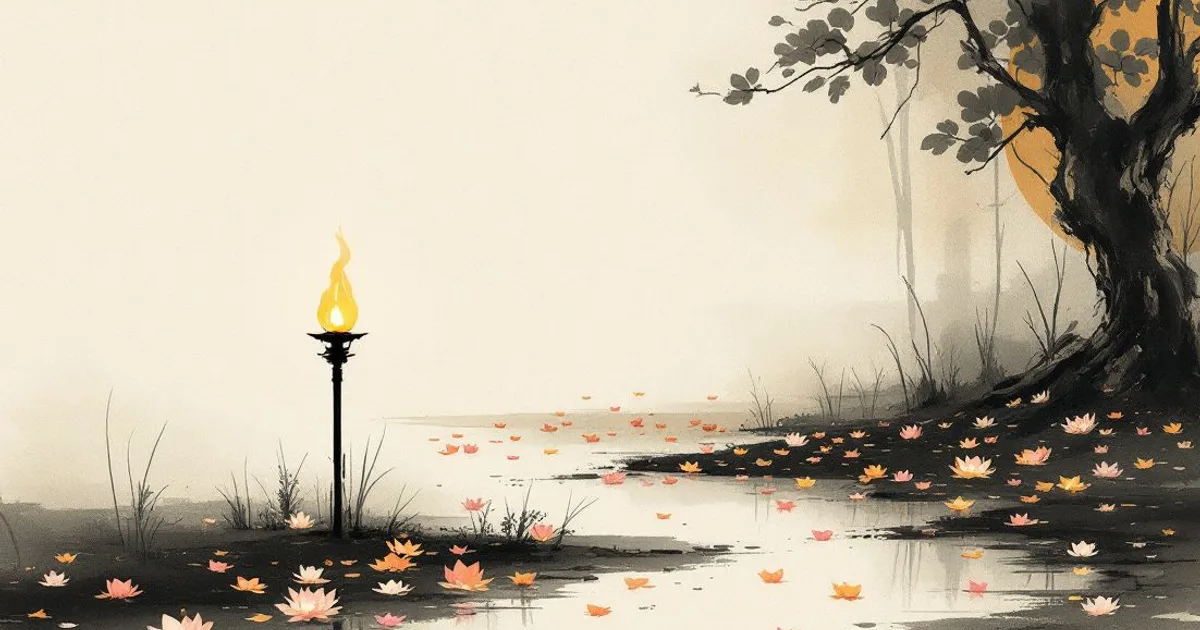
Dīpaṅkara Buddha is a buddha of an age long past, remembered as the one who foretold Gautama’s awakening. In the Pali Buddhavaṃsa the ascetic Sumedha lies face down in the mud so that Dīpaṅkara can walk over him, and Dīpaṅkara predicts that he will one day be a buddha. Sanskrit and Tibetan texts tell the same meeting with a young brahmin named Megha or Sumati, and Nepal’s Newar Buddhists honour Dīpaṅkara with a festival of giving.
- Name
- Dīpaṅkara, also spelled Dīpaṃkara; “Light Maker” in 84000’s gloss of the Sanskrit
- Other names
- Randeng Fo 燃燈佛 (Chinese), Nentōbutsu 燃灯仏 (Japanese), Mar me mdzad (Tibetan)
- Known for
- Predicting that the ascetic who became Gautama would be a buddha (Buddhavaṃsa 2; The Prophecy of Dīpaṅkara, Toh 188)
- In the Buddhavaṃsa
- First of the 24 buddhas before Gotama; born in Rammavatī; awakened under a pipphalī tree; lived 100,000 years (Bv 3)
- Festival
- Samyak Mahādāna, the Newar festival of giving held in Patan every four years
What the name Dīpaṅkara means
84000’s glossary to The Prophecy of Dīpaṅkara says the Sanskrit name “literally means ‘Light Maker.’” The texts that tell of his birth explain it with light. In The Collected Teachings on the Bodhisatva (Bodhisatvapiṭaka, Toh 56) the newborn prince’s “whole body emitted light, as if it were the disk of the sun. He was given the name Dīpaṅkara.” In The Prophecy of Dīpaṅkara (Toh 188) light from the child fills the palace, and Śakra, lord of the gods (see Sakka), declares that “the child should be named Dīpaṅkara” (1.10).
In Chinese he is Randeng 燃燈: the Metropolitan Museum catalogues a Northern Wei image dated 495 as Buddha Dipankara (Randengfo). Kumārajīva’s Chinese Diamond Sutra writes 然燈, which the Buddhist Text Translation Society renders “Burning Lamp Buddha”. In Japan he is Nentōbutsu (燃灯仏); the Nihon Kokugo Daijiten says he was so named because from birth he lit up his surroundings like a lamp. In Tibetan he is Mar me mdzad. He is not Atiśa Dīpaṃkara Śrījñāna (982–1054), the Indian master who shares the name.
Sumedha and Dīpaṅkara in the Buddhavaṃsa
The Theravāda telling is in the Buddhavaṃsa (“Chronicle of the Buddhas”), in the Khuddaka Nikāya of the Pali Canon. SuttaCentral calls it “a late devotional text in verse”, part of a literature “composed in the second and first centuries BCE”. Jan Nattier, quoted by Bhikkhu Anālayo, points out that Dīpaṅkara is entirely absent from the Pāli suttas, and concludes that traditions about him gained currency only several centuries after the Buddha’s death (see what is a bodhisattva?).
In chapter 2, “Sumedha’s Wish”, the Buddha tells in the first person of a time “four asankheyyas and a hundred thousand cycles ago”, in T. W. Rhys Davids’ 1880 translation. Sumedha, a rich brahmin of Amaravatī, gives away his wealth and becomes a hermit in the Himalaya, so absorbed in meditation that he misses the signs at Dīpaṅkara’s conception, birth, awakening and first teaching (Bv 2:35). Travelling through the air, he sees people clearing a road for Dīpaṅkara and asks for a stretch of his own. The Buddha arrives “with four hundred thousand saints” before he has finished (2:45), so Sumedha loosens his hair, spreads his bark robe and skin mantle in the mire and lies face down, asking the Buddha to walk over him rather than through the mud (2:52–53).
Lying there, he sees that he could end his own defilements that very day, and chooses instead to become a buddha and carry others across (2:54–58); that resolve, the model of the bodhisattva path, is told on bodhisattva vows. Then Dīpaṅkara stands at his head:
Dīpankara, knower of all worlds, receiver of offerings,
Standing by that which pillowed my head, spoke these words:
See ye this austere hermit with his matted hair,
Countless ages hence he will be a Buddha in this world.
The prophecy goes on to name the future Gotama’s city, parents, chief disciples and tree (2:62–69). The crowd hears it as a second chance: “As men crossing a river, if they fail to reach the opposite ford, / Gaining the lower ford cross the great river”, so those who miss this Buddha will stand before Sumedha when he is one (2:73–74). Dīpaṅkara praises the deed and walks on (2:75), and Sumedha sits down to search out the ten perfections.
The prose around these verses is the Nidānakathā, the introduction to the Jātaka commentary, which 84000’s introduction to the Prophecy dates to approximately the fifth century CE. It adds that the townspeople gave the hermit a swampy patch, seeing his supernatural power, and that he chose to work by hand: “this day it behoves me to perform menial duties.”
Dīpaṅkara’s own life
Chapter 3 of the Buddhavaṃsa gives Dīpaṅkara a biography of his own. As G. P. Malalasekera’s Dictionary of Pāli Proper Names summarises it, he was born in Rammavatī to King Sudeva and Queen Sumedhā, awakened under a pipphalī tree, had Sumaṅgala and Tissa as chief disciples, stood eighty cubits tall and lived a hundred thousand years; his stupa rose thirty-six leagues. Near its end the chapter turns to impermanence, in Rhys Davids’ words: “All is wholly gone,—are not all existing things vanity!” (3:30).
The Prophecy of Dīpaṅkara, a Mahāyāna sūtra preserved in Tibetan, tells a stranger story. After his awakening Dīpaṅkara remains at the seat of awakening “for fifty years, and not a single being approached to see him”, because the people of his father’s city, being happy, have grown careless. He conjures a city of beryl and sets it ablaze; watching it vanish, they think of their own impermanence, and only then does he teach (1.21–1.27).
Megha, Sumati and the five lotuses
The northern versions keep the spread hair and the prophecy but rename the young man and add flowers. 84000’s introduction to the Prophecy, by its translator Laura Goetz, finds him called Sumati in the Sanskrit Divyāvadāna and Kṣemendra’s Bodhisattvāvadānakalpalatā, and Megha in the Mahāvastu, the Bodhisatvapiṭaka and the Prophecy itself.
In the Bodhisatvapiṭaka (trans. Jens Braarvig, Fredrik Liland and David Welsh), Megha meets a girl carrying seven blue lotuses and offers to buy five. She will give them only if he promises to be her husband in all future lives; he refuses, and she settles for a piece of his flesh the size of a mustard seed (11.264–11.268). The lotuses he showers on Dīpaṅkara become a canopy of flowers, and he offers the golden locks he has grown for twelve years; Dīpaṅkara steps on them and tells the monks not to (11.273–11.275). In the Prophecy Megha does promise to marry her (1.70–1.72), and the scene runs:
The thus-gone, worthy, complete and perfect Buddha Dīpaṅkara looked behind him and said to the monks, ‘Monks, where I put my two feet, there you must not stand. If you ask why, it is because that is the matted hair of one who has honored many hundreds of sextillions of buddhas.’
At the end the Buddha identifies the girl as the Śākya girl Gopā, and a brahmin Megha had beaten in a contest of learning as Devadatta (1.106–1.107). A panel from Sikri in the Lahore Museum tells the Sumati version on its label: seven lotuses, a shower that muddies the road, and Sumati spreading his hair “on the path of Dipankara to enable him to pass”. In Japan, the Nihon Kokugo Daijiten quotes the Konjaku monogatari shū (about 1120), where the Buddha recalls buying five lotus stems for five hundred gold coins.
Not every version makes this meeting the beginning. Anālayo notes that the Mahāvastu, the Divyāvadāna and the Mahāvibhāṣā set Gautama’s first vow long before Dīpaṅkara, and sees the start of the quest shifting “ever more into the distant past”. In the Prophecy the Buddha says he had venerated “hundreds of thousands of buddhas” who gave him no prophecy (1.2).
What did Gautama receive from Dīpaṅkara?
Several Mahāyāna sūtras read the meeting as a matter of insight. The Prophecy opens with the Buddha telling Ānanda that after offering Dīpaṅkara five utpala flowers, “I developed confidence in the selflessness of phenomena and gained the acceptance that phenomena are unarisen” (1.2).
The Diamond Sutra presses the point. In Paul Harrison’s translation from the Sanskrit (§10a), Subhūti answers the Buddha: “There is no dharma at all which the Realized One learned from the Realized, Worthy and Perfectly Awakened One Dīpaṃkara.” In §17, in Kumārajīva’s Chinese as the Buddhist Text Translation Society renders it, the Buddha says that “if there had been a dharma of anuttarasamyaksambodhi which the Tathagata attained, then Burning Lamp Buddha would not have given me the prediction”. The prophecy came because nothing was attained.
The Lotus Sutra goes further. In Peter Alan Roberts’ translation for 84000, Mañjuśrī tells Maitreya that Dīpaṃkara was the last of eight princes whose teacher Mañjuśrī himself had been, in a past life as the bodhisattva Śrīgarbha (1.79–1.88). In chapter 15 the Buddha says that the buddhas “beginning with Tathāgata Dīpaṃkara”, and their passing into nirvāṇa, “were my emanations, noble ones, in order to accomplish the teaching of the Dharma through skillful methods” (15.6). The buddha of the past becomes skilful means.
Dīpaṅkara in art and devotion
Gandhāra. Jan Nattier, quoted by Anālayo, notes that the meeting “is frequently depicted in art from the Gandhāra region … suggesting that it may have originated at the northwestern fringes of the Indian cultural sphere.” In a third-century slate relief in the Rijksmuseum, in the museum’s words, “Buddha Dipankara walks across the hair of a Bodhisattva, spread out in the Buddha’s honour”; the Metropolitan Museum has a panel of about the second century from the Swat Valley.
China and Tibet. At the Zhihua Temple in Beijing, the University of Chicago’s Center for the Art of East Asia identifies the three buddhas of the Zhihua Hall as “The Buddhas of the Three Ages—Shakyamuni (the central historical Buddha), Dipankara (Buddha of the Past), and Maitreya (Buddha of the Future)” (see Buddhism in China). Himalayan Art Resources says that in Tibetan art Dīpaṅkara “is almost always depicted along with Shakyamuni Buddha and the bodhisattva Maitreya - depicted as a Buddha”, the three known as the Buddhas of the Three Times (see types of buddhas).
Nepal. Himalayan Art Resources writes that Dīpaṅkara “is popularly worshiped in Nepal but rarely found in other parts of the Himalayas, Tibet, or surrounding regions”, and that Nepalese Buddhists popularised his rituals in about the seventeenth century, considering him “a patron deity for merchants and alms-giving”. Mary Slusser’s Patan Museum text records a local name, the “Samyak god”, after an alms-giving festival where his images are displayed. Kerry Lucinda Brown’s 2014 dissertation describes the Patan festival, Samyak Mahādāna (“The Perfect Great Gift”): every four years devotees bring images of 126 buddhas, bodhisattvas and other deities, and large Dīpaṅkara images walk to the site with a man inside. His importance, she writes, is rooted in “ancient textual and visual narratives that promote the cultivation of generosity” through giving (see Buddhism in Nepal).
How the traditions differ
| Tradition | Main texts | The young ascetic | What the meeting means |
|---|---|---|---|
| Theravāda | Buddhavaṃsa 2–3; Nidānakathā | Sumedha | The resolve that starts the path; first of 24 buddhas who predict Gotama |
| Mahāvastu and Sanskrit avadānas | Mahāvastu; Divyāvadāna | Megha; Sumati | A prediction, with the first vow placed further back |
| Mahāyāna sūtras | Bodhisatvapiṭaka; Prophecy; Diamond and Lotus sūtras | Megha, where named | Insight that phenomena are unarisen; nothing received; skilful means |
| Chinese and Tibetan art | Temple triads; painting sets | none | The buddha of the past, beside Śākyamuni and Maitreya |
| Newar Buddhism | Samyak Mahādāna | none | Patron of giving and of merchants |
The Pali hermit resolves and is promised buddhahood; in the Prophecy Megha gains insight on the spot (1.104), and the Diamond Sutra insists nothing was received. In devotion, Theravāda keeps Dīpaṅkara within a line of 28 buddhas, which British Library manuscripts from Burma illustrate. For the wider family, see buddhas and bodhisattvas.
Frequently asked questions
Who is Dipankara Buddha?
Dipankara is a buddha of a past age, best known for predicting that the ascetic Sumedha, a former life of Gautama, would one day become a buddha. The Pali Buddhavamsa makes him the first of 24 buddhas before Gotama. Sanskrit and Tibetan texts tell the same meeting, with the young brahmin called Megha or Sumati.
What does the name Dipankara mean?
84000's glossary says the Sanskrit name literally means 'Light Maker'. The texts explain it with his birth: in the Bodhisatvapitaka his newborn body emitted light like the disk of the sun, and in The Prophecy of Dipankara the god Shakra names him for the light that lit the palace. In Chinese he is Randeng, which an English translation of the Diamond Sutra renders 'Burning Lamp Buddha'.
What is the story of Sumedha and Dipankara?
In the Buddhavamsa the hermit Sumedha finds people clearing a road for Dipankara and asks for a stretch to clear. The Buddha arrives before he has finished, so Sumedha lies face down in the mud for him to walk over. He chooses to become a buddha rather than end his own defilements that day, and Dipankara, standing at his head, predicts that he will be a buddha countless ages hence.
Was Dipankara the first Buddha?
No. The Buddhavamsa makes him the first of the 24 buddhas who predicted Gotama's awakening, but its chapter 28 names three earlier buddhas in the same eon: Tanhankara, Medhankara and Saranankara. The Mahavastu and Divyavadana place Gautama's first vow long before Dipankara, and in The Prophecy of Dipankara the Buddha recalls venerating hundreds of thousands of buddhas who gave him no prophecy.
Why is Dipankara important in Nepal?
Newar Buddhists of the Kathmandu Valley honour him as a patron of giving and of merchants; Himalayan Art Resources and the Patan Museum say his cult became popular in about the seventeenth century. Every four years Patan holds Samyak Mahadana, a great festival of giving in his honour, where large images of Dipankara walk in procession with a man inside the body.
Is Dipankara Buddha the same as Atisha Dipankara?
No. Atisha Dipamkara Shrijnana (982-1054) was an Indian Buddhist master whose teaching shaped Buddhism in Tibet; he shares the name. Dipankara Buddha is a buddha of an age long past, known from the Pali Buddhavamsa and from Sanskrit, Tibetan and Chinese texts as the one who foretold Gautama's awakening.
Sources
- Buddhavaṃsa, 'Chronicle of the Buddhas', collection page and description, SuttaCentral: 'a late devotional text in verse', part of a devotional literature 'composed in the second and first centuries BCE'; listed in the Khuddaka Nikāya (Minor Collection)
- Buddhavaṃsa 2, Sumedhapatthanākathā ('Sumedha's Wish'), Pali, Mahāsaṅgīti Tipiṭaka edition, SuttaCentral: Bv 2:1, 2:35–75 (verse numbering used on this page)
- Buddhavaṃsa 3, Dīpaṅkarabuddhavaṃsa, Pali, Mahāsaṅgīti Tipiṭaka edition, SuttaCentral: Bv 3:18–31; and Buddhavaṃsa 28, Buddhapakiṇṇakakaṇḍa, 28:1 (the four buddhas of Dīpaṅkara's eon)
- T. W. Rhys Davids (trans.), Buddhist Birth Stories (1880), the Nidānakathā, 'The Distant Epoch' (the Story of Sumedha, with the Buddhavaṃsa verses it quotes, vv. 12–223 in the translation), Project Gutenberg (public domain)
- The Prophecy of Dīpaṅkara (Dīpaṅkaravyākaraṇa, Toh 188), 84000: Translating the Words of the Buddha, trans. Laura Goetz: introduction i.10–i.12, text 1.2, 1.10, 1.21–1.27, 1.70–1.72, 1.101, 1.104 and 1.106–1.107, and the glossary entry Dīpaṅkara
- The Collected Teachings on the Bodhisatva (Bodhisatvapiṭaka, Toh 56), 84000: Translating the Words of the Buddha, trans. Jens Braarvig, Fredrik Liland and David Welsh: 11.245 and 11.264–11.275
- The White Lotus of the Good Dharma (Saddharmapuṇḍarīka, Toh 113), 84000: Translating the Words of the Buddha, trans. Peter Alan Roberts: 1.79–1.88 and chapter 15, 'The Lifespan of the Tathāgata', 15.6
- Vajracchedikā Prajñāpāramitā (Diamond Sutra), §§10a and 17, English trans. Paul Harrison (2006) aligned with the Sanskrit, Kumārajīva's Chinese (T. 235) and other versions, Bibliotheca Polyglotta, University of Oslo
- The Vajra Prajna Paramita Sutra (from Kumārajīva's Chinese), chapter 17, Buddhist Text Translation Society, with commentary by Master Hsuan Hua, City of Ten Thousand Buddhas
- Bhikkhu Anālayo, The Genesis of the Bodhisattva Ideal (Hamburg Buddhist Studies 1, Hamburg University Press, 2010, open access), pp. 86–87 with p. 87 notes 94–96, quoting Jan Nattier
- G. P. Malalasekera, Dictionary of Pāli Proper Names, 'Dīpaṅkara Buddha', aimwell.org
- San San May (Curator for Burmese), '28 Buddhas', British Library blog, 19 June 2015
- 'Two Buddhist scenes', relief from the base of a stupa, Pakistan, Gandhara, 3rd century, slate, Rijksmuseum, Amsterdam (AK-RAK-1995-2)
- 'Dipankara Jataka (The Story of the Ascetic Megha and the Buddha Dipankara)', Pakistan (ancient region of Gandhara, Swat Valley), ca. 2nd century, schist with gold leaf, The Metropolitan Museum of Art (1998.491)
- 'Buddha Dipankara (Randengfo)', China, Northern Wei dynasty, dated 495, sandstone, The Metropolitan Museum of Art (65.29.3)
- 'Dipankra Jataka', schist panel from Sikri, Lahore Museum, Google Arts & Culture
- 'Buddha Triad from Zhihua Hall (Zhihuadian, Hall of Transforming Wisdom)', 智化殿三世佛, Zhihua Temple, Beijing, Center for the Art of East Asia, University of Chicago
- Buddhist Deity: Dipamkara Buddha (main page), Himalayan Art Resources, Jeff Watt (updated 8-2017, 1-2020)
- Dipamkara Buddha with Kathmandu narrative scenes, Nepal, Rubin Museum of Art, Himalayan Art Resources item 65824, Jeff Watt and David Pritzker (2-2008)
- Mary Slusser, 'Dipankara, the Buddha of Fixed Light', Patan Museum: Highlights, no. 4, Asian Arts
- Kerry Lucinda Brown, 'Dīpaṅkara Buddha and the Patan Samyak Mahādāna in Nepal: Performing the Sacred in Newar Buddhist Art' (PhD dissertation, Virginia Commonwealth University, 2014), abstract
- Nentōbutsu 燃灯仏, Seisen-ban Nihon Kokugo Daijiten (with its Konjaku monogatari shū citation), Kotobank
- Atiśa Dīpaṃkara Series, Lotsawa House