The Endless Knot: Meaning of the Buddhist Symbol
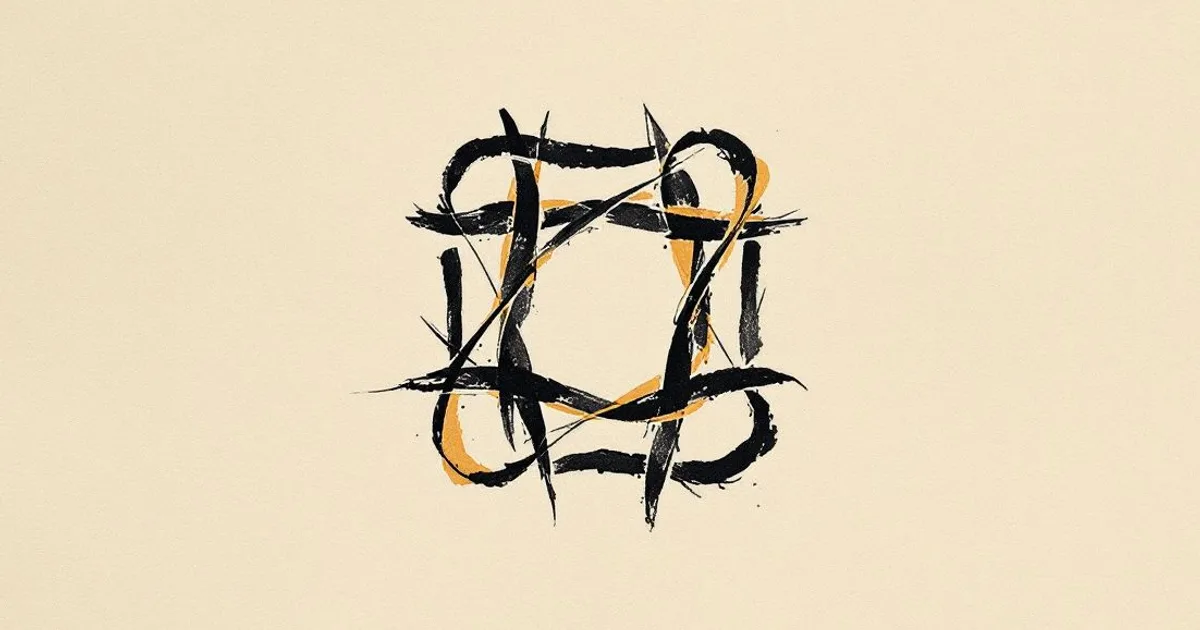
The endless knot (Sanskrit: śrīvatsa; Tibetan: dpal be’u) is one of Buddhism’s Eight Auspicious Symbols — a single looping design with no beginning and no end. Its interwoven lines symbolize the interdependence of all things and, in a favourite Tibetan reading, the union of wisdom and compassion. It is among the most philosophically rich of all Buddhist symbols.
What does the endless knot stand for?
Look at an endless knot and you cannot find where it starts or where it stops: a continuous line loops over and under itself, closed and complete. That simple fact is the whole meaning. Because it has no beginning and no end, the knot stands for the interconnectedness of everything — the way, in Buddhist understanding, no thing exists on its own but only in dependence on countless others. It also carries a cluster of related meanings especially loved in Tibetan Buddhism: the endless cycle of existence, the unbroken continuity of the awakened mind, and above all the inseparable union of wisdom and compassion. It is one of the eight aṣṭamaṅgala, and arguably the one that says the most.
A knot with no beginning or end
The endless knot’s power is in its geometry. Unlike a symbol you “read” — a wheel, a lotus, a flame — the knot works by a property of its shape: it has no loose ends. Trace the line and it returns to itself forever. There is no first point from which it begins and no last point at which it stops.
This is why it resists being flattened into a mere decorative flourish or a generic “infinity” sign. The endlessness is not just visual cleverness; it is the meaning. In a tradition whose deepest teachings are about how things arise together, without any independent starting point, a closed and beginningless knot is close to a perfect emblem.
What the endless knot means
Because its form is so suggestive, the endless knot has gathered several linked meanings, all of them attested in the Tibetan tradition and each illuminating the others:
- The interdependence of all things. This is the core reading. Everything is woven together with everything else — arising in mutual dependence, not in isolation. The knot is a picture of that seamless interweaving, the truth the Buddhist teaching of emptiness and dependent arising points to.
- The union of wisdom and compassion. In a favourite Tibetan interpretation, the intertwining lines represent the inseparable joining of wisdom (prajñā) and compassion (karuṇā) — or, in a closely related reading, of wisdom and skilful method (upāya) — in the mind of an awakened being. Neither can be pulled free of the other; like the knot, they are bound together.
- The endless cycle of existence. The unbroken line can also evoke saṃsāra, the beginningless round of birth, death, and rebirth — and, on the far side of it, the eternal continuum of the awakened mind, which does not end.
These are not competing meanings so much as facets of one insight: that reality is a continuous, interdependent whole, and that the awakened response to it — wisdom and compassion together — is likewise seamless.
Śrīvatsa: a name older than the knot
The Sanskrit name repays a moment’s care, because searching it will land you somewhere unexpected. Śrīvatsa — which the Cleveland Museum of Art glosses as the “child” (vatsa) of Shri, the goddess of good fortune — is in Indian art first of all a mark on the chest of a deity. On a fourth-century sculpture from Bihar of Vishnu riding Garuda, it is the auspicious sign on Vishnu’s chest. On a coping-rail section carved at Mathura in the first or second century CE it is not a knot at all, but “vegetal fronds symmetrically springing from a lotus rosette” — a mark the museum notes is “also found on the chests of Jinas,” the liberated beings of the Jain tradition, as well as on the Hindu god Vishnu.
So śrīvatsa names an old pan-Indian sign of good fortune whose form was not fixed: a chest-mark on one image, a rosette of fronds on another. The tightly interlaced, endlessly looping version is the one the Tibetan world settled on — named dpal be’u, “glorious little knot” — and to which it gave the philosophical reading above. Himalayan Art Resources, the standard iconography database, accordingly lists the sixth of the eight simply as the “Glorious Endless Knot.” Knowing this saves real confusion: the pages about śrīvatsa that show you Vishnu’s chest are not mistaken, they are describing an older layer of the same name.
Where you actually meet the endless knot
The knot is not only contemplated. It is recited, and it is carried.
The Verses of the Eight Noble Auspicious Ones is a short Tibetan prayer of auspiciousness composed by Mipham Rinpoche in 1896 — Himalayan Art Resources links it from its own outline of the eight symbols — and the text’s statement of benefits directs that it be recited on waking, on going to sleep, before a conflict, and on embarking on any project. One stanza names the eight in turn, and it is there that the knot receives its epithet:
The conch of fame and glory, the glorious knot of prosperity,
The eternal banner of victory and the all-powerful wheel:
The colon is a hinge: the stanza runs on to the eight auspicious goddesses who hold these emblems and offer them to the buddhas. The Tibetan behind “the glorious knot of prosperity” is dpal be’u — and dpal, “glory,” is precisely the śrī that the Sanskrit name carries. The knot is not an abstraction in that liturgy; it is one of eight things named aloud at the start of a day.
Away from the shrine it lives on things Tibetans made and used. In the Victoria and Albert Museum’s Tibetan collection the knot is chiselled in relief at the centre of a nineteenth-century iron pen case; it forms the silver-wire finials topping the silk tassels of a leather belt; and it runs through the chased scrollwork of a pair of parcel-gilt steel stirrups, which the catalogue calls “the sacred endless knot emblem.” A repoussé copper dish carries the whole set, described there as the “eight glorious emblems.” It belongs to ritual dress as well: a set of carved bone shoulder ornaments in the same collection — part of a costume the museum records as worn by Nyingmapa lamas during exorcisms, and by other orders in monastic dances — hangs “a representation of the Endless Knot” from strings of beads at each shoulder.
That range is a useful corrective to treating the knot as a purely contemplative diagram. In Tibet it went on saddlery, writing gear, a copper dish, everyday dress and ritual costume alike — the same instinct that strings prayer flags across a pass or offers a white khata scarf at a greeting. If you have wondered whether it is appropriate to wear one, the belt is the honest answer: in the tradition itself the emblem is worn on ordinary clothing, not reserved for the shrine.
The endless knot in other cultures
A brief word to prevent two confusions, which pull in opposite directions.
Celtic knotwork is genuinely separate. Interlaced, “endless” designs appear in many cultures with no shared origin, and the likeness between Celtic knotwork and a Tibetan dpal be’u is resemblance, not descent. The same holds for the various folk knot motifs the design gets compared to.
The Chinese “endless knot,” by contrast, is this symbol. In Chinese decorative art the whole set travels together as the bajixiang — the V&A, in its older romanisation, calls them the “eight Buddhist emblems of Happy Augury (Pa Chi-hsiang)” on a Qing dragon robe, and lists the seven that robe carries, the wheel, the lotus and the endless knot among them. The traffic is visible in the objects themselves. A Jingdezhen porcelain cup in the V&A is painted in underglaze blue “with the Eight Buddhist Emblems and Tibetan script amid floral scrolls”; a Jingdezhen bowl of 1450–1500 carries the same eight above a lotus; that kesi dragon robe bears seven of them; and the Metropolitan Museum’s eighteenth-century Qing kesi sutra cover is catalogued simply as a “Sutra Cover with Eight Buddhist Treasures.” What sits on Ming and Qing porcelain beside the dharma wheel and the lotus is not a Chinese parallel to the endless knot. It is the endless knot.
The knot’s meaning, though, and its place among the Eight Auspicious Symbols, belong above all to Tibetan Buddhism — and it is worth being exact about where that line falls, because “Buddhism’s endless knot” is too broad. The standard reference work on the set, Robert Beer’s, is a handbook of Tibetan Buddhist symbols; the iconographic authority that catalogues the eight is a Himalayan art database; and every object cited above is either Tibetan, or Chinese work carrying the same Buddhist set — one piece of it lettered in Tibetan script. This is, more exactly, the Himalayan world’s endless knot and that of the East Asian traditions it reached. When you see it on a Tibetan hanging, a temple wall, or a piece of jewellery, it is this lineage of meaning — interdependence, and the union of wisdom and compassion — that it carries.
For the full set it belongs to, see the Eight Auspicious Symbols; for the teaching it so beautifully pictures, emptiness and interdependence; and for the wider family of imagery, Buddhist symbols and their meanings.
Frequently asked questions
What does the endless knot symbolize in Buddhism?
The endless knot (Sanskrit: śrīvatsa; Tibetan: dpal be'u) is a looping design with no beginning and no end, and it carries several linked meanings. It symbolizes the interdependence and interconnectedness of all things, the endless cycle of existence (samsara), the eternal continuum of the awakened mind, and — a favourite Tibetan reading — the union of wisdom and compassion (or wisdom and skilful method) in the Buddha's enlightenment.
Is the endless knot the same as the infinity symbol?
No. While both suggest endlessness, the endless knot is not simply a mathematical infinity sign. It is one of Buddhism's Eight Auspicious Symbols, and its specific meaning is about interdependence — how everything is woven together with everything else — and the inseparable union of wisdom and compassion. Reducing it to a generic 'infinity' symbol misses that particular teaching.
Is the endless knot only a Buddhist symbol?
No. The name śrīvatsa is older and wider: in Indian art it marks the chest of the Hindu god Vishnu and of the Jinas of the Jain tradition, and its early forms are not knots at all. The tightly interlaced version is the one the Tibetan world settled on, and it travelled into Chinese decorative art as one of the same eight Buddhist emblems (the bajixiang), not as a separate Chinese motif. Celtic knotwork, by contrast, is a genuinely unrelated tradition that only resembles it.
What is the endless knot's name in Sanskrit and Tibetan?
In Sanskrit it is the śrīvatsa; in Tibetan, dpal be'u (often written palbeu or pelbeu). The Tibetan name combines dpal — which renders the Sanskrit śrī, 'glory' or 'splendour' — with be'u, 'little knot,' so it translates the Sanskrit term quite directly. It is counted among the ashtamangala, the Eight Auspicious Symbols.
Can you wear the endless knot?
Yes — in Tibet it appears on everyday dress, not only in temples. The Victoria and Albert Museum holds a 19th-century Tibetan leather belt whose silk tassels end in endless knots of silver wire, catalogued as one of the Eight Glorious Emblems, and a Tibetan iron pen case chiselled with the same emblem. The knot also belongs to formal ritual costume, so the tradition uses it at both ends: ordinary wear and monastic rite.
Sources
- Tibetan Nuns Project — 'The Eternal Knot Symbol' (palbeu / śrīvatsa; its meanings)
- Robert Beer, 'The Handbook of Tibetan Buddhist Symbols' (Shambhala, 2003)
- Rubin Museum of Himalayan Art — the Eight Auspicious Symbols
- 'The Verses of the Eight Noble Auspicious Ones' by Mipham Rinpoche, composed 1896, Lotsawa House (trans. Rigpa Translations, 2010) — the stanza naming 'the glorious knot of prosperity' and the colophon's statement of benefits
- 'Subject: Eight Auspicious Symbols', Himalayan Art Resources — outline by the HAR Team (updated 9-2022), listing the sixth of the eight as the 'Glorious Endless Knot' and linking Mipham's verses
- 'Vishnu Riding on Garuda', Eastern India, Bihar, 300s CE, schist, The Cleveland Museum of Art (1961.46) — the śrīvatsa as the auspicious mark on Vishnu's chest
- 'Section of a Coping Rail', India, Mathura, Kushan period, 1–200 CE, sandstone, The Cleveland Museum of Art (2011.145) — the early śrīvatsa as a lotus rosette with fronds, shared with Jain and Hindu art
- 'Pen case and lid', Tibet, probably 19th century, iron, Victoria and Albert Museum (IS.36-1965) — 'chiselled in relief the emblem of the endless knot'
- 'Belt', Tibet, 19th century, leather with silver parcel gilt mounts, Victoria and Albert Museum (IS.49 to B-1965) — silk tassels 'ending, at the top, in endless knots of silver wire, one of the Eight Glorious Emblems'
- 'Pair of stirrups', Tibet, probably 19th century, chiselled and parcel-gilt steel, Victoria and Albert Museum (IS.18&A-1965) — 'the sacred endless knot emblem'
- 'Shoulder ornament', Tibet, 19th century, carved bone, Victoria and Albert Museum (IS.1:6-2007) — part of a ritual costume worn by Nyingmapa lamas during exorcisms, hung with 'a representation of the Endless Knot'
- 'Dish', Tibet, 19th century, repoussé copper and brass, Victoria and Albert Museum (IS.39-1965) — plaques with 'the eight glorious emblems (conch, endless knot, twin fish, umbrella, standard of victory, vase, lotus and wheel)'
- 'Cup', Jingdezhen, China, Qing dynasty, 18th century, porcelain painted in underglaze blue, Victoria and Albert Museum (113A-1883) — 'the Eight Buddhist Emblems and Tibetan script amid floral scrolls'
- 'Bowl', Jingdezhen, China, Ming dynasty, ca. 1450–1500, porcelain painted in underglaze blue, Victoria and Albert Museum (380-1884) — 'the Eight Buddhist Emblems above lotus flower'
- 'Robe', China, 1730–50, tapestry-weave silk (kesi) and metallic threads, Victoria and Albert Museum (T.272-1910) — a dragon robe with 'seven of the eight Buddhist emblems of Happy Augury (Pa Chi-hsiang)'
- 'Sutra Cover with Eight Buddhist Treasures', China, Qing dynasty, 18th century, silk and metal thread tapestry (kesi), The Metropolitan Museum of Art (2012.559)