How to Set Up a Home Meditation Space
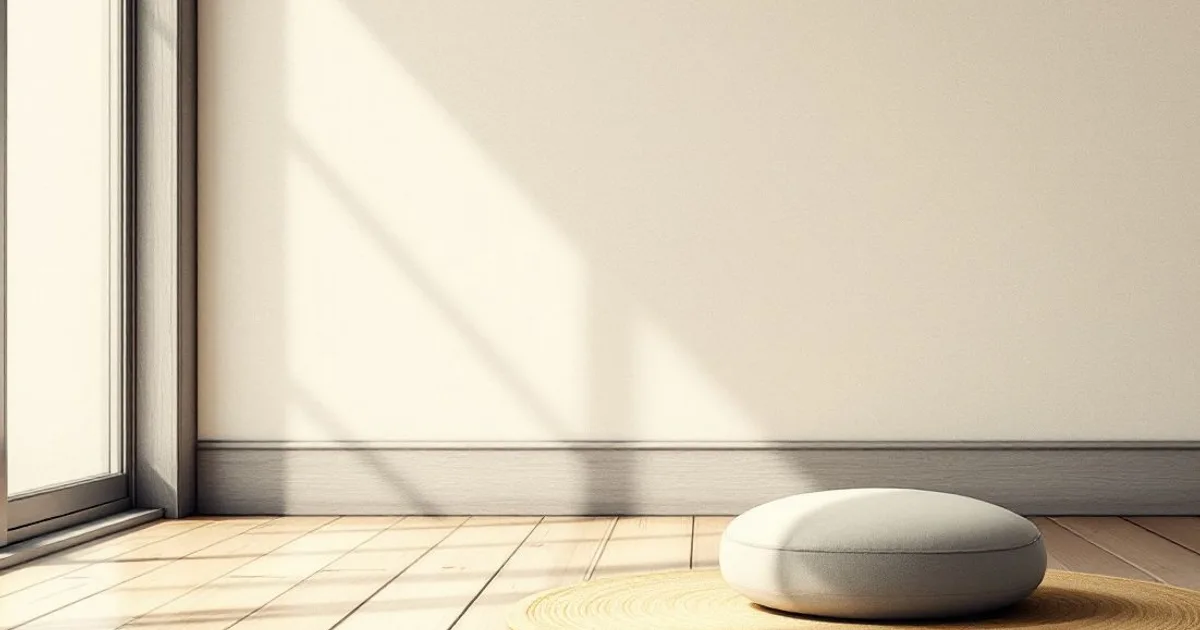
A home meditation space needs three things: a quiet spot you keep for sitting, something stable to sit on, and a way to keep time without watching the clock. A shrine is optional, a dedicated room is not required, and nothing has to be bought. Ṭhānissaro Bhikkhu, a monk of the Thai Forest tradition, says meditation can be done “in any situation and in any posture”, but that a beginner is wise to look for “a minimum of disturbance”.
This guide covers the place itself. The shrine has its own guide, the Buddhist altar, as does the seat, meditation posture; for the wider practice, see our guide to Buddhist meditation.
Do you need a special room?
No. The early discourses set sitting meditation somewhere about as unfurnished as a place can be. In the Ānāpānassati Sutta, the Buddha describes a practitioner “gone to a wilderness, or to the root of a tree, or to an empty hut” who “sits down cross-legged, sets their body straight, and brings mindfulness to the present” (MN 118:17.1, trans. Bhikkhu Sujato). The Satipaṭṭhāna Sutta opens its breathing practice with the same words (MN 10:4.2). The person addressed is a mendicant, a monastic.
Ṭhānissaro Bhikkhu carries the point into ordinary life: the Buddha, he writes, “advised monks to go into the wilderness, and to create a wilderness state of mind even when living in society.” That is his reading, not a line of the canon.
Nor does the canon tie a lay person’s practice to a special place: the householder Mahānāma is told to develop the recollection of the Buddha, one of the recollections, “while working, and while at home with your children” (AN 11.12:4.7, trans. Bhikkhu Sujato), a contrast with the monastic instruction that why Buddhists meditate sets out.
In Sōtō Zen, Dōgen’s Fukan Zazengi, which the Sōtō school publishes in English on its official site, asks no more of the room than this: “For practicing Zen, a quiet room is suitable.” Our step-by-step guide to meditating says the same in modern terms: a corner of an ordinary room is enough.
What the early texts valued in a place
One discourse does list what makes a dwelling good for practice. In the Senāsana Sutta, “Lodgings”, the Buddha names five factors of a suitable lodging:
It’s when a lodging is neither too far nor too near, but convenient for coming and going. It’s not bothered by people by day, and at night it’s quiet and still. There’s little disturbance from flies, mosquitoes, wind, sun, and reptiles. While staying in that lodging the necessities of life—robes, almsfood, lodgings, and medicines and supplies for the sick—are easy to come by. And in that lodging there are several senior mendicants who are very learned, inheritors of the heritage, who have memorized the teachings, the monastic law, and the outlines.
This is a monk’s lodging, paired in the discourse with five qualities of the meditator: faith, good health, honesty, energy and wisdom. The first three factors concern the place itself (its distance, its quiet, its freedom from insects and weather), and a home can often supply the second and third. What it cannot supply is the fifth: senior monks to go to and ask, “Why, sir, does it say this? What does that mean?” (AN 10.11:3.8). A corner at home does not replace a teacher, a sangha or an occasional retreat; it sits alongside them.
Choosing the spot
Teachers from different traditions mostly agree.
- Quiet, and kept for sitting. Ṭhānissaro: “Choose a quiet spot, in your home or outside”, ideally one “you don’t normally use for other purposes”, and sit there only to meditate. “You’ll begin to develop quiet associations with that spot,” he writes; that is a teacher’s experience, not a research finding. Keep the area around it neat and clean.
- Neither too dark nor too bright. The official instructions of the Sōtō Zen school, Sōtōshū, ask for a place “neither too dark nor too bright, warm in the winter and cool in the summer”, adding that “The sitting place should be neat and clean.”
- Permanent, if you can manage it. Still Mind Zendo, a New York Zen centre in the lineage of Taizan Maezumi Roshi and the White Plum Asanga, advises: “If possible, keep your sitting area permanent.”
- Facing a wall, if you sit Sōtō zazen. Sōtōshū places the mat “in front of the wall” (see zazen). That is one school’s form, not a rule for all Buddhism; none of the teachers quoted here prescribes a compass direction.
- Approached without hurry. Still Mind again: “Never rush to your meditation place.”
- Room to walk, if you practise walking meditation. Ṭhānissaro suggests “a level path anywhere from 20 to 70 paces long”, ideally straight, otherwise L- or U-shaped (see walking meditation).
What you actually need
Very little, and none of it needs to be bought. Ṭhānissaro’s wider advice on frugality is to “restrict your purchases to things that really are useful”, and a meditation corner is a good place to start. Decor guides often add colour schemes, plants, diffusers, salt lamps and crystals; none of the teachers quoted here asks for any of them, and the place they describe is quiet, neat and clean.
Something to sit on. A cushion, a kneeling bench or an ordinary chair; our meditation posture guide covers each.
A way to keep time. Ṭhānissaro says to turn off your phone and other devices, use a timer, and once it is set “put it behind you or off to your side” so the sit does not become clock-watching. Our meditation timer rings a bell at the end; if you use it, silence notifications first and set the screen out of sight.
A bell or a chant, if you like. Thich Nhat Hanh’s Breathing Room has a little bell in it; our virtual singing bowl can stand in for one. Ṭhānissaro suggests chanting before you sit “To foster a sense of seclusion”, in an Asian Buddhist language, your own, or both (see Buddhist chanting).
If you want a shrine
A shrine is a support, not a requirement; what goes on one, and how the traditions differ, is covered in our guide to setting up a Buddhist altar. The sitting-place guidance adds two notes. Sōtōshū says that “If possible, a statue of Manjushri Bodhisattva should be enshrined in the room”, otherwise “any statue or painting of a Buddha or a Bodhisattva is fine”, with flowers and incense “when possible” (see Mañjuśrī). Still Mind says you “can set up a small altar with candle, flowers, incense and even a buddha if you wish.” Both are conditional.
Candles and incense, safely
Fire services’ advice applies directly to a shrine corner:
- Never leave a flame unattended. The London Fire Brigade’s guidance covers “candles, incense sticks and oil burners”, including diya lamps used in worship: put them out when you leave the room and especially before bed. The same goes for butter lamps.
- Holders and clearance. Heat-resistant holders on a stable surface, away from curtains, papers, furniture and clothes (London Fire Brigade); at least 12 inches from anything that burns (U.S. Fire Administration). Tea lights get very hot.
- Children and pets. Keep candles, matches and lighters out of their reach (London Fire Brigade).
- No lit candles where you sleep. The U.S. Fire Administration says: “Don’t use lit candles in bedrooms, bathrooms and sleeping areas.” A bedroom corner is fine for sitting; keep it unlit, or use a flameless candle, which the London Fire Brigade calls “a much safer alternative”.
- Fully out, however you do it. The U.S. Fire Administration says to blow candles out, while temple etiquette in much of Asia, described in our guide to Buddhist incense, is not to blow on an offering but to wave or fan it out. What matters for safety is that the flame is completely out.
- Ventilate. A 2008 review of incense smoke and airway disease advises, to reduce exposure to its pollutants, keeping “the room well ventilated when burning incense”, while noting conflicting reports and that more and better-controlled studies are needed.
Small homes and shared homes
Thich Nhat Hanh, in a passage from his book Happiness reprinted by Deer Park Monastery, asks for “a room called the Breathing Room, or at least a corner of a room reserved for this purpose.” A corner is enough.
In a bedroom, mind the timing as well as the flame. Ṭhānissaro says right before sleep “is not the best time to meditate”, since you come to associate meditation with sleep; if you have trouble sleeping he allows meditating in bed, as long as your regular sit is at another time (see mindfulness for sleep).
If you share a home, tell the people you live with. Ṭhānissaro suggests asking not to be disturbed “unless there’s a serious emergency”, and gives a reason they may accept: “You’re taking some time out to be an easier person to live with.” Where a room is shared, agree the time in advance, much as Thich Nhat Hanh asks a family to agree on the Breathing Room practice before it is needed.
If your home is never fully quiet, Ṭhānissaro’s chapter on external noises turns the complaint around: the noise, he says, is not bothering you; “You’re bothering the noise.” He suggests treating the body like a window screen that sound passes through as wind does. That is a teacher’s advice about attention, not about soundproofing; rugs, curtains or white noise are a matter of preference, and none of the teachers quoted here asks for them.
Children and pets
Ṭhānissaro’s advice: if you are the only adult at home with young children, “for whom everything is a serious emergency”, sit while they are asleep. Tell older children how long you will be and that you need privacy; if they interrupt over a non-emergency, say quietly that you are still meditating. If they want to sit with you, welcome them, with a few rules so they do not disturb the quiet. For children’s own practice, see mindfulness for kids.
Thich Nhat Hanh’s Breathing Room is above all a family practice: whoever feels uneasy, sad or angry goes there, invites the bell and breathes, and the family agrees to this in advance, at a time when everyone is happy. He offers it even to a child frightened by a parent’s anger. Our own caution: a breathing practice is a way for a family to pause, not an answer where anyone at home is afraid or being hurt; that needs help from outside the family. (See when a child needs more than practice, and Buddhist parenting.)
For a dog, Ṭhānissaro’s advice is to shut it in another room; if it whines and scratches, let it in but stay strictly unresponsive. In his experience most dogs get the message “after a few days”; if one does not, put it back out. An attention-starved cat gets the same treatment.
Keeping the place in use
A place does its work by being used regularly. Habit research in health psychology, not meditation research, points the same way. Gardner, Lally and Wardle (2012) report that “mere repetition of a simple action in a consistent context” makes an action automatic, and advise choosing “a time and place that you encounter every day of the week.” In one study they cite, automaticity levelled off after an average of 66 days, with “considerable variation across participants and behaviours”, and missing the occasional opportunity “did not seriously impair the habit formation process”.
On timing, Ṭhānissaro finds early morning, after you have woken and washed your face, often best, with the evening another good time, but not straight after a large meal. Still Mind suggests sitting soon after getting up, before news, TV or computer, at about the same time each morning: “If you miss a day, come back the next day.”
On how long to sit at first, the advice ranges: Ṭhānissaro says “twenty minutes is usually about right”; Still Mind suggests 5–10 minutes for a beginner, slowly extended to 25, though it says starting at 20–25 is fine too. How long to meditate has the fuller picture; the meditation journal, a Buddhist morning routine and common meditation problems help keep the rhythm.
How the traditions shape the space
| Tradition and source | The place | Shrine and facing | Before you sit |
|---|---|---|---|
| Thai Forest: Ṭhānissaro Bhikkhu, With Each & Every Breath | A quiet spot at home or outside, used only for meditation, neat and clean | Not addressed in his setting-up instructions | Devices off, timer out of sight; chanting if it helps |
| Sōtō Zen: Sōtōshū, “How to do Zazen” | Quiet, neither too dark nor too bright, warm in winter and cool in summer, neat and clean | Mat in front of the wall; Manjushri or any Buddha image if possible | Enough sleep, a moderate meal, no alcohol |
| Plum Village: Thich Nhat Hanh, the Breathing Room | A room, or at least a corner, for the whole family | A low table with a flower and a little bell; cushions for everyone | The family agrees on it in advance |
| White Plum Zen: Still Mind Zendo, New York | Permanent if possible | A small altar if you wish | Sit in the morning; never rush to the seat |
We have not found a Tibetan school’s own published guidance on the sitting place as distinct from the shrine, so the table does not invent one; the Tibetan shrine is in our altar guide. What the four share is plain: somewhere quiet and clean, kept for the purpose, and used often.
Frequently asked questions
Do I need a dedicated room to meditate at home?
No. A corner of an ordinary room is enough. The early discourses picture a monk sitting at the root of a tree or in an empty hut, and Thich Nhat Hanh asks for a room or at least a corner. What Ṭhānissaro Bhikkhu and the Zen sources drawn on here recommend is a quiet spot kept for sitting, neat and clean, and if possible left set up.
Can I meditate in my bedroom?
Yes. A bedroom corner is a perfectly good place to sit. Two cautions: fire services advise against lit candles in bedrooms and sleeping areas, so keep that corner unlit or use a flameless candle; and Ṭhānissaro Bhikkhu suggests not making the last thing before sleep your main daily sit, so that you do not come to associate meditation with dozing off.
Which direction should I face when I meditate?
None of the teachers drawn on here prescribes a compass direction. Sōtō Zen places the mat in front of a wall, so its practitioners face the wall; that is one school's form, not a rule for all Buddhism. If you keep a shrine, where to place it is covered in our altar guide.
Is it safe to burn candles or incense while meditating?
Yes, with ordinary fire care. Use heat-resistant holders on a stable surface, keep flames at least 12 inches from anything that burns, keep matches away from children and pets, ventilate when burning incense (a review of incense smoke advises this to reduce exposure to its pollutants, though health studies conflict), and never leave a flame unattended; put it fully out before you leave or sleep. A flameless candle is safer, especially in a bedroom.
How do I meditate at home with kids or pets?
Pick your time around them. Ṭhānissaro Bhikkhu suggests sitting while young children sleep, telling older ones how long you will be and that you need privacy, and welcoming them to join with a few rules. Put a dog in another room; if it whines, let it in but do not respond to it. In his experience most dogs settle within a few days.
What colour should a meditation room be?
Whatever keeps the corner calm and uncluttered for you. None of the Buddhist teachers or schools this guide draws on prescribes a colour. Sōtō Zen's instructions ask only that the place be neither too dark nor too bright, warm in winter and cool in summer, and neat and clean.
Sources
- Ānāpānassati Sutta, 'Mindfulness of Breathing' (MN 118), SuttaCentral, trans. Bhikkhu Sujato (CC0) — 'gone to a wilderness, or to the root of a tree, or to an empty hut' (17.1)
- Satipaṭṭhāna Sutta, 'Mindfulness Meditation' (MN 10), SuttaCentral, trans. Bhikkhu Sujato (CC0) — the same place formula opening the breathing section (4.2)
- Senāsana Sutta, 'Lodgings' (AN 10.11), SuttaCentral, trans. Bhikkhu Sujato (CC0) — the five factors of a suitable lodging, alongside the five factors of the meditator
- 'With Mahānāma (2nd)' (AN 11.12), SuttaCentral, trans. Bhikkhu Sujato (CC0) — the recollection of the Buddha developed 'while working, and while at home with your children' (4.7)
- Ṭhānissaro Bhikkhu, With Each & Every Breath (2013), Part One, 'Getting Ready to Meditate: Your Physical Situation', dhammatalks.org (CC BY-NC 4.0) — where and when to sit, session length, housemates, children, devices, timer, pets, and the walking path
- Ṭhānissaro Bhikkhu, With Each & Every Breath (2013), 'Common Problems: External Noises', dhammatalks.org (CC BY-NC 4.0) — 'You’re bothering the noise'; the body as a window screen
- Ṭhānissaro Bhikkhu, With Each & Every Breath (2013), 'Meditation in Daily Life: Your Surroundings' (Frugality; Seclusion), dhammatalks.org (CC BY-NC 4.0) — restricting purchases to what is useful, chanting before meditation, and a 'wilderness state of mind'
- 'How to do Zazen', Sōtōshū (Sōtō Zen school) official English site, SOTOZEN.COM — the place: quiet, neither too dark nor too bright, warm in winter and cool in summer, neat and clean; an image and offerings if possible; the mat placed in front of the wall
- Dōgen, Fukan Zazengi (Universally Recommended Instructions for Zazen), official English text, SOTOZEN.COM (no translator credited) — 'For practicing Zen, a quiet room is suitable'
- Thich Nhat Hanh, the Breathing Room (passage from Happiness), reprinted in 'Deepen Your Practice: The Breathing Room', Deer Park Monastery journal (Deer Park Editors, 23 January 2025)
- 'Home Practice', Still Mind Zendo, New York — a permanent sitting area, an optional small altar, the seat, timing and preparation
- 'About Still Mind Zendo', Still Mind Zendo — formed in 1994, in the lineage of Taizan Maezumi Roshi and the White Plum Asanga
- 'Candles', London Fire Brigade, Fire safety at home — candles, incense sticks, oil burners and worship lamps never left unattended; holders, clearances, children and pets; flameless LED candles
- 'Candle Fire Safety', U.S. Fire Administration (FEMA) — flameless candles, 12-inch clearance, out before leaving a room or going to bed, no lit candles in bedrooms and sleeping areas
- Gardner B, Lally P, Wardle J. 'Making health habitual: the psychology of “habit-formation” and general practice.' British Journal of General Practice, 2012;62(605):664–666 (PMC) — health-behaviour habits, not meditation
- Lin T-C, Krishnaswamy G, Chi DS. 'Incense smoke: clinical, structural and molecular effects on airway disease.' Clinical and Molecular Allergy, 2008;6:3 (PMC, CC BY) — ventilation advice and the call for better-controlled studies