“The Present Moment Is Filled With Joy” — Thich Nhat Hanh
We tend to treat happiness as something ahead of us — after the next achievement, once things settle down. The Zen master Thich Nhat Hanh gently disagrees: the joy is already here, in this very moment; what we usually lack is not the happiness but the attention to notice it. Here is the line, its meaning, and its source.
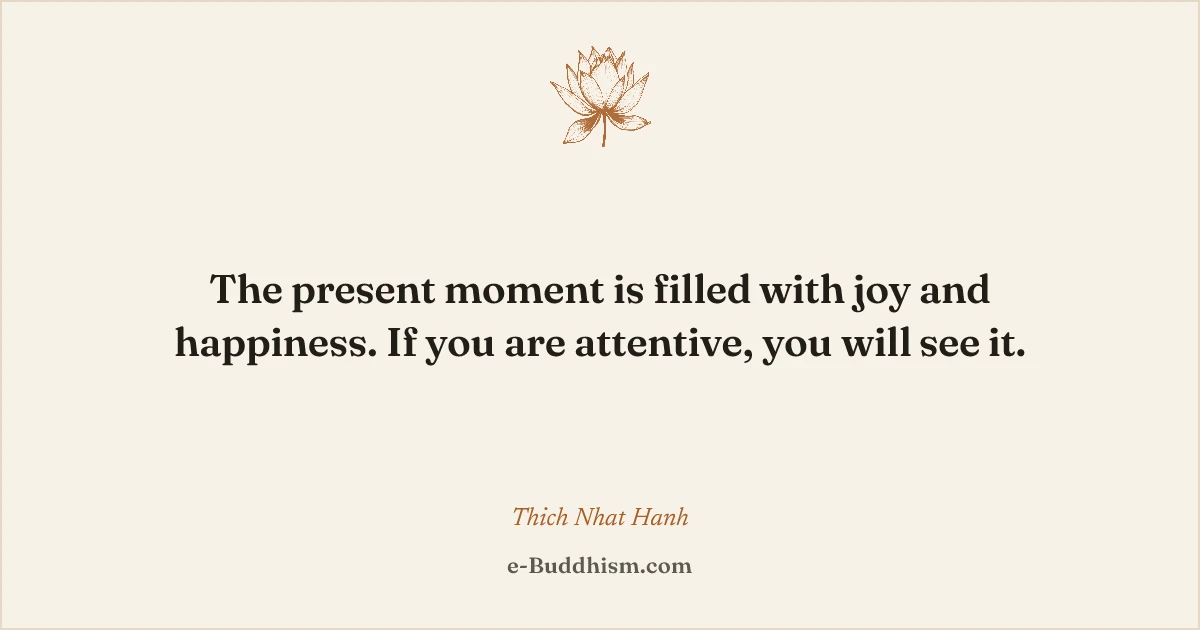
“The present moment is filled with joy and happiness. If you are attentive, you will see it.” — Thich Nhat Hanh, Peace Is Every Step (1991)
What ‘the present moment is filled with joy’ means
The sentence has two halves, and the second is the key. The first makes a claim that can sound naïve — the present moment is filled with joy — until you read the condition: “if you are attentive.” The joy is not guaranteed to be felt; it is there to be seen, and seeing it depends on us.
This is not a denial of suffering. Thich Nhat Hanh, who lived through war and exile, was the last person to pretend life is all sweetness. His point is subtler: alongside whatever is hard, the present is also quietly full of small, real goods we rush straight past — a clear breath, the warmth of a cup, the face of someone we love, the plain astonishment of being alive at all. The habit of always leaning into the next moment makes us blind to the sufficiency of this one.
So the teaching is really an invitation to a kind of attention. Happiness, in this view, is less something to manufacture than something to uncover — and the tool for uncovering it is simply mindfulness: coming back, again and again, to what is actually here.
Where ‘the present moment is filled with joy’ comes from
The line is from Peace Is Every Step: The Path of Mindfulness in Everyday Life (Bantam, 1991), one of Thich Nhat Hanh’s best-loved books. We attribute it to him, not to the Buddha — though it grows straight from the Buddhist practice of mindfulness. For the Buddha’s own words on the present moment, see the Bhaddekaratta Sutta (MN 131).
Why ‘the present moment is filled with joy’ matters
This is the heart of bringing practice off the cushion and into ordinary life — the project of practical Buddhism. It pairs naturally with his breathing gāthā, a simple way to return to the present moment the quote points to.
Browse more sourced lines in our Buddha quotes collection.
Frequently asked questions
What does this Thich Nhat Hanh quote mean?
That happiness is not waiting somewhere in the future or hidden in some special experience — it is already present, woven through ordinary life, right now. What we lack is usually not the joy but the attention. 'If you are attentive, you will see it': mindfulness is simply the willingness to notice what is already here.
Is it really true that the present moment is joyful?
Yes, with attention. Thich Nhat Hanh is not denying pain or pretending everything is wonderful; the quote's key half is 'if you are attentive.' His point is that alongside whatever is difficult, there are countless small, real goods we routinely overlook: a breath, warmth, a friend's face, the fact of being alive. The habit of always reaching for the next moment blinds us to the sufficiency of this one.
Who said it and where?
The Vietnamese Zen master Thich Nhat Hanh, in his 1991 book Peace Is Every Step. We cite it as his words — they grow from the Buddhist practice of mindfulness, but the phrasing is his.
Sources
- Thich Nhat Hanh, Peace Is Every Step: The Path of Mindfulness in Everyday Life (Bantam, 1991).