Why Are Buddhist Robes Orange?
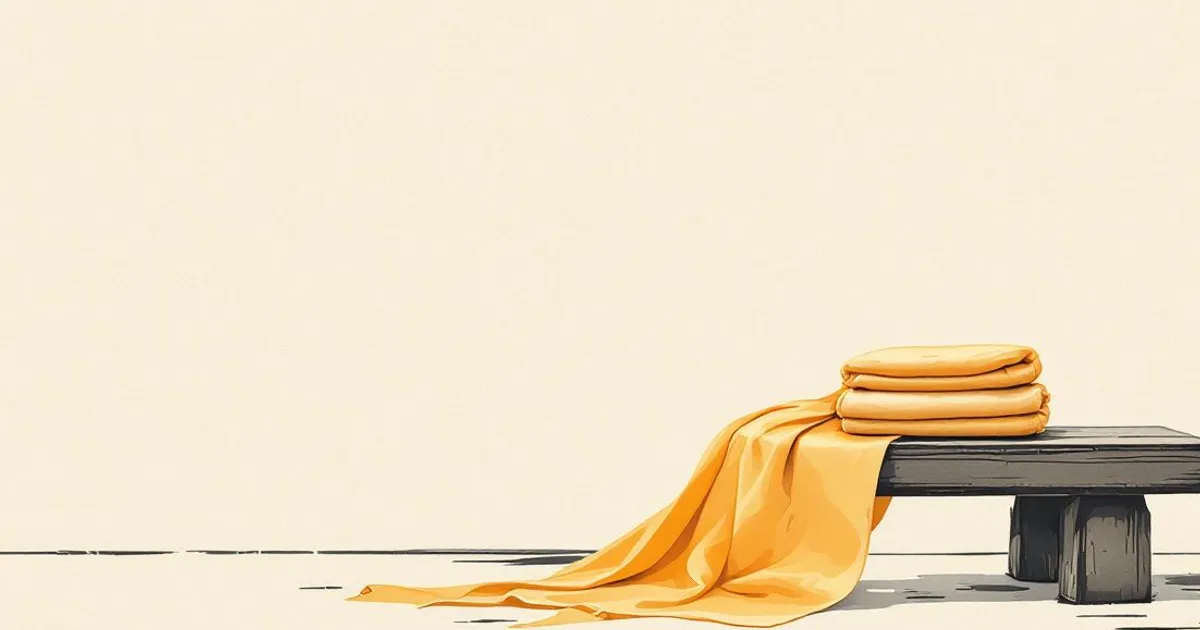
Why are Buddhist robes orange? Because of practicality, not preference. The famous saffron colour began with the earliest monks’ rag-robes — cloth pieced together from what others had thrown away — dyed with whatever cheap natural materials were at hand. Boiled bark, roots, leaves, and spices turned the cloth shades of yellow-orange and ochre, and the colour stuck.
It was never chosen for beauty; it was simply free and available. And, as we’ll see, it isn’t even universal — a small, surprising thread in the story of Buddhist culture.
Robes from rags
To understand the colour, start with the cloth. The monastic ideal was the paṃsukūla, the “rag-robe”: a robe made from discarded fabric — cloth others had cast off, even shroud-cloth from cremation grounds — gathered, washed, cut into rectangular pieces, and stitched back together. A robe made from what no one else wanted was a perfect emblem of the monk’s renunciation of wealth and vanity. This patchwork origin is why traditional robes are still sewn in a grid of panels — and the field-pattern comparison is not a later poetic gloss but the canon’s own account of where the design came from. Wandering on from Rājagaha toward the southern hills, the Buddha looked out over the fields of Magadha and turned to Ānanda:
He saw the fields of Magadha laid out in rectangles defined by long and short boundaries and their intersections. He said to Venerable Ānanda, “Ānanda, have a look at these fields.” “Yes, sir.” “Are you able to make this kind of robe for the monks?” “I am.”
Ānanda then made robes for a number of monks, and the Buddha’s praise names the reason for cutting cloth up and sewing it back together: the robe “will be made of pieces, making it worthless, appropriate for monastics, and undesirable for one’s enemies” (Kd 8:12.2.3). A garment worth taking is a serious problem for someone who owns nothing else. The patches are not decoration — the reason the text itself gives is that the finished robe should be worthless and wanted by nobody.
The colour came from cheap dyes
The dye followed the same logic of making do. The Vinaya (the monastic code) permitted dyes drawn from common, freely gathered natural sources — roots and tubers, plants, bark, leaves, flowers, and fruits — boiled in water to produce a dull, earthy colour. The allowance arrives, as Vinaya allowances usually do, after something had gone wrong: the monks were dyeing with whatever lay nearest to hand, and the results were not presentable.
At that time the monks dyed the robes even with dung and beige clay. The robes were discolored. … “I allow you to use six kinds of dye: dye from roots, dye from wood, dye from bark, dye from leaves, dye from flowers, and dye from fruit.”
Six kinds of dye — and not one of them is a colour. That is the whole character of the rule: it licenses materials, cheap ones a wandering monk could gather and boil, and lets the resulting shade fall where it falls. The chapter then carries on in the same domestic key, one mishap at a time. The monks dye in cold water and the robes come out smelly, so a dye-pot is allowed “to boil the dye” (Kd 8:10.2.4); a dye-ladle follows (10.3.4), and a dyeing trough (10.3.11) after robes kneaded in basins and bowls tore. Drying gets the same treatment — “a bamboo robe rack and a clothesline” (11.1.7) — and then, once the dye has run down one edge, the method: “You should dye them by repeatedly turning them over, and you shouldn’t leave while they’re still dripping” (11.1.17).
The most enduring source is the heartwood of the jackfruit tree, which yields a rich ochre; other plants and spices (turmeric among them) give warmer yellows and oranges. The point is that the colour was a by-product of what was cheaply available, not an aesthetic decision. Forest monks tend toward the darker ochre, town monks toward brighter saffron — but both colours are simply what the local dye-stuff produced.
The colour rule is a list of bans
Most accounts leave out the part that actually answers the question. The code never says wear orange. It says, at some length, what a monk may not wear — and the banned list includes both yellow and orange. The rule follows the group-of-six monks, the small band whose misbehaviour occasions so much of the code, turning up in every bright shade available, and in turbans (Kd 8:29.1.1–29.1.14):
“You shouldn’t wear entirely blue robes, entirely yellow robes, entirely red robes, entirely magenta robes, entirely black robes, entirely orange robes, entirely beige robes … If you do, you commit an offense of wrong conduct.”
The load-bearing word is entirely — the Pali reads sabbanīlakāni, sabbapītakāni, sabbamahāraṅgarattāni, each built on sabba-, “whole, all of it”. What is forbidden is a robe dyed wholly in one of those colours. That, with the staining rule below, is part of why the shade monks actually wear is so hard to name in English — saffron, ochre, mustard, rust, dun, turmeric.
The rule called “making a bad colour”
One further rule makes the logic unmistakable, and its Pali title says it outright: Dubbaṇṇakaraṇasikkhāpada, the training rule on making a bad colour. It is the fifty-eighth of the offences a monk must confess, and its origin story is a robbery: monks and wanderers travelling from Sāketa to Sāvatthī were robbed; the king’s men caught the thieves with the loot and sent word to the monks to “come and pick out your own robes” — and “the monks did not recognize them” (Bu Pc 58:1.2–1.5). The rule that followed does two jobs at once. It spoils the colour, and it makes a robe identifiable.
‘When a monk gets a new robe, he should apply one of three kinds of stains: blue-green, mud-color, or dark brown. If a monk uses a new robe without applying any of the three kinds of stains, he commits an offense entailing confession.’
The mark may be minute — the analysis allows “even if he just applies what fits on the tip of a blade of grass” — and the same analysis defines a new robe precisely as one where “a mark has not been made” (Pali akatakappa, Bu Pc 58:2.1.2). A robe, in other words, becomes wearable by being deliberately spoiled. The scholar Ann Heirman, surveying how the surviving monastic codes handle dyeing, sums up the shared instinct: the colour of monastic robes “should always be rather ‘bad’, and certainly never perfect” — though, as she notes from the Dharmaguptaka Vinaya, a colour should never be so bad as to be unacceptable to the lay community, and a faded robe should be re-dyed (p. 477).
So the honest answer to why orange is that orange was never the aim. The colour is what is left once the rules have subtracted every handsome option and sent you back to boiling bark.
Not orange everywhere
Here is the fact that surprises most people: Buddhist robes are not orange everywhere. The saffron-and-ochre we picture is really the colour of Theravāda monasticism across Sri Lanka and Southeast Asia. Elsewhere:
- Tibetan (Vajrayāna) monastics wear dark red / maroon.
- Chinese, Korean, and Japanese Buddhists — including Zen — often wear muted colours: grey, black, or brown.
The differences reflect local dyes, climates, and histories — and one thing more, which is easy to miss: the living ordination traditions do not all follow the same monastic code. Setting out the legal background to ordination, Bhikkhu Anālayo notes that Chinese, Korean and Vietnamese monastics are ordained in the Dharmaguptaka tradition and Tibetan monastics in the Mūlasarvāstivāda tradition, while it is “close adherence to the rules found in the Pāli Vinaya” that lets bhikkhus from Myanmar, Sri Lanka and Thailand act as a single legal community. Each of those codes carries its own version of the make it a bad colour rule — and, as Ann Heirman’s survey of the texts sets out (p. 476), the three permitted stain-colours are not the same in each:
| Tradition | The code it ordains under | Its three permitted stain-colours | The robes you actually see |
|---|---|---|---|
| Theravāda — Sri Lanka and Southeast Asia | Pāli Vinaya | nīla, a kind of dark green or dark blue; kaddama, mud colour; kāḷasāma, black | saffron through to dark ochre |
| East Asia — China, Korea, Vietnam | Dharmaguptaka Vinaya | dark blue-green, black, magnolia | grey, black, brown |
| Tibetan and Himalayan world | Mūlasarvāstivāda Vinaya | blue-green, mud colour, a kind of red | dark red to maroon |
These are lists of deliberate spoiling-marks, not colour charts for the finished robe. None of the three codes prescribes the shade a monk actually wears, and even the renderings are uncertain — Brahmali gives the third Pali colour as “dark brown” where Heirman gives “black”, and kāḷasāma sits somewhere between. Local dye-plants, climate and long custom did their own work. But the table is a useful corrective to the assumption that one tradition kept the true colour and the others drifted. Each is dyeing inside its own rule.
So “Buddhist monks wear orange” is true of one great branch of the tradition, and quietly wrong about the others.
The whole wardrobe of a monk
It helps to remember how few clothes a monastic owns. The robe is not one outfit among many but essentially the entire wardrobe — received at ordination, worn every day, mended rather than replaced, and treated as a bare requisite rather than a possession to enjoy. This is the deeper reason the colour was never a fashion choice: a renunciant is not meant to be choosing clothes at all, only accepting a plain, uniform garment that removes the whole question of appearance. The dull ochre or maroon is, in that light, the perfect colour — precisely because no one would pick it to look good.
What the robe means
Whatever its colour, the robe carries the same meaning: renunciation, simplicity, and humility. A garment made from cast-off cloth and coloured with common dye is a statement worn on the body — of a life that has set down finery, status, and the endless project of looking good. Traditionally the ochre is also likened, poetically, to flame and to the “banner” of the awakened, though these are devotional images rather than the historical reason for the colour. And the robe is deliberately spare: a monastic owns a “triple robe” (the lower robe, upper robe, and outer cloak) as part of a handful of permitted possessions — the whole wardrobe of a life unburdened by things. (For the life it clothes, see the life of a Buddhist monk.)
Frequently asked questions
Why are Buddhist robes orange?
The saffron-orange colour came from practicality, not preference. The earliest monastic robes were made from discarded 'rag' cloth and dyed with whatever cheap natural materials were available — bark, roots, leaves, and spices — which produced yellow-orange and ochre shades. The colour was simply what was free and to hand, and it became traditional. It also carries associations of renunciation and simplicity.
Are all Buddhist robes orange?
No. Orange and saffron are typical of Theravāda Buddhism in South and Southeast Asia, but the colour varies by tradition. Tibetan (Vajrayāna) monastics wear dark red or maroon; Chinese, Korean, and Japanese Buddhists (including Zen) often wear muted colours — grey, black, or brown. So 'Buddhist robes are orange' is really only true of one branch of the tradition.
What were the first Buddhist robes made of?
Cast-off cloth. The ideal was the paṃsukūla or 'rag-robe' — cloth that others had discarded, even shroud-cloth, gathered, washed, sewn together in patches, and dyed. This expressed the monk's renunciation of wealth and vanity: a robe made from what no one else wanted. The dye was likewise made from cheap, available plant materials, which is where the ochre colour comes from.
Does the Vinaya say Buddhist robes must be orange?
No. The Pali code never orders a monk to wear orange — it bans it. It permits six kinds of dye-stuff (roots, wood, bark, leaves, flowers, fruit), then forbids robes that are entirely blue, yellow, red, magenta, black, orange or beige. What is banned is a robe dyed wholly in one of those colours. A separate rule, titled making a bad colour, has every new robe stained blue-green, mud-colour or dark brown first.
Why are Buddhist robes sewn from patches?
Because a robe cut up and stitched back together is worth almost nothing to anyone else. The Vinaya has the Buddha look out over the rectangular fields of Magadha and ask Ānanda to make robes on that pattern. Ānanda did, and the Buddha's praise gives the reason: the robe will be made of pieces, making it worthless, appropriate for monastics, and undesirable for one's enemies.
What do the Buddhist robes symbolise?
Renunciation, simplicity, and humility above all — a robe pieced from discarded cloth and coloured with common dye is a walking statement of having let go of status and finery. Traditionally the ochre colour is also likened poetically to flame and to the 'banner' of the awakened. The set itself — the 'triple robe' — is one of a monastic's few permitted possessions, part of a deliberately spare, unencumbered life.
Sources
- The original rag-robes (paṃsukūla) made from discarded cloth; the Vinaya's permitted natural dye sources — roots and tubers, plants, bark, leaves, flowers, and fruits — boiled to produce the characteristic dun/ochre colour; BuddhaNet, 'The Monastic Robes'
- Saffron and ochre (the latter from jackfruit heartwood) as the prevalent colours today; the triple robe (ticīvara: antaravāsaka, uttarāsaṅga, saṅghāṭi); Wikipedia, 'Kāṣāya (clothing)'
- Regional colour variation — Theravāda saffron/ochre; Tibetan/Vajrayāna dark red (maroon); East Asian (Chinese, Korean, Japanese/Zen) often muted grey, black, or brown
- Theravāda Collection on Monastic Law, The Great Division, Kd 8 (Cīvarakkhandhaka, the chapter on robes) — the six permitted dyes ('dye from roots, dye from wood, dye from bark, dye from leaves, dye from flowers, and dye from fruit', Kd 8:10.1.4–10.1.5), the dyeing and drying equipment and method (Kd 8:10.2.4, 10.3.4, 10.3.11, 11.1.7, 11.1.17), the ban on wearing any robe that is entirely blue, yellow, red, magenta, black, orange or beige (Kd 8:29.1.18–29.1.19), the fields of Magadha as the pattern for the patched robe (Kd 8:12.1.2–12.1.6), and the robe 'made of pieces, making it worthless, appropriate for monastics, and undesirable for one's enemies' (Kd 8:12.2.3), SuttaCentral (trans. Bhikkhu Brahmali, CC0)
- Theravāda Collection on Monastic Law, The Great Analysis, Bu Pc 58 (Dubbaṇṇakaraṇasikkhāpada, 'Not making stains on a new robe') — the robbery that occasions the rule (Bu Pc 58:1.2–1.5), the ruling that a new robe be stained blue-green, mud-colour or dark brown before use (1.15.1), the tip-of-a-blade-of-grass minimum (2.1.6), and 'new' defined as akatakappa, a mark has not been made (2.1.2), SuttaCentral (trans. Bhikkhu Brahmali, CC0)
- Ann Heirman, 'Washing and Dyeing Buddhist Monastic Robes', Acta Orientalia Academiae Scientiarum Hungaricae 67/4 (2014), pp. 467–488, DOI 10.1556/AOrient.67.2014.4.5 — the three permissible colours each surviving vinaya lists, Pāli, Dharmaguptaka and Mūlasarvāstivāda among them (p. 476), and the principle that a robe's colour should always be rather bad and certainly never perfect, yet, the Dharmaguptaka Vinaya adds, never so bad as to be unacceptable to the lay community (p. 477)
- Bhikkhu Anālayo, 'Theravāda Vinaya and bhikkhunī Ordination', in Rules of Engagement: Medieval Traditions of Buddhist Monastic Regulations, ed. S. Andrews, J. Chen and C. Liu (Bochum: Projekt Verlag, 2017), pp. 333–367 — which monastic code each living ordination tradition follows: Chinese, Korean and Vietnamese monastics the Dharmaguptaka, Tibetan monastics the Mūlasarvāstivāda (p. 343), and bhikkhus of Myanmar, Sri Lanka and Thailand the Pāli Vinaya (p. 341)