Tibetan Monks: Monastic Life in Tibetan Buddhism
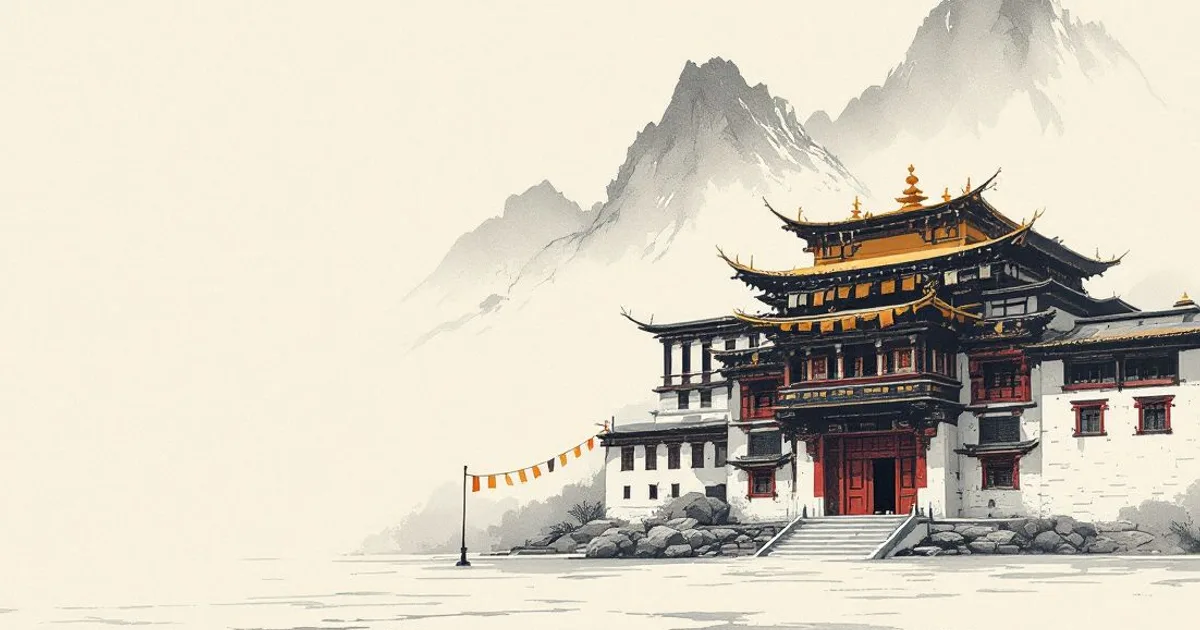
Tibetan monks are the ordained, celibate monastics of Tibetan Buddhism’s four main schools, living in Tibet, India, Nepal, Bhutan, Mongolia and beyond. They keep the Mūlasarvāstivāda Vinaya, first as novices (getsul) and then, not before the age of twenty, as fully ordained monks (gelong), with 253 rules by one standard count. Their days are built around memorising texts, prayer assemblies and ritual, and, above all in the Gelug colleges, years of formal debate.
Who are Tibetan monks?
The everyday Tibetan word for a monk is drapa (grwa pa), which the Rangjung Yeshe dictionary glosses as “monk, ordained person” and also “student”. Monks belong to all four main schools, and Tibetan Buddhism is practised, in the Rubin Museum’s summary, “in Tibet, Mongolia, Bhutan, Ladakh, and among certain groups in Nepal, China, and Russia” (see Bhutan and Mongolia).
Not every Tibetan religious specialist is a monk. In a 2018 lecture abstract, the scholar Georgios Halkias distinguishes a “red sangha” of celibate monks and nuns “who wear the maroon robes” from a “white sangha” of lay, usually non-celibate tantric practitioners, ngakpa (sngags pa), in white cloth with uncut, braided hair; he describes the Nyingma ngakpas of Rebkong in Amdo as well known for being the largest community of householder tantric practitioners. Nicolas Sihlé adds that ngakpas are usually heads of households, farmers or ranchers, often following the path from father to son.
Monks, lamas and tulkus
A monk is not automatically a lama. The Rubin Museum defines lama as “a term of respect for a high monk or religious teacher, often a monastery abbot or a tulku,” and in some traditions, such as the Kagyu, someone who has finished a three-year retreat (see Buddhist retreat). A tulku, in the Rubin Museum’s words, is “a lineage of reincarnated lamas”: when one dies, monks and close disciples search for a child recognised as the new incarnation (see lama); the best known is the Dalai Lama.
Vows: novice and full ordination
Tibetan monastics follow the Mūlasarvāstivāda version of the Vinaya, with two levels. A novice is a getsul (dge tshul, Sanskrit śrāmaṇera), and a fully ordained monk is a gelong (dge slong, Sanskrit bhikṣu). 84000’s glossary gives the counts: “In the Tibetan tradition, which follows the Mūlasarvāstivāda Vinaya, a monk follows 253 rules,” a fully ordained nun 364, and a novice thirty-six, “although in other vinaya traditions novices typically follow only ten.”
Becoming a Tibetan monk
Many Tibetan monks enter as children (on why families sent sons, see why Buddhists become monks), and the Vinaya itself sets the lower age. In its “Chapter on Going Forth”, Ānanda has held back his two orphaned nephews because they are not yet fifteen; when he tells the Buddha they can throw stones to scare away crows, the Buddha answers:
In that case, Ānanda, I give my permission to allow freely the going forth of those as young as seven years old, provided they can scare away crows.
Sera Jey’s biographies of its recent abbots record ordination at five and at eight, and entry to a monastery at seven, nine and twelve. Ordination is given by a preceptor, in Tibetan khenpo (mkhan po, Sanskrit upādhyāya), an office that 84000’s translators describe as decreed by the Buddha “so that aspirants would not have to receive ordination from the Buddha in person.”
In the full ordination rite the same chapter gives, the candidate must have “reached twenty years of age” and own the three robes and a begging bowl. Tsenshap Serkong Rinpoche II writes that at Ganden Jangtse students stay novices for most of their studies and “may only take full monk (dge-slong, Skt. bhikshu) vows at the age of twenty-one.” For the steps across traditions, see how to become a monk.
Tibetan monk names
Ordination brings a new name. In Alexander Berzin’s account of the revival of the vows after Langdarma, a herdsman received a “novice name”, Gewa-rabsel, and later a “full ordination name”, Gongpa-rabsel. Sera Jey records that one of its recent abbots, given the name Lobsang Delek, “received ordained name as Ngawang Soepa” when he was ordained at seventeen. At a novice ordination at the Dalai Lama’s residence in Dharamsala on 29 September 2025, for candidates mostly from Taiwan, his office’s photographs show the ritual hair cutting and him “picking out ordination names for the novice monk and nun candidates.” (For refuge names, see Dharma names.)
Names are often built from two-syllable elements: the THL dictionary notes that Gyatso can stand alone “or often occurs as the second pair of syllables in a four syllable name”. Common elements, with meanings from the University of Virginia’s THL dictionaries:
| Name element | Tibetan spelling | Dictionary meaning |
|---|---|---|
| Tenzin | bstan ‘dzin | holder of the teachings, doctrine-holder (Rangjung Yeshe); “common name” |
| Lobsang | blo bzang | noble-minded (Rangjung Yeshe); “common personal name” (Valby) |
| Ngawang | ngag dbang | lord of speech, an epithet of Mañjuśrī; a person’s name |
| Thubten | thub bstan | the Buddha’s teachings (Rangjung Yeshe); Buddha’s teaching, Buddhism (Ives Waldo) |
| Jampa | byams pa | love; Maitreya (Hopkins); loving-kindness (Rangjung Yeshe) |
| Gyatso | rgya mtsho | ocean; a common personal name for Tibetan men |
The elements recur in well-known names: the Fifth Dalai Lama was Ngawang Lobsang Gyatso, the Thirteenth Thubten Gyatso, and the present Fourteenth is Tenzin Gyatso. The meanings describe the words, not how a teacher chooses them. Lay names share many elements: see Buddhist baby names.
A day in a Tibetan monastery
Schedules differ; Serkong Rinpoche describes Ganden Jangtse, a Gelug college in India. Monks memorise in the early mornings: they “need to memorize the five basic texts and many other smaller works and prayers,” and practise them by reciting aloud, “usually at the top of their voices.” Morning debate runs from 8:00 to 9:30; classes and study fill the day. Evening prayers on the debate ground, opening with the Praises to the Twenty-One Taras, run from 6 to 8; then they debate until 10:30 or later.
Sera Jey adds that besides study, prayers, pujas and ritual ceremonies “form one [of] the main monastic activities.” The assemblies are chanted (see Buddhist chanting), and monks build the sand mandalas described under Buddhist mandala. Compare a day in a monastery and the life of a Buddhist monk.
Do Tibetan monks eat meat? The vinaya allows it, the historian Geoffrey Barstow notes, and of the monastic rulebooks (bca’ yig) that discuss it he concludes that meat “was, thus, generally permitted, but within a context in which it was still viewed in a negative light.” In his fieldwork, mostly in Kham, meat was openly eaten in many monasteries in 2007; five years later it was hard to find one that would serve it openly, though bans are often read to let monks eat it in private (Religions, 2019). See are Buddhists vegetarian? and can Buddhists eat meat?
Why Tibetan monks debate and clap
In the Gelug colleges, debate is the main way philosophy is taught: the monk being questioned sits, the questioners stand. At Ganden Jangtse, Serkong writes, groups of two or three debate side by side, “with everyone shouting at the top of his voice,” which, he says, forces them to concentrate hard, and the debates are “punctuated with ritual gestures, such as clapping hands.”
Debate is not only a Gelug practice: the Tibetan Nuns Project says nuns at the Sakya College for Nuns practise it each afternoon, and calls training in debate “an essential part of monastic education in the Tibetan tradition.”
Why debate? Lodoe Sangpo, a monk of Ganden Jangtse, and his co-authors (Frontiers in Communication, 2021) say its “primary reason” is sharpening understanding of a concept toward spiritual growth, and that debate “is considered to be an analytical meditation.” There is “no winner or loser”; in the next round the partners swap sides.
Two accounts explain the gestures, and they differ:
- The Tibetan Nuns Project says the challenger claps to end each question. The right hand represents “compassion or method”, the left “wisdom”, and the clap “signifies the joining of wisdom and compassion.” The stamp of the left foot “symbolizes the slamming of the door to rebirth in the lower realms.”
- Sangpo and his co-authors write that the slap “is meant to signify striking a wisdom nerve,” the downward motion closes “the door to ignorance,” and the slight pull back of the hand is a reminder “to open the door of knowledge, and to not hold on to opinions too tightly.”
The curriculum and the geshe degree
The Gelug colleges teach five subjects, each through an Indian text. Serkong lists them: Perfection of Wisdom (Maitreya’s Abhisamayālaṃkāra), Middle Way (Candrakīrti’s Madhyamakāvatāra), valid cognition (Dharmakīrti’s Pramāṇavārttika), Abhidharma (Vasubandhu’s Abhidharmakośa) and Vinaya (Guṇaprabha’s Vinayasūtra), each studied through logic and debate.
The degree at the end is the geshe. How long it takes depends on whom you ask:
| Source | What it says |
|---|---|
| Serkong Rinpoche II and Berzin (Ganden) | 3 years of logic, then 11 on the five texts: Geshe Tsogrampa. Lharampa: five more years (Ganden page), or six years of exams starting in the eleventh (education page) |
| Sera Jey | Geshe after 19 years; Lharam Geshe after 6 more, with six annual exams |
| Drepung Loseling (Atlanta) | In Tibet, 20 years of study, then an internship of five to ten years before the Lharampa |
Before the Fourteenth Dalai Lama’s reforms, Serkong writes, only two candidates from each college received the Geshe Lharampa degree each year; the reforms removed that limit. Since the Thirteenth Dalai Lama’s reforms, he adds, new geshes must study for at least a year at Gyume Lower or Gyuto Upper Tantric College, where only two candidates a year may present the tantra exam, so many stay on for years.
The other schools have their own degrees. Namdroling’s Ngagyur Nyingma Institute (founded 1978) runs a nine-year course; more than 1,200 have received its Lopon degree and more than 300 its Khenpo, which it likens to an MA and a PhD. The Tibetan Nuns Project says the Sakya College for Nuns follows the Sakya College monks’ curriculum: the Kachupa after seven years, the Lopon after two more, the Rabjampa after thirteen, with a defended thesis. Khenpo has three senses in the Rangjung Yeshe dictionary: a scholar who has completed about ten years of study, an abbot, and the ordaining preceptor.
The great monasteries
Samye was Tibet’s first monastery; Berzin dates its founding, and the first Mūlasarvāstivāda ordinations there, to 775 CE, though sources differ on the date (see Buddhism in Tibet). Serkong names Ganden, Sera and Drepung as the three main Gelug monasteries of the Lhasa area (gdan-sa gsum). With Tashi Lhunpo, all were re-founded in south India after 1959:
- Ganden, founded by Tsongkhapa in 1409, about 50 kilometres east of Lhasa; in India it has been re-established at Mundgod, Karnataka.
- Drepung, founded in 1416 by Jamyang Choje Tashi Palden. Doboom Tulku notes a popular saying that it had 7,760 monks and writes that there were several thousand more. Accounts of the exile differ: he says several thousand fled to India and several hundred studied for nine years at Buxaduar, West Bengal, before moving to Mundgod in 1970; in 2016 the exile government’s minister for religion said about 300 reached exile and “became the core of the re-established monastery.”
- Sera, whose foundation was laid in 1419, according to Sera Jey; in exile it has been re-established at the Tibetan settlement of Bylakuppe, Karnataka.
- Tashi Lhunpo, founded in 1447 by Gedun Drupa, later counted as the first Dalai Lama, and the seat of the Panchen Lamas; re-established at Bylakuppe in 1972.
What Tibetan monks wear
Tibetan monks and nuns wear maroon rather than the orange of Southeast Asia (on why, see why Buddhist robes are orange). The Tibetan Nuns Project lists the pieces: the dhonka, a shirt with cap sleeves; the shemdap, a pleated maroon lower robe, once of patched cloth and now, the project notes, “simply sewn to look patched”; the maroon zen for ordinary wear; the yellow chogyu, “worn for certain ceremonies and teachings”; and the larger yellow namjar for formal occasions.
Hat colour also separates the Gelug from the older schools. Berzin writes that Tsongkhapa had his monks wear yellow hats, recalling Lumey, who brought the monk’s vows back to Central Tibet in a yellow hat, so the Gelug “became known as the Yellow Hat Tradition”; the older schools’ red hat follows the pandits of Nalanda.
Nuns and the geshema degree
Women who ordain within the Mūlasarvāstivāda tradition become novice nuns, Berzin writes, because a nuns’ order of that tradition “never became firmly established” in Tibet; the Dalai Lama’s office reported him saying in 2016 that it “had not been established within the Mulasarvastivadin tradition in Tibet.” Study has opened up: on 22 December 2016 at Drepung Lachi in Mundgod, twenty nuns received the first Geshe-ma degrees; the degree “follows the pattern of the Gelukpa study programs” but “is open to nuns from all Tibetan traditions,” the exile government’s minister for religion, Karma Gelek, said at the ceremony, as the Dalai Lama’s office reported. More is on the life of a Buddhist nun and bhikkhuni ordination.
Tibetan monks today
In exile, the Central Tibetan Administration’s Department of Religion and Culture says it oversees the welfare and administration of Tibetan monasteries in India, Nepal and Bhutan; in 2018 its minister, Karma Gelek Yuthok, named “the dwindling in numbers of monastics” as a challenge and said monastic education was now mandatory for all monks and nuns. Since the Fourteenth Dalai Lama’s reforms in exile, Serkong writes of the Gelug colleges, all monastics must complete eight years of primary school in common with lay children, studying Tibetan, English, Hindi, mathematics, social studies and science. In 2024 Sikyong Penpa Tsering said monk numbers had fallen over three years and most monks now came from Himalayan communities (The Tribune).
Inside China, accounts differ. The PRC government’s 2025 white paper says the Xizang (Tibet) Autonomous Region has “approximately 46,000 Buddhist monks and nuns”, and that reincarnations are managed under its Measures on the Management of the Reincarnation of Living Buddhas. The US Congressional-Executive Commission on China notes that those measures (2007) require government approval of recognitions. Human Rights Watch’s World Report 2026 says Xi Jinping called in August 2025 for Tibetan Buddhism “to adapt to socialist society”, that the authorities met the Dalai Lama’s 90th birthday in July with a security crackdown, and that the few reports reaching the outside world suggested arrests and tightened restrictions at the Kirti monasteries and Tsang monastery. The history is on Buddhism in Tibet; for the wider map, see the branches of Buddhism.
Frequently asked questions
What is a Tibetan monk called?
In everyday Tibetan a monk is a drapa (grwa pa), which dictionaries gloss as monk or ordained person. A novice is a getsul (dge tshul) and a fully ordained monk a gelong (dge slong), the Tibetan equivalents of the Sanskrit sramanera and bhiksu. Lama is a different word: a title of respect for a teacher, not a name for every monk.
How many vows does a Tibetan monk take?
By 84000's count, 253 for a fully ordained monk (gelong) under the Mulasarvastivada Vinaya that Tibetan monastics follow, against 364 for a fully ordained nun. A novice (getsul) keeps 36 by the same count, where other vinaya traditions usually give novices ten.
Why do Tibetan monks clap when they debate?
To close each question, and the gesture carries a meaning. The Tibetan Nuns Project says the standing challenger claps at the end of a question: the right hand stands for compassion or method, the left for wisdom, and the clap joins them, while the stamp of the left foot shuts the door to lower rebirths. A Ganden Jangtse monk and his co-authors describe the slap as striking a wisdom nerve.
How do Tibetan monks get their names?
They receive a new name at ordination. Sera Jey records that one of its abbots, given the name Lobsang Delek, received the ordained name Ngawang Soepa at seventeen, and the Dalai Lama's office shows him picking out ordination names at a 2025 novice ordination in Dharamsala. Common elements have dictionary meanings: Tenzin, holder of the teachings; Thubten, the Buddha's teachings; Ngawang, lord of speech.
How long does it take to become a geshe?
Geshe is the Gelug degree; Nyingma and Sakya colleges award their own, such as khenpo and rabjampa. Sources differ on its length, from about 14 years to as many as 30. Serkong Rinpoche describes three years of logic and eleven on the five great texts at Ganden Jangtse; Sera Jey gives 19 years, and six more for Lharam Geshe; Drepung Loseling says the program in old Tibet took twenty years.
Are all lamas monks?
No. The Rubin Museum's glossary calls lama a term of respect for a high monk or religious teacher, often an abbot or a tulku, and in some traditions, such as the Kagyu, someone who has completed a three-year retreat. A lama may be a monk, but the title marks a teacher. Tibetan Buddhism also has householder tantric practitioners, ngakpas, who are not monks.
Sources
- 'The Chapter on Going Forth' (Pravrajyāvastu), Vinayavastu of the Mūlasarvāstivāda Vinaya, Toh 1-1, trans. Robert Miller with Geshé Tséwang Nyima, 84000 (2018; CC BY-NC-ND 4.0): 4.14 (going forth at seven), 1.580 (twenty years of age), glossary entries 'preceptor' and 'five types of offenses'
- 84000 glossary authority, 'bhikṣu' (dge slong): 253 rules for a monk, 364 for a nun and thirty-six for a novice in the Tibetan Mūlasarvāstivāda tradition
- Tsenshap Serkong Rinpoche II, 'The Gelug Monastic Education System' (Ganden Jangtse form), Study Buddhism
- Alexander Berzin and Tsenshap Serkong Rinpoche II, 'Gelug Monasteries: Ganden', Study Buddhism (first published in Chö-Yang, Year of Tibet Edition, Dharamsala, 1991)
- L.T. Doboom Tulku, 'Gelug Monasteries: Drepung', Study Buddhism
- Alexander Berzin, 'History of the Mulasarvastivada Ordination in Tibet', Study Buddhism
- Alexander Berzin, 'The Origin of the Yellow Hat', Study Buddhism
- Sera Jey Monastic University, 'Philosophical Studies' (the monastery's own account)
- Sera Jey Monastic University, 'Introductory History' and abbots' biographies (the monastery's own account)
- Sera Jey Monastic University, 'Prayer & Ritual' (the monastery's own account)
- Sera Jey Monastic University, home page notice on Protected Area Permits for Bylakuppe
- Tashi Lhunpo Monastery, 'About' (the monastery's own account)
- Drepung Loseling Monastery, Inc. (Atlanta), 'Drepung Loseling Monastery in India'
- Namdroling Monastery, 'Ngagyur Nyingma Institute' (the monastery's own account)
- Tibetan Nuns Project, 'The Meaning of Gestures in Tibetan Buddhist Debate' (25 October 2022)
- Tibetan Nuns Project, 'Tibetan Monastic Robes' (1 June 2022)
- Tibetan Nuns Project, 'Sakya College for Nuns'
- Lodoe Sangpo, Manan Dhuldhoya, Niyati Dhuldhoya and Brian G. Dias, 'Fostering Respectful and Productive Conversations: Lessons Learned From Debating Courtyards in Tibetan Buddhist Monasteries', Frontiers in Communication 6 (2021), doi:10.3389/fcomm.2021.755445 (CC BY 4.0)
- Geoffrey Barstow, 'Monastic Meat: The Question of Meat Eating and Vegetarianism in Tibetan Buddhist Monastic Guidelines (bca' yig)', Religions 10 (2019): 240, doi:10.3390/rel10040240 (CC BY 4.0): abstract; p. 6 (fieldwork, 2007 and five years later); p. 9 (meat eaten in private)
- THL / Mandala Tibetan-English dictionaries (University of Virginia), 'grwa pa' (monk)
- THL / Mandala Tibetan-English dictionaries, 'dge tshul' (novice)
- THL / Mandala Tibetan-English dictionaries, 'dge slong' (fully ordained monk)
- THL / Mandala Tibetan-English dictionaries, 'mkhan po' (khenpo)
- THL / Mandala Tibetan-English dictionaries, 'bstan 'dzin' (Tenzin)
- THL / Mandala Tibetan-English dictionaries, 'blo bzang' (Lobsang)
- THL / Mandala Tibetan-English dictionaries, 'ngag dbang' (Ngawang)
- THL / Mandala Tibetan-English dictionaries, 'thub bstan' (Thubten)
- THL / Mandala Tibetan-English dictionaries, 'byams pa' (Jampa)
- THL / Mandala Tibetan-English dictionaries, 'rgya mtsho' (Gyatso)
- THL / Mandala Tibetan-English dictionaries, 'sngags pa' (ngakpa)
- Georgios T. Halkias (University of Hong Kong), 'The Shitro Ceremony and Lay Tantric Buddhism in Amdo, Qinghai Province', lecture abstract (8 March 2018), Tianzhu Global Network for the Study of Buddhist Cultures
- Nicolas Sihlé (CNRS), 'Tibetan Tantristes (ngakpa), Buddhist religious specialized in rituals of power and violence', lecture abstract (18 November 2014), SEECHAC
- Project Himalayan Art glossary, 'Lama', Rubin Museum of Art
- Project Himalayan Art glossary, 'Tibetan Buddhism', Rubin Museum of Art
- Office of His Holiness the Dalai Lama, 'Novice Monk and Nun Ordination in Dharamsala' (photo captions, 29 September 2025)
- Office of His Holiness the Dalai Lama, 'The 600th Anniversary of the Founding of Drepung Monastery' (Mundgod, December 2016)
- Office of His Holiness the Dalai Lama, 'Ceremony to Award Nuns the First Geshe-ma Degrees and Golden Jubilee of CST Mundgod' (22 December 2016)
- Central Tibetan Administration, 'Tibet TV interviews Kalon Karma Gelek Yuthok on completion of 15th Kashag's second year' (June 2018)
- The Tribune (India), 'Sikyong expresses concern over decreasing number of monks' (30 September 2024)
- State Council Information Office of the PRC, white paper 'Human Rights in Xizang in the New Era' (March 2025), as posted by the PRC Consulate-General in Edinburgh
- Congressional-Executive Commission on China, 'New Legal Measures Assert Unprecedented Control Over Tibetan Buddhist Reincarnation' (5 May 2008), on the measures issued by SARA on 18 July 2007
- Project Himalayan Art glossary, 'Tulku', Rubin Museum of Art: a lineage of reincarnated lamas, institutionalised in Tibet from the thirteenth century
- Human Rights Watch, World Report 2026: China (Tibet section)