Enso: The Zen Circle and What It Means
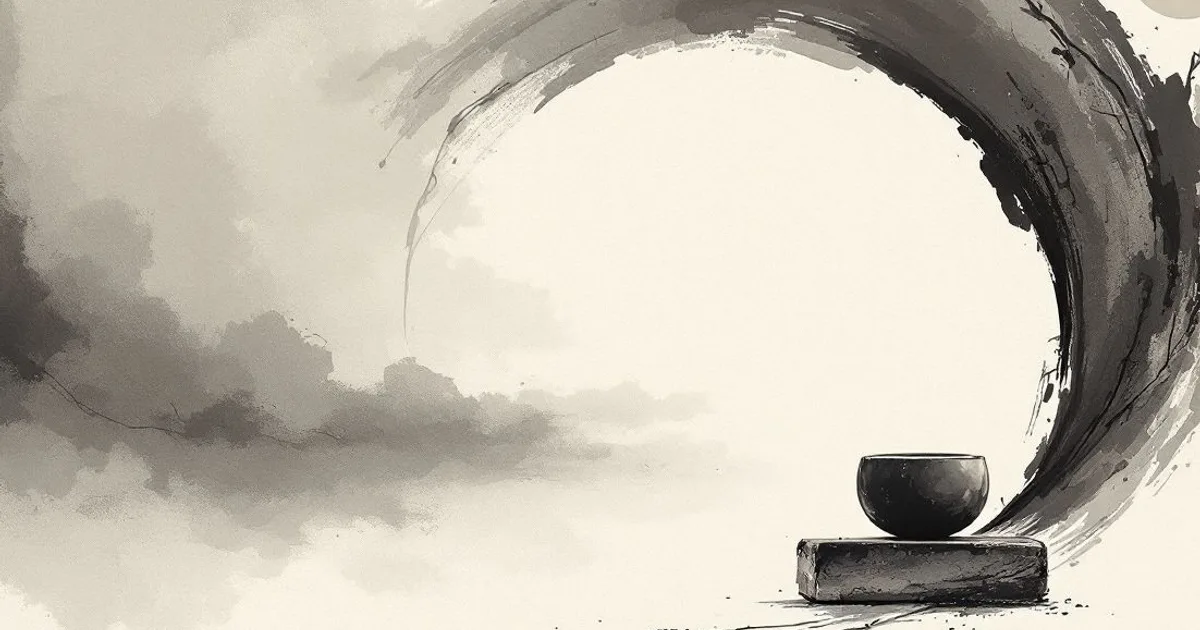
An ensō (円相, usually written enso in English) is the Zen circle: in Japan, usually brushed in ink on paper by a Zen monk or teacher, typically in a single stroke and often beside a short inscription. The Minneapolis Institute of Art (Mia) glosses the word as “mark of a circle.” Museums read it as enlightenment, wholeness or the universe, but in the koan literature a commentator warns against fixing the circle as a symbol, and some Japanese painters treat it lightly.
At a glance
- Word: Japanese ensō 円相; in Chinese Chan texts 圓相 (yuanxiang), “circle figure.”
- Form: typically one stroke, not always; often with an inscription.
- Painters with museum examples: Tōrei Enji, Sengai Gibon, Hakuin Ekaku, Taidō Sōtō.
- Roots: circle figures drawn by Chan teachers in China, as Chan texts from the tenth century on tell their stories.
What does the word ensō mean?
The word is written 円相. Its first character, en 円, is the Japanese form of the older 圓, which the Unicode Consortium’s Unihan database defines as “circle; round, circular; complete.” The second, sō 相, the Sōtō Zen Text Project renders as “form” (“appearance”) in the line “My body manifests a round moon form” (engetsu sō 圓月相), from a verse attributed to Nāgārjuna that Dōgen discusses; the translators note that 圓 there can also be read as “perfect.” So ensō is “circle form,” or, in Mia’s gloss, “mark of a circle.”
Chinese Chan texts from the tenth century on write the same two characters, 圓相, for the circle figures that teachers drew with a hand, in the air, on the ground or on paper. The Rentian yanmu, a Chan compendium compiled by Zhizhao in 1188, gives them a section of their own under the heading “the origin of the circle figures.”
How an ensō is painted
The Japan Society’s 2024 guide to Zen paintings from the Gitter-Yelen Collection describes the ensō as “a circular form typically made with a single brushstroke.” Louvre Abu Dhabi’s ensō by Tōrei Enji (1721–1792) is made of “two semicircles,” and the museum adds that “the one on the right is realised with a thinner brush style.”
The dry brush shapes the result. On its ensō by Taidō Sōtō (1776–1836), Mia notes that “as the brush deposits ink, the stroke becomes scratchier, leaving the circle incomplete,” and reads that imperfection as “the inevitable discrepancy between the ideal and reality.” Popular explanations often give an open circle and a closed one separate fixed meanings; none of the museum records or Zen texts used for this page draws that distinction, so we do not present it as a Zen teaching. Some popular guides also tie the open circle to wabi-sabi, the Japanese taste for imperfect beauty; that link is theirs, not our sources’.
Is brushing one a practice in itself? Louvre Abu Dhabi writes that, besides koans, “another common exercise used to achieve this enlightenment was artistic practice.” It is still taught: Upaya Zen Center has published a 2025 workshop session in which the calligrapher Kazuaki Tanahashi shares “the meditative practice of creating ensos” and, in Upaya’s words, “the subtle art of leaving them either open or closed.”
Many ensō carry an inscription. Taidō’s has a Chinese poem, which Mia translates: “With a heart permeated with innocence / The virtuous dragon walks alone.” Tōrei’s ensō in the Gitter-Yelen Collection reads, in the Japan Society’s translation, “In heaven and earth, I alone am the Honored One.” The guide explains that this quotes the declaration the Buddha “is supposed to have made” just after his birth, and that Tōrei uses it to suggest that “we all contain the Buddha nature and, like the ensō, are whole within ourselves.”
These paintings belong to what is now called zenga, Zen painting, which JAANUS, the online dictionary of Japanese art terms compiled by Mary Neighbour Parent and hosted by Columbia University, calls “a modern and somewhat ambiguous term”: usually quick, light-hearted ink paintings by Edo-period Zen priests, above all Fūgai (Fūgai Ekun), Hakuin and Sengai (1750–1837). JAANUS separates it from the historical term gazen, “painting Zen,” the practice of painting as a Zen activity. Louvre Abu Dhabi puts that idea plainly: “the ink brush itself expresses the concept of the mind.”
What is the ensō said to show?
Each reading below belongs to the source that gives it:
- Mia: “In Zen Buddhism, a circle brushed in a single stroke represents the universe, perfection, and the enlightened mind.”
- The Japan Society guide (on Tōrei’s ensō): “Simultaneously full and empty, it is an important Zen symbol of nonduality and wholeness.”
- Louvre Abu Dhabi: the circle “without beginning or end” is “considered the manifestation of the Buddha’s wisdom springing from the Absolute Essence of Nature.”
- The Idemitsu Museum of Arts: Zen monks have long favoured drawing a round circle as a statement of perfect awakening (our translation of the museum’s Japanese).
- The National Gallery of Victoria: the Zen circle “represents enlightenment, strength, elegance and the universe.”
- Shigenori Nagatomo, in the Stanford Encyclopedia of Philosophy, describes Zen’s movement from nondual seeing back into the everyday world, and writes that this movement “is symbolized in Zen by a circle, an image of the whole, which is also an image of perfection.”
The ideas these readings lean on have their own pages: emptiness (śūnyatā), and buddha-nature, which Tōrei’s inscription invokes. Louvre Abu Dhabi adds a caution of its own: even with “a complex background of symbols and allegories, a convincing interpretation is not always possible.”
Koan stories against fixing the circle
In the old Chan stories, the circle is a challenge put to someone, not a sign to be decoded. In case 69 of the Blue Cliff Record, the Song-dynasty koan collection with verses by Xuedou and commentary by Yuanwu Keqin (1063–1135), three monks, Nanquan, Guizong and Magu, set out to visit the National Teacher Huizhong. Halfway there Nanquan draws a circle on the ground and says, in Thomas Cleary’s translation, “If you can speak, let’s go on.” Guizong sits down inside it; Magu curtseys. Nanquan says, “Then let’s not go on.” Commenting on Xuedou’s verse, just after quoting his teacher Wuzu, Yuanwu writes:
Yuanwu, commenting on the verse, puts it this way (trans. Thomas Cleary, BDK English Tripiṭaka 75, p. 317): “Though Magu curtseyed, he never understood it as curtseying; though Nanquan drew a circle, he never understood it as a circle.”
In case 33, when Zifu draws a circle on seeing Chen Cao arrive, Chen replies: “My coming here like this has already missed the point; how much more so to go on and draw a circle.” (For how such cases are worked with in practice, see Zen koans.)
Dōgen, the founder of Japanese Sōtō Zen, makes a related point about a related image. In his essay “Buddha Nature” he discusses a story in which Nāgārjuna manifests a body like the full moon, and his verse “My body manifests a round moon form.” Dōgen complains that painters in Song China depicted the scene as “the form of a disk that is like a mirror” on a dharma seat, and writes:
If we understand the body manifesting a round moon form to be the form of a disk, it is a real painted cake.
The translators note that he is playing on the Chan proverb that a painted cake cannot satisfy hunger. Nāgārjuna’s moon is not the ensō scroll, and this is Dōgen’s Sōtō voice, not that of the Japanese painters below; read it as a parallel about round images, not as a comment on ensō painting.
Painters could treat the circle lightly and still mean it seriously. On Sengai’s Ichiensō gasan at the Idemitsu Museum, the inscription, as the museum gives it, tells the viewer to think of the circle as a tea sweet and eat it. The museum reads this as Sengai lightly throwing away the precious ensō: in Zen one keeps seeking a higher awakening, so finishing the painting is also a start on a deeper search; and it concludes that the painting shows Sengai’s earnest search for the Way (our translation).
Where the circle comes from: Chan circle figures
The circle stories are Chinese, written down in Chan compilations of the tenth century and later, long after the events they describe. The Jingde chuandeng lu, a Chan lineage record compiled by Daoyuan in 1004, shows the National Teacher Huizhong of Nanyang, on seeing a monk approach, drawing a circle with his hand and writing the character 日, “sun,” inside it; the monk had no reply. (Yuanwu’s commentary on case 69 notes that Huizhong had met the sixth patriarch, Huineng.) The same record shows Yangshan Huiji drawing circles again and again: on paper for a visitor who asked for a verse; in the air with 佛, “buddha,” inside; on the ground with 水, “water.” Versions of the same Yangshan episodes already appear in the Zutang ji, a lineage record whose own text counts its years up to 952. (These renderings are ours, from the Chinese on CBETA.)
The Rentian yanmu of 1188 tells the fuller story, and it should be read as that compilation’s account, not as documented history. In its telling, the making of circle figures began with Huizhong, who passed ninety-seven of them, inherited from six generations of patriarchs, to his attendant Danyuan. Danyuan gave them to Yangshan, who burned the book. Asked why, he said one look had shown him their meaning, and what matters is using them, not clinging to the original; then he wrote the set out again without a single error. The circles came to be regarded as the house style of the Guiyang school, and the next section of the text adds that Yangshan later awakened suddenly through the ○ figure while with Guishan. (Again our rendering, from CBETA.)
Thomas Cleary, introducing the Blue Cliff Record, explains that the Guiyang line, named for Guishan Lingyou (771–854) and Yangshan Huiji (813–890), was one of the five houses of Chan, each, he says, with its own vocabulary and symbols. Yuanwu calls Zifu an adept of the Guiyang line, given to teaching with objects. Yet in the koan stories the circle is not Guiyang property alone: Nanquan, whom the Jingde chuandeng lu lists among the heirs of Mazu, draws one too.
The Japanese ensō is a later form. The Chan stories describe a circle made in a moment of encounter; the ensō on this page are mostly Edo-period ink paintings by Japanese Zen priests. Another well-known Chan circle in pictures is the empty one in the Ten Oxherding Pictures: JAANUS describes the eighth stage, “bull and self forgotten,” as “represented with an empty circle.”
Famous ensō and their painters
- Hakuin Ekaku (his life is told here) painted ensō: an Ichiensō by him from the Eisei Bunko collection was no. 17 in Kumamoto’s 2023 exhibition “Hosokawa Collection: Hakuin and Sengai.”
- Tōrei Enji (1721–1792) was, in the Japan Society’s words, “one of Hakuin’s most important disciples”; the guide names him with Suiō Genro as one of Hakuin’s “two most prominent successors” and says he “systematized many of his master’s reforms to the Rinzai sect of Zen.” It calls his ensō “particularly distinctive.” Examples include the inscribed scroll in the private Gitter-Yelen Collection of Kurt A. Gitter and Alice Yelen Gitter, and the two-semicircle ensō at Louvre Abu Dhabi.
- Sengai Gibon (1750–1837) painted the ensō above whose inscription tells the viewer to treat it as a tea sweet and eat it. His ○△□, signed but otherwise uninscribed, is, the Idemitsu says, considered the hardest of his Zen paintings to interpret, and there are various theories about it.
- Taidō Sōtō (1776–1836), whose name should not be confused with the Sōtō school, was, Mia records, the 444th abbot of Daitoku-ji in Kyoto, which it calls “one of 14 head temples of the Rinzai school.” His incomplete ensō is at Mia (accession 2001.267.2).
The ensō today
The National Gallery of Victoria holds Ensō (2014), a work in bamboo, rattan and lacquer by Tanabe Shōchiku, a fifth-generation bamboo artist of the Tanabe family, which the gallery says “references the traditional Zen symbol of a circle.” Ensō also turn up as logos. Some people wear an ensō as a tattoo; for how Buddhists think about that, see can Buddhists have tattoos? For a book-length study in English, see Audrey Yoshiko Seo’s Ensō: Zen Circles of Enlightenment (Weatherhill, 2007).
The sources on this page point the same way: an ensō is not a logo with one fixed meaning but a brush mark made by a particular teacher, often with words beside it, in a tradition whose koan stories warn against stopping at the circle. For the words Zen uses for awakening itself, see satori and kenshō; for the circle among other Buddhist emblems, Buddhist symbols; and for the wider family of Japanese ideas this belongs to, Eastern wisdom.
Frequently asked questions
What does an enso symbolize?
There is no single fixed meaning. Mia reads a one-stroke circle as the universe, perfection and the enlightened mind; the Japan Society calls it a Zen symbol of nonduality and wholeness; Louvre Abu Dhabi says it is considered the manifestation of the Buddha's wisdom. The Blue Cliff Record's commentator Yuanwu warns against fixing it: Nanquan drew a circle, he says, but never understood it as a circle.
What does enso mean in Japanese?
Enso (円相) means 'circle form'; Mia glosses it 'mark of a circle'. The first character, 円, is the Japanese form of 圓, which the Unicode Unihan database defines as 'circle; round, circular; complete'. Chinese Chan texts write the same two characters, read yuanxiang, for the circle figures that teachers drew.
Is an enso always painted in one brushstroke?
Usually, but not always. The Japan Society's 2024 guide calls it a circular form typically made with a single brushstroke. Louvre Abu Dhabi holds an ensō by Tōrei Enji made of two semicircles, the right one in a thinner brush. Many ensō also carry a short inscription beside the circle.
What is the difference between an open and a closed enso?
No fixed rule in the sources used here. Popular guides say an open circle stands for incompleteness and a closed one for wholeness, but none of the museum records or Zen texts on this page sets that out. Mia describes one ensō left incomplete as the dry brush grew scratchier, and reads the gap as the discrepancy between the ideal and reality. That is one museum's reading of one painting.
Who are well-known painters of enso?
Mostly Japanese Zen priests of the Edo period. Examples include Tōrei Enji, one of Hakuin's leading disciples, whose ensō the Japan Society calls particularly distinctive; Sengai Gibon, whose ensō at the Idemitsu Museum tells the viewer to eat it like a tea sweet; Hakuin Ekaku himself; and Taidō Sōtō, an abbot of Daitoku-ji, whose ensō is at Mia in Minneapolis.
Is the enso a Buddhist symbol or just Japanese art?
It is Buddhist, from the Zen tradition. Ensō were brushed by Zen monks, often with a Buddhist inscription, and Chinese Chan texts from the tenth century on describe teachers drawing circle figures in their encounters with students. It is also prized as art, and museums display it as Zen painting (zenga).
Sources
- Minneapolis Institute of Art (Mia), 'Ensō', Taidō Sōtō (Japanese, 1776–1836), 19th century, hanging scroll, ink on paper, accession 2001.267.2, collection record
- Japan Society (New York), None Whatsoever: Zen Paintings from the Gitter-Yelen Collection, exhibition guide (8 March – 16 June 2024; organized by the Museum of Fine Arts, Houston; curated by Bradley M. Bailey and Yukio Lippit)
- Louvre Abu Dhabi, 'En-Sô', Tôrei Enji (1721–1792), 18th century, Indian ink on paper, inventory LAD 2011.022, collection record
- Idemitsu Museum of Arts, Sengai (1750–1837), Ichiensō gasan 一円相画賛 (circle painting with inscription), Edo period, ink on paper, collection page (Japanese)
- Idemitsu Museum of Arts, Sengai (1750–1837), ○△□ (marusankakushikaku), Edo period, ink on paper, collection page (Japanese)
- National Gallery of Victoria, Tanabe Shōchiku, 'Ensō (Ensō 円相)', 2014, bamboo, rattan, lacquer, accession 2016.1145, collection record
- 'Zenga 禅画' (entry), JAANUS, the online Dictionary of Japanese Architectural and Art Historical Terminology compiled by Mary Neighbour Parent, hosted by the Media Center for Art History, Columbia University
- 'jūgyū 十牛' (entry), JAANUS, the online Dictionary of Japanese Architectural and Art Historical Terminology compiled by Mary Neighbour Parent, hosted by the Media Center for Art History, Columbia University
- Shigenori Nagatomo, 'Japanese Zen Buddhist Philosophy', Stanford Encyclopedia of Philosophy (substantive revision 7 March 2024), section 8
- The Blue Cliff Record (Biyanlu, T2003), trans. Thomas Cleary, BDK English Tripiṭaka 75 (Berkeley: Numata Center for Buddhist Translation and Research, 1998): translator's introduction; case 33, 'Zifu's Circle', pp. 174–175; case 69, 'Nanquan's Circle', pp. 314–317
- 'Buddha Nature' (Busshō 佛性), Treasury of the True Dharma Eye: Dōgen's Shōbōgenzō, vol. 1, no. 3, trans. Sōtō Zen Text Project (Tokyo: Sōtōshū Shūmuchō, 2023), pp. 73–87, SOTOZEN.COM
- Zutang ji 祖堂集 (comp. Jing and Yun; its text counts years to Baoda 10, 952), B0144: Yangshan's circle figures at B25 pp.639a01, 639b04–05, CBETA
- Jingde chuandeng lu 景德傳燈錄 (comp. Daoyuan, 1004), T2076: Nanyang Huizhong at T51 p.244c09; Nanquan among Mazu's heirs at p.256b27; Yangshan Huiji at pp.282b17, 283a09, 283b18, CBETA
- Rentian yanmu 人天眼目 (comp. Zhizhao, 1188), T2006, juan 4, 'Yuanxiang yinqi 圓相因起' (the origin of the circle figures) and the following section 'Anji 暗機', T48 p.321c10–322a09, CBETA
- Kumamoto Prefecture, exhibition list 'Hosokawa Collection: Hakuin and Sengai' (14 April – 2 July 2023), no. 17: Ichiensō 一円相, Hakuin Ekaku, mid-Edo period, Eisei Bunko
- Unihan Database, U+5713 圓 (kDefinition: circle; round, circular; complete), Unicode Consortium
- Unihan Database, U+5186 円 (kJapaneseOldVariant: U+5713 圓), Unicode Consortium
- Upaya Zen Center, 'Heart of the Brush: Color and Completion', Zen Circle 2025 workshop session (Kazuaki Tanahashi), 16 February 2025
- Audrey Yoshiko Seo, Ensō: Zen Circles of Enlightenment (Weatherhill, 2007), Open Library edition record (further reading)