The Ten Oxherding Pictures: Zen's Path in Images
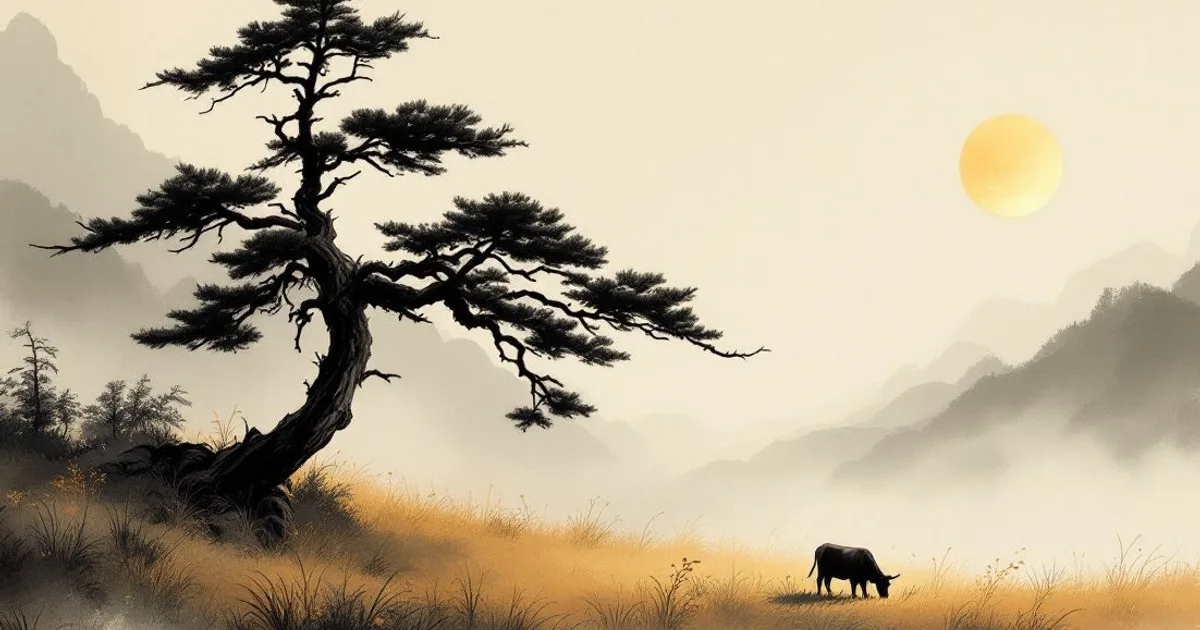
The Ten Oxherding Pictures are a Chan (Zen) series of ten images with verses in which a herdboy searches for a lost ox, finds it, tames it and rides it home, then forgets the ox, forgets himself in an empty circle, returns to the source, and walks into the marketplace. The classic set is by the Song-dynasty Chan master Kuoan Shiyuan (Japanese Kakuan Shien), twelfth century.
In the tradition’s own reading the ox is the mind, or one’s true nature, and the boy is the person looking for it. Kuoan’s was not the first such series. Qingju’s earlier set ended with the ox and herdboy vanishing; Kuoan’s goes on past that point and back into the world. Older Buddhist texts herd cattle too, but as similes, not as a path in ten steps.
- Name
- Chinese 十牛圖 shiniu tu, Japanese jūgyūzu; in English also Ten Bulls (JAANUS glosses jūgyū literally as “ten bulls”)
- Famous painting
- Handscroll at Shōkoku-ji, Kyoto, fifteenth century, traditionally attributed to Shūbun
What the pictures show
The sets share two figures, a herdboy and an ox. Hu Wenhuan, the Ming editor of one printed set, states the allegory in his preface: the herdboy is the person, the ox is the mind, and the round light is the two wholly merged (X1270). Where this page gives Chinese in English without naming a translator, the gloss is ours. The Nara National Museum’s catalogue reads it the same way. The Zen teacher Kubota Ji’un, named head of the Sanbō Kyōdan after Yamada Kōun’s death in 1989 (under Yamada, Ruben Habito writes, “primarily a lay community”), calls the ox “the essential self which we are seeking”, in talks translated by J. Cusumano and Satō M.
The Nara record notes that the pictures were normally drawn inside a circle (for the brushed circle itself, see ensō). For the wider tradition, see Zen Buddhism and Eastern wisdom.
Kuoan’s set: the text and who wrote what
Kuoan’s text survives in the Xuzangjing, the Manji supplementary canon, as 十牛圖頌, Verses on the Ten Ox Pictures (X1269). The Wudeng huiyuan, a Song record of Chan lineages, lists “Chan master Kuoan Shiyuan of Liangshan” among the heirs of Dazui Yuanjing, in the Linji line. His dates are unknown; JAANUS dates his illustrated verses to about 1150. Each stage has a short prose preface and a four-line verse, followed by two matching verses by other monks.
Who wrote the prose is disputed. The general preface is signed by Ciyuan (慈遠, Japanese Jion). D. T. Suzuki, in his Manual of Zen Buddhism (1935, p. 127), gave Kuoan “the poems and introductory words” alike. Wu Rujun (1991, p. 316) gives the general preface to Ciyuan but treats the stage prefaces as Kuoan’s. Kubota says Jion “is said to have” written both kinds, adding “some say Kakuan himself, others say the friend of Kakuan”. Bret W. Davis (Zen Pathways, 2022, p. 321) gives both to Ciyuan (his Ziyuan), Kuoan’s successor. The safe statement: verses by Kuoan, general preface signed by Ciyuan, stage prefaces of disputed authorship.
In English the series is also known as Ten Bulls, a section of Paul Reps’s Zen Flesh, Zen Bones (first published 1957), which its publisher, Tuttle, calls “a commentary on the stages of awareness leading to enlightenment”; Reps acknowledged a deep debt to the Buddhist scholar Nyogen Senzaki.
The ten stages
The Chinese titles are Kuoan’s (X1269); the English come from two named translations.
| No. | Chinese | Suzuki (1935) | Cusumano and Satō |
|---|---|---|---|
| 1 | 尋牛 | Searching for the Ox | Seeking the Ox |
| 2 | 見跡 | Seeing the Traces | Finding the Tracks |
| 3 | 見牛 | Seeing the Ox | Catching Sight of the Ox |
| 4 | 得牛 | Catching the Ox | Seizing the Ox |
| 5 | 牧牛 | Herding the Ox | Taming the Ox |
| 6 | 騎牛歸家 | Coming Home on the Ox’s Back | Riding the Ox Home |
| 7 | 忘牛存人 | The Ox Forgotten, Leaving the Man Alone | Ox Forgotten, Person Remaining |
| 8 | 人牛俱忘 | The Ox and the Man Both Gone out of Sight | Person and Ox Both Forgotten |
| 9 | 返本還源 | Returning to the Origin, Back to the Source | Returning to the Source |
| 10 | 入鄽垂手 | Entering the City with Bliss-bestowing Hands | Entering the Marketplace with Arms Hanging Loose |
垂手 in the tenth title is literally “hands hanging down”, which Cusumano and Satō keep. Suzuki’s “Bliss-bestowing Hands” renders what the hands do; Wu Rujun reads the stage as humble service to others (p. 313).
The first preface opens with a paradox: the ox has never been lost, so why search? The boy lost it by turning his back on awakening. His verse begins:
Incessantly you brush aside thick grasses in pursuit;
The waters are wide, the mountains far, and the path leads on without end.
At the second stage he knows the sutras and teachings but has not yet gone through the gate himself, so he has only seen the tracks. At the third he enters through hearing, as a bird sings on a branch; Kubota insists this must be a clear experience, not an abstraction about Mu. The ox is caught still wild at the fourth, tamed at the fifth, ridden home at the sixth; at the seventh it is gone, and whip and rope lie idle in the hut.
The empty circle, and why it is not the end
The eighth verse opens, in Cusumano and Satō’s English, with whip, tether, person and ox: “all are empty”. JAANUS gives the stage as “represented with an empty circle”.
Ciyuan’s preface explains why Kuoan did not stop here. An earlier master, Qingju, had drawn an ox that whitens by degrees until “person and ox are not seen”. That left shallow students confused: some suspected a fall into empty nothingness, others called it eternalism (X1269). So Kuoan adds two stages. In the ninth, even the return to the source was wasted effort; inside his hut he does not see what lies before it, and “The water flows of itself and the flowers are naturally red” (Cusumano and Satō). In the tenth, the man walks into town with a gourd, bare-chested and barefoot, smiling, turning wine-shops and fish-stalls into buddhas.
The man in the marketplace
Painters usually drew this figure as Hotei (Chinese Budai), the big-bellied monk with a sack: Kubota says all pictures of the tenth stage “show a fellow named Hotei”. Kuoan’s own words never name him; the identification belongs to the painted tradition. For who Budai was, see why the Laughing Buddha is fat.
Where is awakening in the series?
Readers differ. For Kubota, the third picture is a clear seeing of the real self, yet “still only the third stage”. Davis calls the third “the first breakthrough moment” and finds the biggest breakthrough in the eighth, the empty circle (pp. 322–323). Wu Rujun reads two halves (p. 313): stages one to eight are the individual’s practice, recovering the lost mind-ox (心牛), with the eighth as its peak; in the ninth and tenth the practitioner turns what he has gained back to the world, serving people humbly. On the words themselves, see satori and kenshō; across the traditions, what enlightenment is.
The other sets, and their different endings
Wu Rujun counts three sets that drew most notice: Qingju’s five pictures, Kuoan’s ten and Zide’s six (p. 314; Suzuki agrees). Wu places Qingju in the Caodong (Sōtō) line; Zide Huihui was an heir of Hongzhi (X1554).
| Set | Pictures | The ox | How it ends | Source |
|---|---|---|---|---|
| Qingju | five | whitens by degrees | person and ox not seen | Ciyuan’s preface, X1269 |
| Zide Huihui | six (text only survives, Wu n. 1) | whitens, as in Qingju’s (Suzuki) | beyond emptiness, back among the six realms: “every worldly affair is a Buddhist work” (Suzuki, p. 128) | Wu, p. 314 and n. 1; Suzuki, p. 128; X1554 |
| Kuoan Shiyuan | ten | no whitening (Suzuki) | the marketplace | X1269 |
| Puming | ten | ”first black, then white, until there is nothing” (Zhuhong) | 雙泯, “both vanished” | X1270; X1271 |
Puming’s set survives in Ming printings. Yunqi Zhuhong, who reprinted it with a preface dated 1609 (Suzuki cites an edition of 1585), admits nobody knows where Puming came from. In Japan, Suzuki wrote in 1935, Kuoan’s pictures “gained a wide circulation, and at present all the oxherding books reproduce them” (p. 128). Davis notes that they “did not become popular in China”: Puming’s set, which he takes to be slightly earlier and probably by a Caodong master, became the most popular in China and also in Korea (p. 321). The series kept changing. A later set draws the ox white from start to finish, which Davis reads as a critique of gradual whitening like Puming’s (p. 327). In seventeenth-century Japan the Sōtō monk Geppa added two pictures at the start, “Arousing Aspiration” and “Leaving Home” (p. 324). Davis also sets beside them a Tibetan series in which a monk tames an elephant that turns from black to white as the mind is purified (p. 322).
Older roots: herding the ox before the pictures
The image is far older than the pictures. Zhuhong’s preface begins with the Sutra of the Bequeathed Teaching, in Kumārajīva’s Chinese: guard the senses “like a herdsman holding a stick and watching”, so the ox does not trample people’s crops (T389); this, he says, is where the talk of herding the ox began. In the Jingde Record of the Transmission of the Lamp, Shigong Huizang tells Mazu he herds the ox: when it goes into the grass, he drags it back by the nostrils.
The early discourses have cowherds of their own. They are a parallel, not a source the pictures name: Zhuhong traces the Chan image to the Bequeathed Teaching, and JAANUS to the Ekottarika Āgama. In MN 19 the Buddha recalls sorting his thoughts before his awakening. In autumn a cowherd must keep his cattle out of the crops with a staff. Once the harvest is in, the work changes:
Suppose it’s the last month of summer, when all the crops have been gathered within a village, and a cowherd must take care of the cattle. While at the root of a tree or in the open he need only be mindful that the cattle are there. In the same way I needed only to be mindful that those things were there.
“Those things” are thoughts of renunciation, good will and harmlessness. MN 19 is a simile about thought, not a map of awakening. So is MN 33, the Longer Discourse on the Cowherd, where a cowherd’s eleven skills stand for a monk’s: picking out flies’ eggs means not tolerating a sensual, malicious or cruel thought. SuttaCentral lists Chinese parallels, among them EA 49.1 in the Ekottarika Āgama and SA 1249, “The Cowherd”. For more early similes, see Buddhist parables, the Pāli Canon and a tamed mind brings happiness.
The pictures in Japan
The Nara National Museum holds a surviving fifth picture, “herding the ox”, from a set of ten, ink on silk. Its inscription matches the fifth of ten ox verses by Yishan Yining (1247–1317), a Chinese Rinzai monk who came to Japan in 1299, and he wrote it in 1310 for a lay patron.
JAANUS says Muromachi painter-monks often took up the subject, drawing on copies of Kuoan’s text and pictures “which may have been reprinted in Japan as early as 1325”. Perhaps the most famous, in JAANUS’s words, is the set traditionally attributed to the Zen priest Shūbun (JAANUS: fl. 1414–63) at Shōkoku-ji in Kyoto; the list of works for a 2025 Tokyo exhibition of Shōkoku-ji’s treasures records it as a fifteenth-century handscroll in ink and light colour. The Metropolitan Museum of Art holds a Kamakura-period handscroll, Ten Verses on Oxherding, dated 1278, and Karasumaru Mitsuhiro’s Ten Oxherding Songs of around 1634.
JAANUS adds a caution: paintings of a herdboy with his ox are related but “essentially distinct in meaning”. Not every ox in Zen ink is one of the ten.
How to read them
The pictures lay the path out in stages, in a tradition whose orthodox teaching, Davis notes, became sudden awakening; he credits their makers with avoiding “an overly simplistic dichotomy” between gradual path and sudden breakthrough (p. 322). Their editors said what the map is good for and where it stops. Zhuhong valued them as a measure for students of what they have reached and what is still ahead, a guard against being satisfied with little. Only for one who “leaps straight in”, he adds, do the pictures become unsold goods and the verses surplus words. Kubota calls them “merely an indication of the way to practice and not an object for conceptual thought”: “very useful” to those who actually sit, of no use to those who want only Zen’s rationale. For the sudden and gradual debate, see satori and kenshō.
Modern readings differ: Wu Rujun finds Shibayama Zenkei’s commentary balanced, and that of Hisamatsu Shin’ichi, a second-generation master of the Kyoto School in Wu’s description, insightful but very subjective. No single school owns the pictures: Kuoan was a Linji monk, Qingju on Wu’s account a Caodong one, Zide an heir of Hongzhi, Geppa a Sōtō monk. What they point to is practice, sitting as in zazen and, for Kubota’s Sanbō Kyōdan, koan work under a teacher.
Frequently asked questions
What are the Ten Oxherding Pictures?
They are a Chan and Zen series of ten pictures with verses. A herdboy searches for an ox, finds its tracks, catches it, tames it and rides it home; then the ox is forgotten, both are forgotten in an empty circle, he returns to the source, and finally walks into the marketplace. The classic set is by the Song Chan master Kuoan Shiyuan, twelfth century.
What does the ox represent in the oxherding pictures?
In the tradition's own reading, the mind or one's true nature. The Ming editor Hu Wenhuan wrote that the herdboy is the person and the ox is the mind. The Nara National Museum describes the pictures as the trainee and the ox (the mind). Kubota Ji'un, who became head of the Sanbo Kyodan Zen group in 1989, calls the ox the essential self that the practitioner is seeking.
Which oxherding picture represents enlightenment?
There is no single answer. Kubota Ji'un treats the third picture, seeing the ox, as a first clear seeing of the true self, though still only the third stage. Bret W. Davis calls the third the first breakthrough and the eighth, the empty circle, the biggest. Wu Rujun makes the eighth the peak of personal practice and the ninth and tenth its return to the world.
Why is the eighth oxherding picture an empty circle?
Because by the eighth stage the seeker and the sought have both dropped away. Kuoan's verse says whip, rope, person and ox are all empty, and the picture is drawn as a bare circle. Qingju's earlier set ended there. The preface signed by Ciyuan says that ending left some students suspecting a fall into empty nothingness, so Kuoan's set goes on to two more stages.
Why does the last oxherding picture show a man in the marketplace?
Because in Kuoan's set awakening is not the end of the road. The tenth stage has him carrying a gourd into town, bare-chested and barefoot, smiling, turning wine-shops and fish-stalls into buddhas. Painters usually drew this figure as Hotei (Budai), though Kuoan's text never names him. The scholar Wu Rujun reads it as the return to serve others.
Who painted the most famous oxherding pictures?
JAANUS, the Columbia art-history dictionary, calls the Shokoku-ji set in Kyoto 'perhaps the most famous': a fifteenth-century handscroll traditionally attributed to the Zen priest Shubun. Older are a surviving fifth picture in the Nara National Museum, with an inscription by Yishan Yining dated 1310, and a Kamakura-period handscroll, Ten Verses on Oxherding, dated 1278, in the Metropolitan Museum of Art.
Sources
- 十牛圖頌 (Verses on the Ten Ox Pictures), X64 no. 1269, internal heading 住鼎州梁山廓庵和尚十牛圖頌并序 (Kuoan of Liangshan in Dingzhou), with the general preface signed by Ciyuan 慈遠, the ten stage prefaces and verses, and two matching verses to each stage — CBETA
- CBETA catalogue record for X1269: title 十牛圖頌, vol. X64, byline 宋 師遠述 (Song, related by Shiyuan)
- 十牛圖頌 / 新刻禪宗十牛圖, X64 no. 1270: Hu Wenhuan's preface (the herdboy is the person, the ox the mind) and Puming's ten verses, from 未牧 (not yet herded) to 雙泯 (both vanished), with Yun'an's matching verses (Ming) — CBETA
- 十牛圖和頌, X64 no. 1271: Yunqi Zhuhong's preface to the ox-herding pictures (dated 萬曆己酉, 1609, in this text), the matching verses to Puming by Ming and Qing masters (contents note dated 1662), and Juche's White Ox verses — CBETA
- 五家正宗贊 (Wujia zhengzong zan), juan 3, X78 no. 1554, p. 607c: Chan master Zide Hui(hui) 自得慧暉, heir of Hongzhi, 'the master has six ox pictures', with their prefaces and verses, the sixth returning among the six paths — CBETA
- 五燈會元 (Wudeng huiyuan), juan 20, X80 no. 1565: Chan master Kuoan Shiyuan of Liangshan, Changde prefecture, among the dharma heirs of Dazui Yuanjing, fifteenth generation under Nanyue — CBETA
- 景德傳燈錄 (Jingde Record of the Transmission of the Lamp), juan 6, T51 no. 2076: Mazu and Shigong Huizang, herding the ox — CBETA
- 佛垂般涅槃略說教誡經 (Sutra of the Bequeathed Teaching), trans. Kumārajīva, T12 no. 389, p. 1111a: the herdsman who holds his stick and watches so the ox does not trample the crops — CBETA
- Dvedhāvitakka Sutta, Two Kinds of Thought (MN 19), the cowherd in autumn and at the end of summer; trans. Bhikkhu Sujato, SuttaCentral
- Mahāgopālaka Sutta, The Longer Discourse on the Cowherd (MN 33), the eleven factors of a cowherd and of a mendicant; trans. Bhikkhu Sujato, SuttaCentral
- SuttaCentral parallels for MN 33: EA 49.1 (T 125.49.1) and SA 1249 (T 99.1249, 牧牛者), among others
- Wu Rujun 吳汝鈞, '十牛圖頌所展示的禪的實踐與終極關懷' (The practice and ultimate concern of Chan in the Ten Oxherding Pictures and Verses), Chung-Hwa Buddhist Journal 4 (1991), pp. 313–340
- Bret W. Davis, Zen Pathways: An Introduction to the Philosophy and Practice of Zen Buddhism (Oxford University Press, 2022), ch. 24, 'Reviewing the Path of Zen: The Ten Oxherding Pictures', pp. 321–338
- 'jūgyū 十牛', JAANUS, the on-line Dictionary of Japanese Architectural and Art Historical Terminology compiled by Dr. Mary Neighbour Parent (Media Center for Art History, Columbia University)
- Ten Ox-herding Pictures, verse by Kuoan Shiyuan with the prefaces, and teisho by Kubota Ji'un, trans. J. Cusumano and Satō M. (originally printed in Kyōshō nos. 245–259, 1994–96, revised), Terebess Asia Online's mirror of the Sanbō Zen text
- Ruben L. F. Habito, 'In Memoriam: Yamada Kōun Rōshi (1907–1989)', Buddhist-Christian Studies 10 (1990), pp. 231–237, at pp. 233–234: Kubota Ji'un named head of the Sanbō Kyōdan; Yamada's community 'primarily a lay community'
- Zen Flesh, Zen Bones (Classic Edition), Paul Reps, Tuttle Publishing book page: contents include 'Ten Bulls', first published in 1957, Reps's debt to Nyogen Senzaki
- 牧牛図(十牛図), Oxherding picture, the surviving fifth of a set of ten, inscription by Yishan Yining dated 1310, ink on silk, Nara National Museum — Cultural Heritage Online (Agency for Cultural Affairs, Japan)
- Legacy of Zen Temples: Shokoku-ji, Kinkaku-ji and Ginkaku-ji, Kyoto, List of Works (University Art Museum, Tokyo University of the Arts, 2025): no. 52, Ten Ox Herding Pictures, attributed to Shūbun, handscroll, ink and light color on paper, 15th century, Shokoku-ji; Zekkai Chūshin, Ten Ox Herding Verses, Important Cultural Property
- Ten Verses on Oxherding, Japan, Kamakura period, dated 1278, handscroll, ink and color on paper (2015.300.10) — Metropolitan Museum of Art
- Ten Oxherding Songs, Karasumaru Mitsuhiro (1579–1638), ca. 1634, handscroll, ink on dyed paper with stenciled decoration in gold and silver (1986.142) — Metropolitan Museum of Art
- D. T. Suzuki, Manual of Zen Buddhism (Kyoto, 1935; Grove Press reprint, 1960), 'The Ten Oxherding Pictures', pp. 127–144: the stage titles, the earlier sets of Seikyo (Qingju) and Jitoku (Zide), and the Shūbun pictures at Shokoku-ji