Mindfulness Gathas: Short Verses for Daily Life
Mindfulness gathas are short verses, often four lines, said silently while you do something ordinary (waking, washing, driving, using the phone) so that the act itself brings you back to the present. This page follows the practice as the Plum Village tradition of Thich Nhat Hanh teaches it. He learned such verses as a Vietnamese novice in 1942. Gāthā itself is the Pali word for a verse.
What a gatha is
Plum Village defines gathas as “short verses that we can recite during our daily activities to help us return to the present moment and dwell in mindfulness”, and adds that using one “doesn’t require any special knowledge or religious practice.” At Plum Village in France, the same article says, “we practice gathas when we wake up, when we enter the meditation hall, during meals, and when we wash the dishes”, and silently through the rest of the day as well.
The word is older than the practice. In the Pali discourses gāthā simply means verse: it is one of the nine kinds of teaching listed in the Alagaddūpama Sutta (MN 22), where Bhikkhu Sujato renders it “verses”. The Dhammapada uses the same word when it praises a single verse that lands:
Better than a thousand
meaningless verses
is a single meaningful verse,
hearing which brings you peace.
The early texts already ask for awareness in many of these moments. The Satipaṭṭhāna Sutta (MN 10) has a practitioner act “with situational awareness” when “bearing the outer robe, bowl and robes; when eating, drinking, chewing, and tasting; when urinating and defecating; when walking, standing, sitting, sleeping, waking, speaking, and keeping silent.” It gives no verse to say. A gatha is a later and different way to bring attention to an ordinary act.
How to practise with a gatha
Plum Village’s method, in our words:
- Choose one gatha for one act you do every day. Start with “one or two that resonate with you”, Plum Village says, “and learn more over time.”
- Learn it or put it where you will see it. Some people memorise a favourite; others write the verse down where they will meet it. Plum Village publishes printable cards for this.
- Pause before the act. At a light switch, it suggests you “stop for a few seconds to recite this gatha before you turn on the light.”
- Say it silently with the breath: the first line breathing in, the second breathing out, the third breathing in, the last breathing out.
- Carry on with the act. “When the gatha ends, we continue our activity with heightened awareness.”
Stepping into Freedom, Thich Nhat Hanh’s handbook for novices, is stricter: the verses are memorised, and the brushing-teeth gatha is kept up “during the whole time we brush our teeth”, standing still. Both sources compare gathas to road signs, each guiding you until the next.
With your steps. The words can also be paced by your feet. In Happiness (2009) Thich Nhat Hanh teaches the gatha “I have arrived, I am home” this way: “As you breathe in, you say, ‘Arrived’ with each step, and as you breathe out, you say ‘Home’ with each step.” Later you can switch to “Here” and “Now”: “The words are different, but the practice is the same.” A Plum Village article by Sister Giac An heads it “The Classic Plum Village Gatha”. For the walking practice itself, see walking meditation.
Gathas through the day
Some of Plum Village’s verses, in the order a day brings them. Three are quoted in full; the rest get a line or our own words.
Waking up
The waking verse begins “Waking up this morning, I smile”; the full verse is on our Buddhist morning routine page. Thich Nhat Hanh says its last line comes from the Lotus Sutra, where the one who looks on all beings with eyes of compassion is Avalokiteshvara. The line is there in the verse section of the Universal Gate chapter of the standard Chinese Lotus Sutra (T262: 慈眼視眾生). That verse section was added to Kumārajīva’s translation later, as the preface to the revised version of 601 CE (T264) notes. In the sutra, he writes, the line reads “Eyes of loving kindness look on all living beings.”
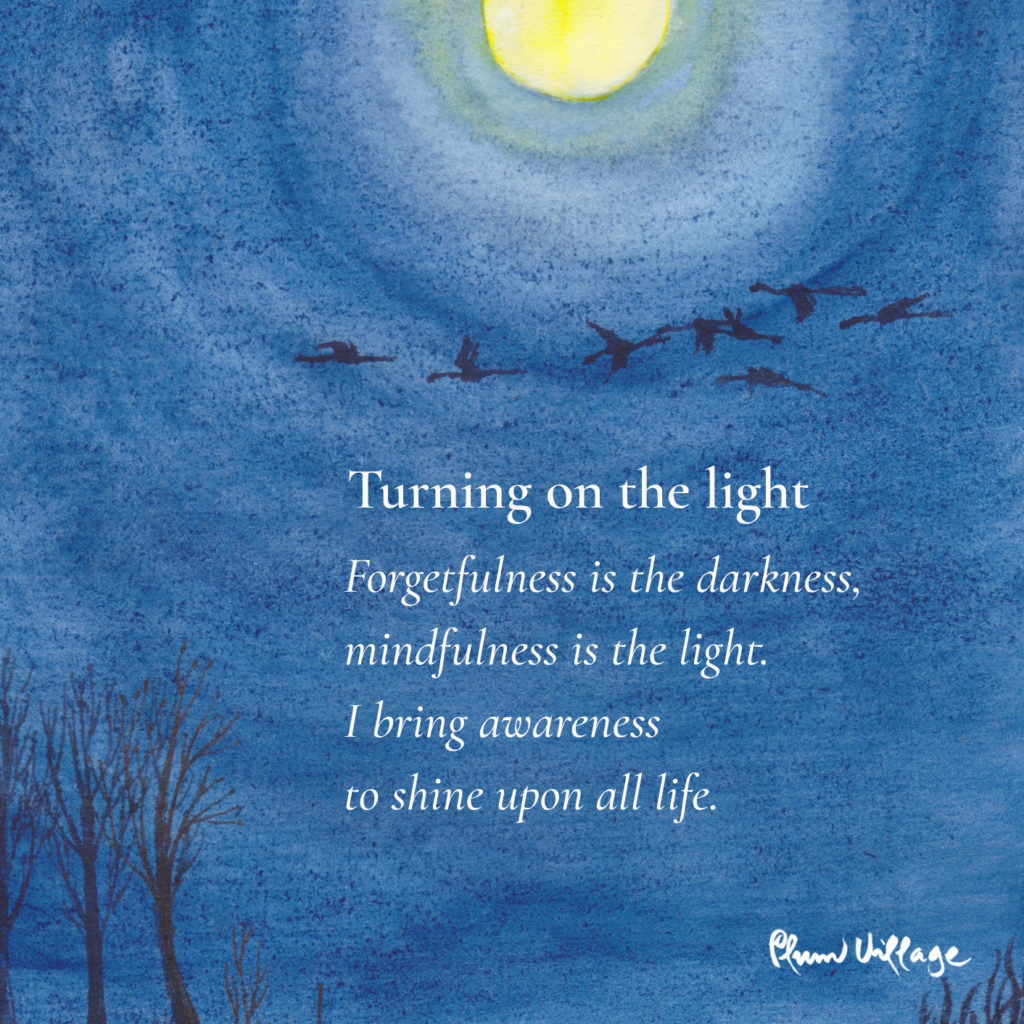
Turning on the light
Forgetfulness is the darkness,
mindfulness is the light.
I bring awareness
to shine upon all life.
— Plum Village, “Turning on the light” gatha card (plumvillage.org, 2021)
Turning on the tap
Thich Nhat Hanh’s tap gatha begins “Water flows from high mountains” and traces the water from the mountains and from deep in the Earth until it comes to us and sustains all life. He pairs it with looking deeply to “see how precious the water is”, and with not wasting a drop (Happiness, 2009).
Brushing your teeth
Brushing my teeth and rinsing my mouth,
I purify the way I speak.
Through Right Speech my mouth becomes fragrant,
and a flower blooms in the garden of my heart.
— Thich Nhat Hanh, Stepping into Freedom, second edition (excerpted in The Mindfulness Bell 88, 2021)
This gatha exists in more than one wording. The version in Thich Nhat Hanh’s Happiness (2009) has the vow “to speak, purely and lovingly” where this one says “I purify the way I speak”. The speech it points to is right speech.
Starting the car
Before starting the car, I know where I am going. The car and I are one.
If the car goes fast, I go fast.
— Thich Nhat Hanh, Happiness (Parallax Press, 2009)
He says the gatha “brings your mind and body together”, and that with “a calm and clear mind” you are “less likely to get into a car accident”: his teaching, not a road-safety finding.
The telephone
Thich Nhat Hanh taught that “the sound of the telephone is the voice of the Buddha, calling you back to your true home”, and Plum Village counts a ringing telephone among its bells of mindfulness. In Happiness (2009) he gives a short verse to say after two breaths before making a call, beginning “Words can travel thousands of miles”. It is quoted, with his practice of letting the phone ring three times, on Buddhism and technology.
Breathing, walking and eating
The breathing gatha begins “Breathing in, I calm my body”; it has its own page, and Stepping into Freedom prints it among the novice gathas as “Harmonizing the Breath”. Plum Village’s card for “taking the first step of the day” calls walking on the Earth a miracle; for his line about walking see kissing the Earth. For meals, Thich Nhat Hanh wrote five “Contemplations Before Eating” of his own, the first beginning “This food is a gift of the earth, the sky, numerous living beings”; older Chinese meal contemplations are below, and eating with attention is covered in mindful eating.
How to write your own gatha
When Thich Nhat Hanh wrote gathas for the telephone, driving and the computer, Plum Village says, “he did so within the tradition that he inherited from his teachers”, and it tells readers: “You are now one of the inheritors of this tradition.” In Happiness he calls writing your own gathas “a longstanding Zen tradition, one that I inherited from my teacher and pass on to my students.”
When the sutra class of Plum Village’s Lower Hamlet, led by Sister Luc Nghiem, wrote their own, they agreed that “time and space were key ingredients”, and their verses ranged, in the words of one heading, “From Flip Flops to Toilet Paper” (Sister Giac An, plumvillage.org, 2020).
None of the Plum Village pages we read gives a recipe, but the verses above share a shape you can borrow:
- One act you do every day on autopilot: unlocking a door, filling a kettle.
- Name it plainly in the first line: “Turning on the light”, “Brushing my teeth”.
- One breath per line. If a line will not fit an in-breath or out-breath, cut it.
- Point it somewhere. Several of the verses above turn the act toward something larger: speech, all life, the water’s journey.
Here is one we wrote for this page. It is ours, not Thich Nhat Hanh’s:
Filling the kettle,
I hear the water rise.
While it comes to the boil
I have nowhere else to be.
— e-Buddhism.com, an example written for this page
Where the form comes from
Plum Village says that “the use of gathas goes back for over two thousand years” but names no text. What the texts we read can show is shorter: verses for daily acts in Chinese from the third century CE, and the handbooks that carried them to Thich Nhat Hanh.
The Avatamsaka’s “Pure Conduct” verses
In the “Pure Conduct” chapter of the Avataṃsaka Sūtra, the bodhisattva Foremost Wisdom asks Mañjuśrī how a bodhisattva comes to have faultless body, speech and mind. Mañjuśrī answers in verses that turn everyday acts into wishes for all beings: leaving home, putting on robes, walking, using the toilet, washing, begging for food, eating, bathing, sleeping, waking. By our count of the formula in the CBETA text there are 141 such verses in Śikṣānanda’s 80-fascicle Chinese (where “Pure Conduct” is chapter 11) and 140 in Buddhabhadra’s 60-fascicle version (chapter 7). The verses end on waking:
When I awake from sleep,
I vow that sentient beings
Will enlighten to All Wisdom,
And see everything in the ten directions.
At meals the verse wishes that beings “take dhyana bliss as food”. An earlier Chinese text has verses of the same kind: a third-century text attributed to Zhi Qian, the Pusa benye jing (T281, which CBETA dates to 223–253), has verses for rising early, counting the breath and holding the tooth-stick.
The novice’s handbook
Thich Nhat Hanh tells the next part himself, in Stepping into Freedom: “When I entered Tu Hieu Monastery as a novice in 1942, I received a copy of gathas for daily use compiled by Chinese meditation Master Duti.” Plum Village’s biography names the book: the Essential Vinaya for Daily Use (Pini riyong qieyao, CBETA X1115), a small book of fifty short verses in classical Chinese, by its account, to be learned by heart and recited silently with each act.
The compiler was the Chinese Vinaya master Duti (1601–1679), whom Thich Nhat Hanh calls a meditation master; the same biography calls him “Vinaya-Master Duti”, and the Dharma Drum authority record makes him the second patriarch of a Vinaya lineage and abbot of Baohua Shan. His book’s first verse, for waking, is the Avataṃsaka’s waking verse word for word (睡眠始寤,當願眾生), and its verses for dressing, washing and holding the bowl also come from “Pure Conduct”, set among short mantras and rules. An earlier Ming handbook of the same kind, Xingzhi’s Pini riyong lu (X1114), states its own origin in its preface: monks ought to practise the “Pure Conduct” chapter verse by verse, but beginners cannot manage all of it, so he abridged it and added mantras. We found no Plum Village source that draws this line back to the Avataṃsaka; the Chinese texts show it.
What Thich Nhat Hanh changed
He kept the habit and changed the voice. Plum Village says that one summer, “in order to help the children and adults at Plum Village practice mindfulness, we began assembling gathas relevant for life today.” Parallax says the verses of Present Moment, Wonderful Moment (Parallax Press, 1990), translated from his Vietnamese, were “developed during a summer retreat in Plum Village”. Stepping into Freedom (1997) kept the novice handbook form, and its second edition, prepared after Prajna Monastery opened in Vietnam in 2005, added “many more practice gathas”. The published excerpt includes verses for the stairs, the bicycle and anger.
The two head-shaving verses show what changed and what stayed. In “Pure Conduct” the vow is that sentient beings be “forever free from afflictions”; in Stepping into Freedom the novice makes “the great vow today” to transform their own afflictions and bring happiness to all beings. The wish for all beings stays; the novice’s own afflictions and the word “today” are new. Some Plum Village verses, such as the breathing and car verses above, have no vow at all and speak only of what is happening now. They are related to the old verses, not the same practice.
Parallels in other traditions
Other traditions have their own verses for daily acts, each with its own aim.
Sōtō Zen’s liturgy includes a robe verse (Takkesa ge):
How great, the robe of liberation,
a formless field of merit.
Wrapping ourselves in Buddha’s teaching,
we free all living beings.
— Soto School Scriptures, Sotozen.com
Its formal meal verses (Gyōhatsu nenju) include the Five Contemplations (Gokan no ge), which also appear in Chinese in Duti’s handbook, noting that they are chanted at meals in China. Some Sōtō verses come from the same chapter as Duti’s. By our comparison of Sotozen.com’s English with the Chinese on CBETA, the Sōtō Zen bath verse (“Bathing the body, / may all living beings / be clean in body and mind…”) and face-washing verse follow “Pure Conduct” in Śikṣānanda’s 80-fascicle version, and the verse for holding the toothbrush follows Buddhabhadra’s 60-fascicle version.
The Theravāda parallel is a reflection rather than a verse. In the Sabbāsava Sutta (MN 2) the Buddha describes a monk who reflects on why he uses each of his requisites, starting with the robe:
Take a mendicant who, reflecting rationally, makes use of robes: ‘Only for the sake of warding off cold and heat; for warding off the touch of flies, mosquitoes, wind, sun, and reptiles; and for covering up the private parts.’
The Amaravati chanting book prints it, in Pali and English, as the “Reflection on the Four Requisites”: a reflection on purpose, not a breath-paced verse or a wish for all beings.
What gathas are not
- Not mantras. Duti’s handbook follows many of its verses with a short mantra, often to be said three times. Plum Village’s gathas are plain sentences in your own language. (For the other practice, see Buddhist mantras.)
- Not the Buddha’s words. Plum Village’s gathas are modern compositions or reworkings of older Chinese verses, and a few lines borrow from sutras, as Thich Nhat Hanh points out for his waking verse.
- Not a treatment. Plum Village says of practising with gathas, “We find that we have more peace, calm, and joy”. We found no study of gatha practice itself, so that is the tradition’s claim, not a research finding. (On the wider practice, see what is mindfulness?)
You can start with one verse at one light switch, the same scale the practice has kept from the novice handbooks of Buddhism in China and Vietnam to Plum Village’s printable cards: one act, one breath, one line at a time. For a fuller set of his verses for daily life, see Present Moment, Wonderful Moment (Parallax Press). For the other practices around it, see our guide to Buddhist meditation.
Frequently asked questions
How do you practise a mindfulness gatha?
Learn one short verse for one daily act, then say it silently as you do the act, one line per breath: the first line breathing in, the second breathing out, and so on. At a light switch, Plum Village suggests stopping for a few seconds to say the verse first. When the verse ends, carry the same attention on. Start with one or two verses, not a whole book.
Did Thich Nhat Hanh write all of his gathas himself?
He wrote many himself, including the verses for the telephone, driving and the computer, but within an older practice: he says he received a Chinese collection of verses for daily use as a novice in 1942. Some lines are borrowed: he says the last line of his waking gatha comes from the Lotus Sutra.
Where do Buddhist gathas for daily activities come from?
One documented source is the 'Pure Conduct' chapter of the Avatamsaka Sutra, where Manjushri gives about 140 verses that turn ordinary acts into wishes for all beings. Ming and Qing Chinese monks abridged them into short handbooks for novices, and Thich Nhat Hanh trained with one of these before writing his own.
Can I write my own gatha?
Yes, and Plum Village invites it. Thich Nhat Hanh called writing your own gathas a longstanding Zen tradition that he inherited from his teacher. Choose one act from your day, name it in the first line, keep each line short enough for one breath, and say what you want to bring to the act.
What is the difference between a gatha and a mantra?
In the Plum Village tradition a gatha is a plain sentence in your own language, tied to one everyday act and said silently with the breath. The Chinese novice handbook Thich Nhat Hanh trained with sets the two side by side: many of its verses are followed by a short mantra, often to be said three times.
Sources
- Plum Village, 'Survival Kits / Mindfulness Verses for Daily Living' (plumvillage.org, 18 June 2021)
- Plum Village, gatha card 'Turning on the light', signed 'Plum Village', printed with the 'Survival Kits' article (June 2021)
- Plum Village, gatha card 'Taking the first step of the day', printed with the 'Survival Kits' article (June 2021)
- Sister Giac An, 'Creating Gathas: Mindfulness at Play' (plumvillage.org, 7 July 2020)
- Plum Village, 'Extended Practices': the bell of mindfulness, including the ringing telephone
- Thich Nhat Hanh, 'Gathas', excerpted from Happiness (Parallax Press, 2009), Deer Park Monastery journal (13 July 2025)
- Thich Nhat Hanh, 'Deepen Your Practice: Waking Up', excerpted from Happiness (Parallax Press, 2009), Deer Park Monastery journal (11 February 2025)
- Thich Nhat Hanh, 'I Have Arrived, I Am Home', from Happiness (Parallax Press, 2009), Deer Park Monastery journal (6 November 2025)
- Thich Nhat Hanh, 'Telephone Meditation', excerpted from Happiness (Parallax Press, 2009), Deer Park Monastery journal (5 August 2025)
- Thich Nhat Hanh, 'Telephone Meditation', excerpt of a Dharma talk at Deer Park Monastery, 25 March 2004, Plum Village app
- Thich Nhat Hanh, 'Contemplations Before Eating', Plum Village app
- Thich Nhat Hanh, excerpt from Stepping into Freedom (second edition), with 'Interview with Brother Chan Phap Luu', The Mindfulness Bell no. 88 (October 2021), Parallax Press
- Plum Village, Das Leben und Wirken des Zen-Meisters Thich Nhat Hanh (German translation of Plum Village's biography, 2020), main text on the fifty verses of the Essential Vinaya for Daily Use, and note 14 on Vinaya-Master Duti
- Parallax Press, Present Moment Wonderful Moment: Verses for Daily Living (revised, updated third edition), publisher's page
- Thich Nhat Hanh, Present Moment, Wonderful Moment: Mindfulness Verses for Daily Living (Berkeley: Parallax Press, 1990), translation of Tung buoc no hoa sen, Internet Archive catalogue record
- Avatamsaka Sutra, 80 fascicles, trans. Siksananda, fascicle 14, chapter 11 'Pure Conduct' (Jingxing pin), T279, CBETA
- Avatamsaka Sutra, 60 fascicles, trans. Buddhabhadra, fascicle 6, chapter 7 'Pure Conduct', T278, CBETA
- The Avatamsaka Sutra, chapter 11 'Pure Conduct', trans. Buddhist Text Translation Society, part 1
- The Avatamsaka Sutra, chapter 11 'Pure Conduct', trans. Buddhist Text Translation Society, part 2
- Pusa benye jing, attributed to Zhi Qian, T281, CBETA
- Duti (comp.), Pini riyong qieyao (Essentials of the Vinaya for Daily Use), Qing dynasty, X1115, CBETA
- Xingzhi, Pini riyong lu (Record of the Vinaya for Daily Use), Ming dynasty, preface, X1114, CBETA
- Dharma Drum Institute of Liberal Arts, Buddhist Studies Person Authority, record A001972: Duti (Jianyue Duti, 1601-1679)
- Lotus Sutra (Miaofa lianhua jing), T262, Universal Gate chapter, verse section (a later addition to Kumarajiva's translation), CBETA
- Tianpin miaofa lianhua jing, preface (601 CE), T264, CBETA
- Dhammapada 100-115, trans. Bhikkhu Sujato, SuttaCentral
- Alagaddupama Sutta (MN 22), trans. Bhikkhu Sujato, SuttaCentral
- Satipatthana Sutta (MN 10), trans. Bhikkhu Sujato, SuttaCentral
- Sabbasava Sutta (MN 2), trans. Bhikkhu Sujato, SuttaCentral
- Soto School Scriptures for Daily Services and Practice, 'Robe Verse (Takkesa ge)', p. 72, Sotozen.com
- Soto School Scriptures for Daily Services and Practice, 'Formal Meal Verses (Gyohatsu nenju)', including the 'Verse of Five Contemplations (Gokan no ge)', Sotozen.com
- Soto School Scriptures for Daily Services and Practice, 'Bath Verse (Nyuyoku no ge)' and 'Face-Washing Verse (Senmen no ge)', pp. 78-79, Sotozen.com
- Chanting Book, Volume One: Morning and Evening Chanting (Puja) and Reflections (Amaravati Publications, 2021), 'Reflection on the Four Requisites', pp. 53-54, hosted by Abhayagiri Buddhist Monastery