Why Do Buddhists Ring Bells? (Four Real Reasons)
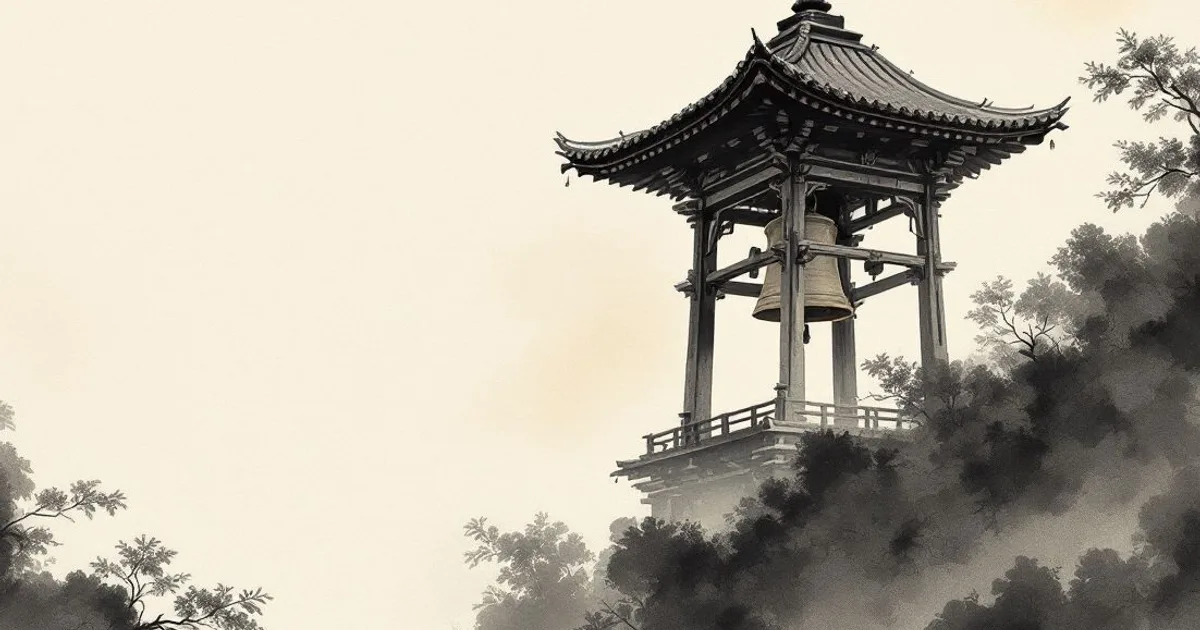
Why do Buddhists ring bells? For four separate reasons: to organise the monastic day, to open and punctuate a service, to mark a date in the calendar, and — in some traditions — to call a wandering mind back to the present. There is no single Buddhist meaning of the bell. Each tradition states its own, and they do not agree.
At Lingyin Temple in Hangzhou the count of 108 falls twice a day. In Japan it belongs to a single night of the year. The Jogye Order’s Korean bell uses neither figure: 28, then 33. Those are not three versions of one custom. They are three customs.
Before bells, a struck wooden beam
The instrument that ran the early Buddhist monastery was not a bell. It was the gaṇḍī, a wooden beam struck with a wooden striker — “sometimes misleadingly translated into English as ‘gong’”, says the introduction to 84000’s translation, which dates its monastic use “from as early as the first century ᴄᴇ down to the present day” and notes that the Vinayavastu classifies five distinct uses of it, from assembling monks to emergencies. The Gaṇḍī Sūtra gives the timetable:
Cleansing the gaṇḍī with flower-petal water
At mealtime, sunrise, and sunset,
Strike it three times at the three intervals.
When it is time for bathing, let it resound twice.
It also gives the sound a symbolic identity — worth naming whose, since this is one Mahāyāna text in the Tibetan canon, not pan-Buddhist doctrine: “The Mother, the Perfection of Insight, is present in the form of the gaṇḍī.”
The early Pali canon, meanwhile, barely rings anything. Its most memorable use of struck bronze is a simile pointing the other way, toward silence:
If you still yourself
like a broken gong,
you reach extinguishment
and know no conflict.
The bell is not a founding Buddhist object, then. It arrived, spread, and picked up a different job almost everywhere it landed — which is why what follows differs so much. (For that arc: the history of Buddhism.)
The great temple bell is struck, not rung
A Japanese bonshō is sounded from outside. The National Bell Festival’s guide to the parts of a Japanese bell puts the mechanism in one line — “there is no clapper inside the bell” — and names the two things that do the work: the shu-moku, “the swinging wooden beam suspended by rope or chain”, and the tsuki-za, the reinforced panel on the bell’s flank that it lands on. Nippon.com, reporting from the Oigo Seisakusho foundry, describes the result as “the deep resounding tone of a Buddhist temple bell after it is struck by a long wooden beam”. Hence the single deep pulse that hangs and fades rather than a peal. The same report gives the making of one: an earthen mould of sand and clay, copper and tin melted in a furnace, and “at least three or four months to create a bell”.
Its two everyday jobs are unglamorous and well attested: mark the passage of time, and call people to services. Nippon.com’s 2013 report from the foundry has Japanese temple bells “periodically announcing the time of day throughout the year”. In the Chinese pattern a bell tower and a drum tower flank the entrance hall — the “morning bell and evening drum” that order the day, a layout Buddhist temple architecture sets out.
That phrase misleads, and Nan Tien Temple says so on its own site: it “may be mistaken as: ‘the gong is sounded in the morning and the drum is hit in the evening.’” In fact both sound at both ends of the day — “in the morning, the gong is sounded first then the drum is hit; in the evening, the drum is hit first and then the gong is sounded.”
The same bell, three different numbers
The Japanese custom is the one that travels. It is not the general one, and the temples and orders below — each describing its own practice, in its own words — show why.
China: 108, twice a day, every day
At Lingyin Temple in Hangzhou the big bell is the ordinary daily signal, “used to call all the monks together or strike the hour, morning and evening”, and the count is exact: “In the morning and evening, the big bell rings three times, with thirty-six strikes respectively, one hundred and eight in total.” Each sounding has its job — “the morning bell rings to awake the long night sleep, while the evening bell striking away the drowsiness.”
Nan Tien Temple, the Fo Guang Shan monastery in Australia, gives the same number with a reason: the gongs sound 108 times “because sentient beings have one hundred and eight types of worries”, at 6:00 each morning and 4:30 each afternoon. (Gong is Nan Tien’s own English for the great bronze bell, not for the wooden gaṇḍī above.) (Buddhism in China has the background.)
Japan: 108, once a year
In Japan the same number belongs to a single night. Joya no kane is the New Year’s Eve bell, struck 108 times to dispel “the 108 worldly passions, such as greed and envy”. The Sōtō Zen school states the meaning of its own observance at Sōjiji plainly: “The bell tolls 108 times to symbolize the eradication of worldly desires.” At Chion-in, head temple of Jōdo Shū in Kyoto, “it takes a team of seventeen monks to strike the bell, and each time the bell rings the monks can be heard shouting ‘Ee hitotsu’ (One more!) and ‘sōre’ (Now!)”.
Where does 108 itself come from? Rev. Toyokazu Hagio of the Honpa Hongwanji Hawaii Betsuin does the arithmetic out loud: six senses — “sight, touch, sound, taste, smell, and consciousness” — times three, for the ways each is taken, “good, bad, or neutral”; times two, “attached or unattached”; times three, “past, present, and future”. That is 108. Take it as one minister’s reckoning: other derivations circulate, and the Korean account below is not doing this sum at all.
One detail needs correcting: the tidy claim that 107 strikes fall before midnight and the 108th after. No source we checked states it, and Chion-in’s own listing starts at 10:40 p.m. It happens around midnight, and temples vary.
Korea: 28 at dawn, 33 at dusk
The Jogye Order of Korean Seon gives different numbers entirely for the great temple bell. Its own guide to the instruments states that the great temple bell “is rung 28 times in the morning and 33 times in the evening”, and that the sound “will save the beings in the heaven and hell realms.”
It derives the numbers from cosmology: 28 for the twenty-eight heavens of the three realms — six of desire, eighteen of form, four formless — and 33 for Doricheon, the Heaven of the Thirty-Three atop Mount Sumeru. But the order’s own essay is careful, saying openly that “there are a number of theories regarding the numbers”, and attaching different meanings to the civil count: “The 28 times signify the 28 constellations and the 33 times refer to the 33 heavens.” Take the cosmological reading as the order’s own.
That civil bell is a different thing again: Bosingak in Seoul is rung 33 times at New Year, a custom the order traces to the Joseon-era curfew signal — which ran 33 at dawn and 28 at night, the exact mirror of the monastic pattern. English sources flip that pair constantly; the mirroring is the fact worth having. Of the New Year tolls the order says the sound is Beomeum, the voice of Brahma.
The bell that runs the day — and everything that is not a bell
Ask which instrument structures monastic time and the answer splits — by region, and even between two monasteries of the same broad tradition. In East Asia the bell is one voice in a set, and often not the one you would guess.
Theravada does not have a single answer either. Wat Pah Nanachat, the international forest monastery near Ubon Ratchathani founded in 1975 for Ajahn Chah’s Western students, opens its published day with a bell and nothing else: “03:00 am Morning wake-up bell”, then “03:30 Morning meeting: chanting and meditation”. No count, no cosmology. But Na Uyana Aranya in Sri Lanka — which its own site calls “one of the oldest Buddhist forest monasteries in Sri Lanka” and home to “more than 200 monks and 40 lay practitioners” — tells guests on that same site, as of September 2026, to listen for something else at mealtimes: “after the wooden block has been sounded, monks should meet outside the Sīmā Sālā with both shoulders covered.” Not a bell. A struck wooden board, like the gaṇḍī above.
In Korean temples the bell is one of four objects of the main hall, each, the Jogye Order says, aimed at a different class of beings: the cow-skin dharma drum for animals, the cloud-shaped gong of bronze or iron plate for “the flying animals and spirits in the air”, the wooden fish “for the sake of saving the living beings in the water”, and the great bell for those in the heavens and hells. One border away the same object means something else: in Chinese temples, the order notes, the cloud-gong hangs in kitchens to signal meal times.
Sōtō Zen’s official instrument list is equally specific. The denshō in the main hall “is rung to announce the beginning of a ceremony”. The bowl-shaped bronze keisu signals “the beginning and the end of sutra chanting”. The wooden moppan is struck by a monastic arriving at the mountain gate “for the first time to join the practice”, and again to confirm the complex is ready for a ceremony. The taiko drum marks “the passage of time”.
Does a bell open and close meditation?
In some traditions, by a precise and old code. In others, not at all — and that split is the assumption most worth unpicking.
Sōtō Zen has a full signal code for it, on the school’s own zendo-manners page: “When zazen begins, the bell is rung three times (shijosho). When kinhin begins, the bell is rung twice (kinhinsho). And when kinhin is finished, the bell is rung once (chukaisho). Also, when zazen is finished, the bell is rung once (hozensho).” So the bell that opens and closes a sit is not a Western invention. It is one school’s liturgy — and not the next school’s.
Rinzai and Ōbaku Zen time a sitting by incense instead. The Joint Council’s own site explains that “a stick of incense ordinarily burns for thirty to forty minutes, a good length of time for a single sitting of zazen. Indeed, in the Zen monastery one sitting is called isshu, ‘one incense stick’.” It mentions no bell at all. (Buddhist incense covers that use.)
Korean Seon halls use wood: the Jogye Order describes the bamboo clapper, jukbi, as “most often used to signal the start and end of meditation and to signal meal times”. And Sōtō’s own instrument list, above, ties the keisu to chanting rather than to zazen — the same school, a different signal, for a different job.
So the bell that opens and closes a sit is neither universal nor modern. It is Sōtō Zen’s rubric, counted out; Rinzai measures the same period by incense, Korean Seon halls by a clapper. The retreat-and-app version inherits a Zen hall’s signal without the rest of the hall. Sit at home without one and nothing is missing.
The bell inside a service
Where bells are genuinely central is liturgy, and there the traditions say what they mean.
In Jōdo Shinshū, a Japanese Pure Land school, the kansho is “rung to signal the beginning of the service and allow time for focusing” and, the Honpa Hongwanji Mission of Hawaii says, “symbolizes the voice of Buddha calling out to ‘Come, seek refuge’.”
In Nichiren Shōshū the household bell is first of all a count. The practice manual scores it exactly through gongyo: face the Gohonzon and ring the bell seven times, recite and sound it three times, then five — and “the bell is not rung during the first prayer”. A bell and bell striker sit among the basic items of a home butsudan. It carries a stated meaning too: when cooked rice is offered to the Gohonzon, the manual says, “ringing the bell three times signifies appreciation for the Three Treasures.” That is a bell used daily by lay people, and it belongs to Nichiren Shōshū specifically, not to Nichiren Buddhism at large.
The mindfulness bell
The best-documented modern use comes from Plum Village, the tradition founded by Thich Nhat Hanh, which states it in its own words. When the bell sounds, everyone is to “stop all of our conversations and whatever we are doing and bring our awareness to our breathing”, for three conscious breaths, with a verse short enough to hold in the mind: “Listen, listen, this wonderful sound, brings me back, to my true home.”
Two details are distinctive. The tradition invites the bell rather than hitting it, and whoever does so first recites a gatha: “Body, speech, and mind in perfect oneness. I send my heart along with the sound of this bell. May the hearers awaken from their forgetfulness and transcend the path of anxiety and sorrow.” And a half-sound warns the community that a full sound is coming.
Most usefully, the mindfulness bell is not really an object. Plum Village extends it to “the ringing of our telephone, the local church bells, the cry of a baby, or even the sound of fire engines and ambulances” — anything that interrupts you can do the work. Note the convergence without merging it: Plum Village in the Zen lineage and Jōdo Shinshū in Pure Land, sharing no liturgy, each describe a bell as the voice of the Buddha.
The Tibetan bell is a different object
The small hand bell held with the vajra belongs to another system. It is a Tibetan ritual implement rather than a timekeeping one — wisdom paired with the vajra’s method, in the teaching of both Lama Zopa Rinpoche and the 14th Dalai Lama, and rung as a reminder of emptiness. The vajra and bell sets that out in full; what matters here is only that it is not the bell in the tower. Its reach shows up elsewhere, though: the Jogye Order says its own hand bell, the yoryeong, “originates from Vajrayāna Buddhism”. Different again is the modern “Tibetan singing bowl”, rubbed rather than struck — see singing bowls. The traditional bowl-shaped Buddhist bell is the keisu above.
What the sound is said to mean — attributed, every time
Symbolic claims about bells are repeated far more often than they are sourced. Here is every meaning we could trace to someone actually stating it:
| Who says it | What the sound is said to be |
|---|---|
| Gaṇḍī Sūtra (Toh 298), Tibetan canon | the Perfection of Insight in audible form |
| Lama Zopa Rinpoche (FPMT) | wisdom, paired with the vajra’s method; the ring a reminder of emptiness |
| Nan Tien Temple (Fo Guang Shan) | 108 strikes for the 108 worries of sentient beings |
| Rev. Toyokazu Hagio (Hawaii Betsuin) | 108 as 6 senses × 3 receptions × 2 × 3 times |
| Sōjiji (Sōtō Zen) | 108 strikes for the eradication of worldly desires |
| Jogye Order (Korea) | the twenty-eight heavens and Doricheon; Beomeum, the voice of Brahma; a sound reaching beings in the heaven and hell realms |
| Nichiren Shōshū (Myoshinji manual) | three strikes at a rice offering: appreciation for the Three Treasures |
| Plum Village | the voice of the Buddha calling you back to your true home |
| Honpa Hongwanji Mission of Hawaii | the voice of the Buddha: “Come, seek refuge” |
One line is missing on purpose. You will read almost everywhere that a bell’s tone fading into silence is a teaching on impermanence. It is a lovely thought, and a teacher may well have taught it. But every meaning in the table above is one we can put a name to, and that one we could not. We went looking for it through the sources listed at the foot of this page — among them 84000’s Gaṇḍī Sūtra, the Jogye Order’s guide to the ritual instruments and its New Year essay, Sōtō Zen’s own liturgy and instrument pages, Plum Village, Chion-in, Lingyin, Nan Tien, the two Hongwanji pages, and the Lama Zopa and Dalai Lama teachings. Between them they identify the sound as the Perfection of Insight, as wisdom and as emptiness, as the voice of the Buddha, as the voice of Brahma, and as a count of defilements. None of them called it a teaching on impermanence. That is a report on what we read, not a claim about what no one has ever taught.
Which points to the practical upshot. In front of a temple bell the useful question is not “what do bells mean in Buddhism” but “what does this one do, here” — where temple etiquette starts, and the same instinct behind bowing: look at what is being done, and ask.
Frequently asked questions
Why is a Buddhist bell rung 108 times?
Because 108 is a traditional count of the defilements. Nan Tien Temple says the gong sounds 108 times because sentient beings have 108 types of worries. Rev. Toyokazu Hagio of the Honpa Hongwanji Hawaii Betsuin derives the number as six senses times three receptions times two times three times. But it is not the only count: the Jogye Order of Korean Buddhism gives 28 in the morning and 33 in the evening.
Can a visitor ring a temple bell?
Sometimes, and it depends on the temple rather than the school. Sojiji, a head temple of Soto Zen, allows each and every visitor a single strike at the New Year. Nippon.com says temple-goers take part at some locations, which means at others they do not. Look for an invitation, and never strike a bell uninvited.
Do you need a bell to meditate?
It depends which tradition you are in. Soto Zen rings the bell three times to begin zazen and once to end it, and names each signal. Rinzai and Obaku Zen instead time a sitting with a stick of incense, which burns thirty to forty minutes, and call one period isshu, one incense stick. The Jogye Order says Korean Seon halls use a bamboo clapper. So a bell is one school's rubric, not a requirement.
What is a mindfulness bell?
In the Plum Village tradition of Thich Nhat Hanh it is any sound that stops you. When it sounds, everyone stops talking and stops what they are doing and takes three conscious breaths. Plum Village extends it to the telephone ringing, the local church bells or the cry of a baby, so it is a category of reminder rather than one object.
Is a singing bowl a Buddhist bell?
A bowl-shaped bell is genuinely traditional; the singing is the modern part. Soto Zen liturgy uses the keisu, a bronze bowl bell resting on a cushion, struck with a cloth-covered stick to mark the beginning and end of sutra chanting. The continuous tone made by rubbing the rim, and the Tibetan origin story attached to it, are much more recent.
Do Buddhist bells ward off evil spirits?
Not in the temple sources we checked. The purposes they state in their own words are practical or symbolic: calling people to a ceremony, marking the hours, counting defilements, opening a service. The Jogye Order does describe bell-ringing to chase out malicious spirits, but as a Joseon-era folk custom of commoners at New Year, alongside firecrackers, not as what a temple bell is for.
Sources
- The Gaṇḍī Sūtra (Toh 298), trans. Annie Bien, 84000: Translating the Words of the Buddha — the gaṇḍī as a struck wooden beam used in Buddhist monasteries 'from as early as the first century ᴄᴇ' to summon monks, 'sometimes misleadingly translated into English as gong'; the Vinayavastu's five uses; the striking schedule at mealtime, sunrise and sunset (1.25); and 'The Mother, the Perfection of Insight, is present in the form of the gaṇḍī'
- Dhammapada 134 (Daṇḍavagga), SuttaCentral (trans. Bhikkhu Sujato, CC0) — 'If you still yourself like a broken gong, you reach extinguishment and know no conflict' (Pali: kaṁso upahato yathā); the early canon's use of the struck bronze instrument as an image of silence
- 'Bell and Drum Tower', Lingyin Temple (Hangzhou) official English site — the bell and drum towers flanking the Hall of Heavenly Kings, and the daily morning and evening bell: 'In the morning and evening, the big bell rings three times, with thirty-six strikes respectively, one hundred and eight in total'; 'The morning bell rings to awake the long night sleep, while the evening bell striking away the drowsiness'
- 'Symbolism', Nan Tien Temple (Fo Guang Shan, Australia) — the common misreading of 'the morning gong and evening drum' and the temple's own correction ('In the morning, the gong is sounded first then the drum is hit; in the evening, the drum is hit first and then the gong is sounded'); the gong sounded 108 times 'because sentient beings have one hundred and eight types of worries'; and the temple's own times of 6:00 and 4:30
- 'Ōmisoka: New Year's Eve in Japan', Nippon.com — joya no kane, the temple bell struck 108 times to dispel 'the 108 worldly passions, such as greed and envy', usually by monks and 'at some locations' by ordinary temple-goers
- 'Why do we ring the temple bell 108 times on New Year's Eve?', Rev. Toyokazu Hagio, Honpa Hongwanji Hawaii Betsuin (Jōdo Shinshū), 2 January 2017 — one minister's derivation of 108 as six senses × three receptions × two × three times, and striking the kansho to symbolically 'ring out' our passions and delusions
- 'Joya-no-kane (Bell Ringing on New Year's Eve)', Chion-in official site (head temple of Jōdo Shū, Kyoto) — 108 strikes representing the number of desires we hold, a start time of 10:40 p.m., and 'it takes a team of seventeen monks to strike the bell, and each time the bell rings the monks can be heard shouting "Ee hitotsu" (One more!) and "sōre" (Now!)'
- 'The Sōtō Zen Annual Event Calendar', SOTOZEN.COM (official site of the Sōtō Zen school) — at Sōjiji 'the bell tolls 108 times to symbolize the eradication of worldly desires', and 'Sojiji allows each and every visitor a single strike on the bell'
- 'Narashimono (Buddhist Musical Instruments)', SOTOZEN.COM — the denshō rung 'to announce the beginning of a ceremony or to assemble the participants', the bowl-shaped bronze keisu that signals 'the beginning and the end of sutra chanting', the hand-held shukei (inkin) that leads 'the procession and the recession of the officiant', the wooden moppan struck by a monastic arriving at the mountain gate 'for the first time to join the practice' and to confirm the complex is ready for a ceremony, and the taiko that marks 'the passage of time'
- 'Manners in the Zendo', SOTOZEN.COM (official site of the Sōtō Zen school) — the school's own bell code for a sitting: 'When zazen begins, the bell is rung three times (shijosho). When kinhin begins, the bell is rung twice (kinhinsho). And when kinhin is finished, the bell is rung once (chukaisho). Also, when zazen is finished, the bell is rung once (hozensho)'
- 'Zazen – Sitting', Rinzai-Ōbaku Zen, 'The Official Site of the Joint Council for Japanese Rinzai and Obaku Zen' — a sitting is timed by a stick of incense that 'ordinarily burns for thirty to forty minutes', and one period is called isshu, 'one incense stick'
- 'A Typical Day' / 'Visiting', Wat Pah Nanachat, the International Forest Monastery near Ubon Ratchathani, Thailand (established 1975 in the Ajahn Chah lineage for Western monks) — the monastery's published practice schedule, which opens '03:00 am Morning wake-up bell' and continues '03:30 Morning meeting: chanting and meditation'
- 'Na Uyana – English', Na Uyana Aranya (Ironwood Grove Forest Monastery), Sri Lanka — the monastery's own guest page: 'one of the oldest Buddhist forest monasteries in Sri Lanka', 'more than 200 monks and 40 lay practitioners', and the mealtime signal 'After the wooden block has been sounded, monks should meet outside the Sīmā Sālā with both shoulders covered'
- '08. Instruments for Buddhist Rituals (Beopgu)', Introduction to Korean Buddhism, Jogye Order of Korean Buddhism (Internet Archive capture; the live site is http-only and was unreachable) — the great bell 'rung 28 times in the morning and 33 times in the evening', the four objects of the main hall and the beings each is said to reach, the cloud-shaped gong 'made of bronze or iron plate', the bamboo clapper (jukbi) that signals 'the start and end of meditation', and the hand bell (yoryeong) that 'originates from Vajrayāna Buddhism'
- '[The Day We Go to Temple] 13. The Buddhist Customs on New Year's Eve', Jogye Order of Korean Buddhism, from Lotus Lantern magazine, winter 2016 (Internet Archive capture) — Bosingak rung 33 times; the Joseon curfew bell rung 33 at dawn and 28 in the evening, where '28 times signify the 28 constellations and the 33 times refer to the 33 heavens'; the reversed temple pattern with 'a number of theories regarding the numbers'; Doricheon; the tolls as Beomeum, the voice of Brahma; and the commoners' New Year custom of loud noises to chase out malicious spirits
- 'The Jodo Shinshu Service', Honpa Hongwanji Mission of Hawaii — the kansho bell 'rung to signal the beginning of the service and allow time for focusing', symbolising 'the voice of Buddha calling out to Come, seek refuge'
- 'Extended Practices', Plum Village (official site of the Plum Village tradition) — the bell of mindfulness: stopping all conversation and activity, three conscious breaths, the gatha 'Listen, listen, this wonderful sound, brings me back, to my true home', and the extension to 'the ringing of our telephone, the local church bells, the cry of a baby, or even the sound of fire engines and ambulances'
- 'Inviting the Bell', Plum Village App (official Plum Village) — why the tradition says 'inviting' rather than hitting the bell, the bell-master's four-line gatha, the half-sound that precedes the full sound, and the full sound as the voice of the Buddha calling hearers back to their true home
- 'Nichiren Shoshu Basics of Practice' (PDF), Myoshinji Temple, Nichiren Shōshū — the exact bell counts through the five prayers of gongyo (seven, three, five), the note that 'the bell is not rung during the first prayer', a bell and bell striker listed among basic butsudan items, and, at a rice offering, 'Ringing the bell three times signifies appreciation for the Three Treasures'
- Lama Zopa Rinpoche, 'When You Ring the Bell, Think of Emptiness' (FPMT, from the 100 Million Mani Mantra Retreat, Italy, October 2017) — 'the vajra symbolizes method and the bell, wisdom', that the two 'should be held together, not one by one', and 'You ring the bell and meditate on that', meaning emptiness
- 'Permission and Empowerment of Avalokiteshvara…' (Tokyo, 13 April 2015), dalailama.com — the 14th Dalai Lama stating that 'the vajra represented deity yoga, while the bell represented understanding of emptiness', and that the two 'are employed together to show that deity yoga and wisdom are indivisible'
- 'Learn about the Different Parts of a Japanese Bell', National Bell Festival (bells.org, a US non-profit devoted to bells and campanology) — 'There is no clapper inside the bell'; the shu-moku, 'the swinging wooden beam suspended by rope or chain'; and the tsuki-za, 'a raised striking point or reinforced area on the bell's surface'
- 'New Bells with an Age-old Sound: Oigo Seisakusho', Nippon.com, 7 October 2013 — a working Japanese bell foundry: 'the deep resounding tone of a Buddhist temple bell after it is struck by a long wooden beam'; an earthen mould of sand and clay, copper and tin melted in a furnace, and 'at least three or four months to create a bell'; and Japanese temple bells 'periodically announcing the time of day throughout the year'