Ullambana: The Buddhist Ghost Festival
Ullambana — the Buddhist “Ghost Festival” — is an East Asian festival of the dead, kept on the 15th day of the 7th lunar month, on which people make offerings to the monastic community and to their ancestors and transfer the merit to their departed parents and to suffering hungry ghosts.
Known in China as Yulanpen and in Japan as Obon, it grows from the story of the disciple Mulian — the monk we met in Pāli as Mahā Moggallāna — rescuing his mother from a wretched rebirth. It is among the most tender of the Buddhist festivals.
The story of Mulian and his mother
At the festival’s heart is one of the most beloved stories in East Asian Buddhism. Mulian — the Chinese name for Maudgalyāyana, the disciple foremost in psychic power — after his awakening used his spiritual sight to seek out his deceased mother. He found her reborn among the hungry ghosts (pretas): beings tormented by insatiable hunger, whose throats are too narrow to eat. Whatever food he sent her by his own power turned to fire or ash before she could swallow it.
Grief-stricken and unable to free her alone, Mulian went to the Buddha. The Buddha explained that the burden of her past deeds was too heavy for any single person to lift — but that the combined merit of the whole monastic community, offered on his mother’s behalf at the close of the rains retreat, could reach where he could not. Mulian made the offering, and his mother was released. The festival re-enacts that rescue every year: through generosity to the Sangha and the transfer of merit, the living reach back to help the dead.
Many names, one festival
The festival travelled, and took on many names — worth keeping straight:
- Ullambana / Yulanpen (盂蘭盆) is the Buddhist name (the Japanese Bon is a shortening of Ullambana).
- Zhongyuan (中元) is the Daoist name for the same day, honouring a different festival calendar that happens to coincide.
- The “Hungry Ghost Festival” is the popular, folk name, wrapped in customs about wandering spirits let loose during the seventh “ghost month.”
- Obon (お盆) is the Japanese form.
This overlap is itself instructive: Ullambana is an East Asian observance — Chinese, Japanese, Korean, Vietnamese — in which Mahayana Buddhism, Daoism, and older folk religion have long intermingled. It is not a Theravada festival, and one should be careful not to flatten its distinct Buddhist, Daoist, and folk strands into a single thing.
The scripture — and an honest note
The Buddhist basis of the festival is the Yulanpen Sūtra (the Ullambana Sūtra), which tells the Mulian story. Here honesty about sources, which this site holds to, requires a clear note: most modern scholars regard the Yulanpen Sūtra as a Chinese composition — an “apocryphon” — rather than a translation of an Indian scripture. No Indic original survives, and the text places great weight on filial piety, the Confucian devotion to one’s parents that runs deep in Chinese culture. The standard scholarly study, Stephen Teiser’s The Ghost Festival in Medieval China, traces how the festival rose to prominence in medieval China on exactly this fusion of Buddhist merit and Chinese reverence for ancestors.
None of this lessens the festival’s meaning for the millions who keep it. But it would be inaccurate to present the sūtra as canonically Indian, and so we don’t. What the festival unmistakably is — a yearly act of love toward the dead — needs no false pedigree.
When it falls
Ullambana is kept on the 15th day of the 7th lunar month, the high point of the “ghost month” of Chinese tradition — usually falling in August by the Western calendar. Japan’s Obon varies by region: most of the country keeps it around 15 August, parts of Tokyo in mid-July, and some areas still by the old lunar date. As ever with the Buddhist calendar, there is no single fixed day.
How it is observed
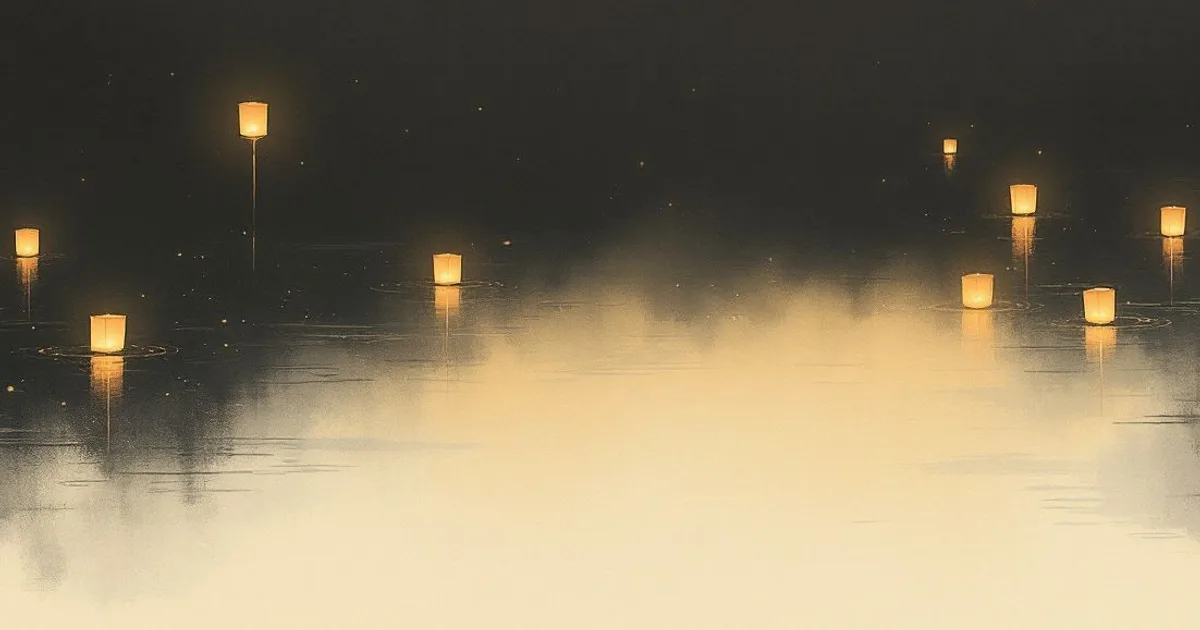
The festival’s acts all flow from the Mulian story. Families make offerings of food to the monastic community, understood as the “field of merit” through which help reaches the departed; they set out offerings for their ancestors and for the wandering, unclaimed “orphan” ghosts who have no descendants to feed them; and they transfer the merit of all this giving to their parents and forebears. In Japan, Obon adds its own gentle customs: visiting and tidying family graves, lighting lanterns to welcome the ancestral spirits home and to see them off again, and the communal Bon-odori folk dance of welcome.
Beneath the imagery of ghosts and merit lies something simply human: the wish to care for those we have lost, and the refusal to believe that death ends our responsibilities to them. For anyone carrying such a loss, our reflections on grief may be a quieter companion; for the beings the festival reaches toward, see hungry ghosts; for its Japanese form, Obon; and for the disciple whose love began it all, Mahā Moggallāna.
Frequently asked questions
What is Ullambana?
Ullambana (Chinese: Yulanpen) is an East Asian Buddhist festival of the dead, kept on the 15th day of the 7th lunar month. People make offerings to the monastic community and to their ancestors, and transfer the merit to their departed parents and to suffering 'hungry ghosts.' It is rooted in the story of the disciple Mulian, known in Pāli as Mahā Moggallāna, rescuing his mother from rebirth among the hungry ghosts.
What is the story behind the Ghost Festival?
The disciple Mulian (Maudgalyāyana / Mahā Moggallāna), foremost in psychic power, used his spiritual sight to find his deceased mother, and saw she had been reborn among the hungry ghosts, unable to eat. Unable to free her himself, he asked the Buddha, who told him to make offerings to the whole monastic community at the end of the rains retreat. Through that merit his mother was released, and the festival re-enacts this yearly.
Is Ullambana the same as Obon?
Essentially, yes. Obon is the Japanese form of the same festival; the word 'Bon' is a shortening of 'Ullambana'. In China it is Yulanpen, the Ghost Festival. Japan adds its own customs, such as visiting family graves, lighting lanterns to welcome the ancestral spirits home, and the Bon-odori dance, but the root is the same story and the same purpose: caring, through offerings and merit, for the dead.
Is the Ullambana Sutra a genuine Indian scripture?
Probably not. Most modern scholars regard the Yulanpen (Ullambana) Sūtra as a Chinese composition, an 'apocryphon', rather than a translation of an Indian original, partly because no Indic version survives and because the text foregrounds Confucian filial piety. This does not lessen the festival's meaning, but it would be inaccurate to present the sūtra as canonically Indian.
Sources
- Stephen F. Teiser, 'The Ghost Festival in Medieval China' (Princeton University Press, 1988) — the standard scholarly study, which translates the Yulanpen Sūtra and treats it as a Chinese composition
- Yulanpen (Ullambana) Sūtra — the source of the Mulian / Maudgalyāyana story; widely regarded in modern scholarship as a Chinese apocryphon (no surviving Indic original), foregrounding filial piety
- 'Mulian Rescues His Mother' (Encyclopedia of Buddhism) — the legend behind the festival; the identity of Mulian with the disciple Maudgalyāyana (Pāli: Mahā Moggallāna)
- The festival's names: Ullambana / Yulanpen (盂蘭盆, Buddhist); Zhongyuan (中元, Daoist); the popular 'Ghost Festival'; and the Japanese Obon (お盆) — kept on the 15th day of the 7th lunar month