Giant Buddha Statues: Leshan, Bamiyan and the Tallest
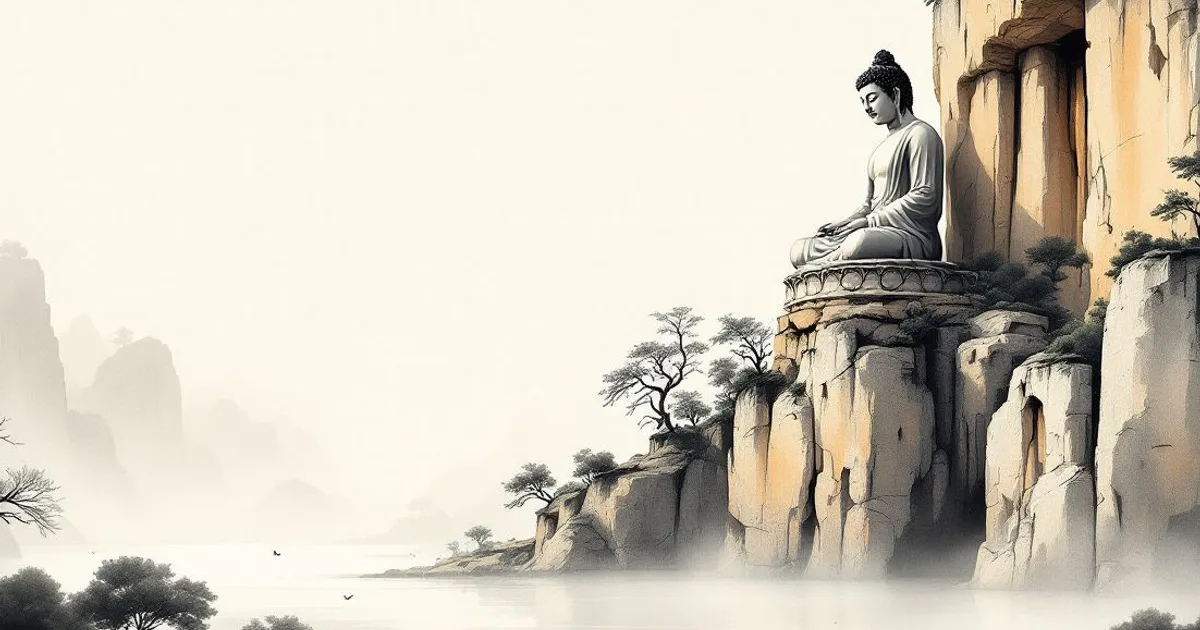
A giant Buddha is a statue far larger than life, made out of devotion or to honour a ruler. The tallest standing today, according to the art historian Dorothy Wong and Henan’s government, is China’s Spring Temple Buddha, a Vairocana 108 metres tall and 208 in total. The largest before modern times, in Wong’s view, is the 71-metre Leshan Maitreya; the Bamiyan Buddhas were destroyed in 2001. Bangkok’s Golden Buddha is, for Guinness, the largest solid gold sculpture, and Hong Kong’s “Big Buddha” is the Tian Tan Buddha.
Not every giant Buddha is the historical Buddha: Wong finds that the colossi “predominantly feature Śākyamuni (the Historical Buddha), Maitreya (the Future Buddha), and Vairocana” (p. 1). Heights vary with what is counted, statue, lotus seat, pedestal or platform, so each is given here as its source gives it.
The giant Buddhas at a glance
| Statue | Depicts | Where | Made | Height (source) |
|---|---|---|---|---|
| Spring Temple Buddha | Vairocana, standing | Lushan County, Henan, China | 1997–2008 (Wong) | 108 m statue; 208 m in total (Wong) |
| Ushiku Daibutsu | Amida (Amitabha) | Ushiku, Ibaraki, Japan | completed 1992 (Guinness) | 120 m (temple); 110 m, Buddha and lotus base (Guinness) |
| Buddha at Lingshan | Amitabha, standing | Wuxi, Jiangsu, China | 1996 (Wong) | 88 m (Wong) |
| Leshan Giant Buddha | Maitreya, seated | Leshan, Sichuan, China | 713–803 (Wong) | 71 m (UNESCO); body 59.96 m (ICOMOS) |
| Bamiyan Buddhas (two) | likely a transcendent Shakyamuni (Wong) | Bamiyan, Afghanistan | larger AD 591–644, smaller AD 544–595 (scientific dating); destroyed 2001 | 55 m and 38 m (UNESCO) |
| Tian Tan (“Big”) Buddha | Shakyamuni, seated | Po Lin Monastery, Hong Kong | inaugurated 1993 (Po Lin) | 26.4 m (Wong) |
| Great Buddha of Todai-ji | Vairocana, seated | Nara, Japan | consecrated 752 (temple) | 14.98 m, on a 3.05 m pedestal (temple) |
| Great Buddha of Kamakura | Amida (Amitabha), seated | Kotoku-in, Kamakura, Japan | begun 1252 (temple) | 11.312 m; 13.35 m with platform (temple) |
| Reclining Buddha of Wat Pho | the Buddha lying down | Bangkok | Rama III, B.E. 2375 (temple) | 46 m long; 15 m high, base to topknot (temple) |
| Golden Buddha | a Buddha image | Wat Traimit, Bangkok | unknown; Sukhothai style (Guinness) | 3 m; 5.5 t of gold (Guinness) |
Which giant Buddha is the biggest?
It depends what you measure, and who is measuring:
- Tallest standing: the Spring Temple Buddha. Wong wrote in 2019 that “Currently, the largest standing Buddha statue is the Vairocana image” at Yaoshan (p. 20); Henan’s government called it “the tallest of its kind in the world” in 2020. We found no Guinness record for a tallest Buddha statue, and colossi are still being built, so this is a dated claim.
- Bronze: Guinness World Records lists the Ushiku Daibutsu under “Tallest bronze sculpture”: 110 metres for the Buddha and its lotus base. Chen Ching-hsiang, writing in 2013, calls the Spring Temple Buddha the world’s largest cast-bronze standing Buddha. The two claims conflict, so we give both.
- Before modern times: the Leshan Maitreya, “the largest of all colossi in pre-modern times” in Wong’s words (p. 15). UNESCO’s superlatives for it are set out in the greatest Buddhist monuments.
- Seated: the Leshan Maitreya, carved from the cliff, is 71 metres high (UNESCO). Two newer claims conflict: Wong (2019, p. 20) calls the 48-metre seated Buddha at Liudingshan, Jilin (2011) “the world’s tallest seated Buddha statue”, “20 meters taller than the Hong Kong example”, while Po Lin Monastery’s site (read November 2026) calls its Big Buddha “the biggest sitting Buddha statue built outdoor”.
- Solid gold: the Golden Buddha of Wat Traimit, by Guinness’s record.
Myanmar’s Laykyun Sekkya at Monywa often appears in such lists; we have not found a reliable source for its height, so it is not in our table (for the country’s Buddhism, see Buddhism in Myanmar).
Why Buddhists built colossal Buddhas
Devotion. Colossi, Wong writes, “were fashioned out of religious devotion and frequently in conjunction with notions of Buddhist kingship” (p. 1), and she notes the “religious economy associated with travels and pilgrimages to view and worship” them (p. 18).
What counts as giant. According to descriptions in Buddhist texts, Wong writes, the Buddha stood 16 chi, about 4.8 metres, which became the standard “full-size” image in East Asia (jōroku in Japanese). Anything taller, she reports, scholars call a “Great Buddha” (p. 3): Chinese dafo, Japanese daibutsu.
A cosmic Buddha. As Buddhist thought exalted the Buddha as supramundane, colossal size “became a metaphor for the cosmic, universal dimension of the Buddha or Buddhahood” (Wong, p. 3). Several East Asian giants depict Vairocana, the cosmic Buddha of the Avatamsaka Sutra.
The future Buddha. Maitreya sutras, such as the one Wong cites from the Chinese canon (T 456), make Maitreya, the Buddha to come, 320 chi tall; Akira Miyaji argues, as Wong reports, that such descriptions inspired colossal Maitreyas (p. 5).
Kings and emperors. Once spiritual and temporal kingship merged, Wong argues, a statue’s scale came “to symbolize the authority and stature of rulers” (p. 3). Todai-ji’s history says Emperor Shomu ordered a monumental Vairocana in 743, hoping that “the benefits of peace may be brought to all in heaven and on earth”.
Giving. The early projects were started by monks, Wong notes, raising funds themselves or securing the support of rulers and local officials (p. 18); the sums needed often relied on official support (p. 24). At Bamiyan, Xuanzang records that the king often held a five-yearly assembly at which he gave everything from his queen down to the national treasures to the monks, then gave himself, and his officials ransomed him: an act of dana, or generosity, which Wong reads with the statues as evidence of Buddhist kingship (p. 8).
The Leshan Giant Buddha
The Leshan Giant Buddha is a seated Maitreya carved from a sandstone cliff where the Min, Qingyi and Dadu rivers meet in Sichuan. Wong (p. 15) records that the monk Haitong began it in 713 and that it was finished in 803, after two further phases funded by the officials Zhangchou Jianqiong and Wei Gao. Wei’s dedicatory inscription records Haitong’s hope that the Buddha would “calm the turbulent waters” that plagued boats on the river.
UNESCO gives 71 metres; ICOMOS’s 1996 evaluation gives 71 metres overall, with the body 59.96 metres. Three drainage tunnels cut in ancient times run through the head, neck and chest, a 2021 conservation study reports, but seepage through the chest and abdomen is still damaging the stone. The statue is inscribed with Mount Emei as a World Heritage site, covered in the greatest Buddhist monuments; for its setting, see Buddhism in China.
The Bamiyan Buddhas
Two standing Buddhas, 55 and 38 metres high by UNESCO’s figures, stood in niches cut into the cliffs of the Bamiyan Valley in Afghanistan. The Chinese pilgrim Xuanzang passed through in the early 7th century:
To the northeast of the royal city, at a corner of the mountains, there is a rock statue of the standing Buddha, one hundred forty or fifty feet in height, of a dazzling golden color and adorned with brilliant gems.
“Feet” renders the Chinese chi (尺). He also describes a cast standing Buddha over 100 chi tall; our sources do not say which description matches which niche.
Who they were. Wong judges that the two “most likely represent a transcendent form of Śākyamuni” (p. 7), linking their scale to the Lokottaravāda school, which Xuanzang found among Bamiyan’s monks.
How old. Still debated. Mass-spectrometer dating of organic matter in the statues’ clay, by a Technical University of Munich team led by Erwin Emmerling, gave the smaller Buddha AD 544–595 and the larger AD 591–644, Archaeology magazine reported in 2011. Most scholars, it says, had dated them one to two centuries earlier from the style of the robes; Wong (p. 7), citing earlier studies, puts the larger in the 7th century and the smaller probably in the 8th.
What happened. The Taliban leader Mullah Mohammed Omar ordered all statues in Afghanistan broken, citing a fatwa of Afghan scholars and a verdict of the country’s Supreme Court: the “idols”, he said, “have been gods of the infidels” and might become gods again (quoted in Archaeology, 2 March 2001). On 2 March 2001 the Taliban began firing artillery at the statues; explosives brought them down by the end of the month (Archaeology, 2011). In 2011 Brendan Cassar of UNESCO’s Kabul office said plans to rebuild them had been rejected as too costly and difficult; he did not rule out a reconstruction someday, but said the work then was to plug cracks in the unstable niches, clear mines and unexploded bombs, and conserve what could be saved of the rubble. Field work halted after August 2021; UNESCO reported in 2024 that some projects had resumed since February 2023, in particular those funded by Italy and Japan, and it lists the “risk of collapse of the Giant Buddha niches” among the threats to the site. For the valley as a World Heritage site, see the greatest Buddhist monuments.
The Great Buddhas of Japan
Todai-ji, Nara. The Great Buddha is “properly known as Vairocana Buddha”, the temple says, and it explains Vairocana through Śākyamuni’s enlightenment as the Avatamsaka Sutra describes it; Wong calls Vairocana “the transcendent form of Śākyamuni” (p. 4). Cast in eight stages, it was finished in 749 and consecrated in 752. Much of what stands is restored. Its head fell in an earthquake in 855; after fires set in 1180 the monk Chōgen repaired the head and left hand and rededicated it in 1185; after the hall burned in 1567 the statue “was washed by rains for almost one hundred years”, until the head was recast from 1686 and the statue rededicated in 1692. The present hall, about sixty percent of the original width, was dedicated in 1709. The temple measures it at 14.98 metres on a 3.05-metre pedestal. Todai-ji and its hall are covered in the greatest Buddhist monuments; see Buddhism in Japan for its place in Nara Buddhism.
Kotoku-in, Kamakura. The Kamakura Daibutsu is “a colossal copper image” of Amida, the temple says: Amitabha, the Buddha of the Pure Land. Construction began in 1252, according to the chronicle Azumakagami; its maker is unknown. Its hall was destroyed in 1334, 1369 and 1498, so it sits in the open air, which, the temple notes, makes it unusual among large Buddha statues in Japan. The temple gives 11.312 metres for the statue, 13.35 metres with the platform.
Ushiku Daibutsu, Ibaraki. Also an Amida. Its official site, that of the head temple of the Jodo Shinshu Higashi Honganji-ha, a Pure Land denomination, gives 120 metres, a height chosen for Amida’s twelve lights, and says sutras are chanted inside every morning and evening. Guinness measures the Buddha and lotus base only: 110 metres, completed in 1992.
The Big Buddha of Hong Kong
The Tian Tan Buddha at Po Lin Monastery, Lantau Island, is the statue the monastery itself calls “the Big Buddha”. Po Lin named it for the Tian Tan, Beijing’s Altar of Heaven, which inspired its base. It depicts Shakyamuni, seated, right hand in the gesture of fearlessness, left in the gesture of granting wishes (see mudras). The monastery says its monks resolved to build it after seeing the Kamakura Great Buddha in 1973, and that it “symbolizes the stability of Hong Kong, prosperity of China and peace on earth”. Cast in 202 bronze pieces, it had its last piece put in place on 13 October 1989 and was inaugurated on 29 December 1993. Wong gives its height as 26.4 metres, without saying what the figure includes; Po Lin’s own page gives no overall height, and we have found no official source for the larger figures quoted elsewhere.
The modern colossi of China
China’s modern wave of colossi began with the Hong Kong Buddha, Wong writes (p. 20). Others followed, among them the standing bronze Amitabha at Lingshan, Wuxi (1996), 88 metres in Wong’s table (p. 19). The tallest is the Spring Temple Buddha, the “Great Buddha of the Central Plain”, a standing Vairocana completed in 2008 at Yaoshan, Henan: 108 metres for the statue and 208 in all (Wong). Chen Ching-hsiang, reporting on a 2013 visit in the Buddhist magazine Torch of Wisdom, places it in the scenic area of the Foquan Temple (佛泉寺) and gives its total height as 208 metres, with a 20-metre lotus seat, a 25-metre vajra seat and a 55-metre sumeru pedestal (p. 36). Not every modern giant is a Buddha: Wong’s 108-metre figure at Sanya, Hainan, is the bodhisattva Guanyin.
Why build them now? Not for Buddhist kingship, Wong finds; the money comes from governments and companies, and while “the religious intents in making these colossal statues are not in doubt”, heritage and tourism are more prominent (p. 23). The tourism consultant Zhou Mingqi argued in Sixth Tone (2018) that, for the local governments that approve them, these statues “may be aimed at the country’s religious believers”, but their “real purpose is far more worldly: making money”. Henan’s government says the Spring Temple Buddha draws believers to worship.
The Golden Buddha of Wat Traimit
The Golden Buddha in Bangkok is giant by weight, not height. Guinness World Records lists the Golden Buddha of Wat Traimit as the world’s largest solid gold sculpture: 3 metres tall and 5.5 tonnes of gold. Its origin is unknown, Guinness says, though its style suggests the Sukhothai era. At some point it was covered in plaster, “most likely” to hide it from invading Burmese. On 25 May 1955 it was dropped while being moved, the plaster chipped, and the gold showed through. See also Buddhism in Thailand.
Reclining Buddhas
A reclining Buddha shows the Buddha’s final passing. In the Mahāparinibbāna Sutta he asks Ānanda to set up a bed between twin sal trees:
And then the Buddha laid down in the lion’s posture—on the right side, placing one foot on top of the other—mindful and aware.
The posture is explained in what a Buddha statue means, the story of his last days in the death of the Buddha, and the day that remembers it in Parinirvana Day.
Wat Pho, Bangkok. The temple’s Phra Buddha Saiyas is brick and stucco, lacquered and gilded, 46 metres long and 15 metres high from the base to the topknot, in what it calls the “Lion Sleep” position. Its Thai page says King Rama III had it made in the restoration of C.S. 1193 / B.E. 2375, and calls it the largest reclining Buddha in Bangkok and third largest in Thailand.
Gal Vihara, Polonnaruwa. ICOMOS (1982) dates the Gal Vihara, “with its gigantic rock sculptures”, to the reign of Parakramabahu I (1153–1186). The Cleveland Museum of Art describes a 12th-century monastic site with “a colossal stone sculpture of the reclining Buddha”, in ruins when Joseph Lawton photographed it in 1870–71. See Buddhism in Sri Lanka.
For how these statues fit the wider story, see the history of Buddhism.
Frequently asked questions
What is the tallest Buddha statue in the world?
The Spring Temple Buddha in Lushan County, Henan, China, according to the art historian Dorothy Wong (2019) and Henan's provincial government (2020). It is a standing Vairocana, 108 metres tall and 208 metres in total height (Wong), completed in 2008. We found no Guinness record for a tallest Buddha statue, and new colossi are still being built, so treat any such title as dated.
Why was the Leshan Giant Buddha built, and who does it depict?
To calm the dangerous waters below: Dorothy Wong (2019) reports that the monk Haitong began it in 713 and that its dedicatory inscription records his hope that the Buddha would calm the turbulent waters. It was finished in 803. It depicts Maitreya, the future Buddha, as Wong and a 2021 conservation paper both identify it. UNESCO gives its height as 71 metres.
How old were the Bamiyan Buddhas?
Their dates are debated. Mass-spectrometer tests by a Technical University of Munich team, reported in 2011, dated the smaller Buddha to AD 544-595 and the larger to AD 591-644. Before the tests, Archaeology reported, most scholars had dated them one to two centuries earlier from the style of the robes; Wong (2019), citing earlier studies, dates the larger to the 7th century and the smaller probably to the 8th.
Why were the Bamiyan Buddhas destroyed?
The Taliban destroyed them in March 2001 on the order of their leader, Mullah Mohammed Omar, who cited a fatwa of Afghan scholars and a verdict of the Afghan Supreme Court and called such statues idols that had been 'gods of the infidels'. Archaeology magazine reported that artillery probably did little damage and that explosives brought them down by the end of the month.
Is the Golden Buddha in Bangkok really solid gold?
Yes, according to Guinness World Records, which lists it as the world's largest solid gold sculpture: 3 metres tall and 5.5 tonnes of gold. It sits in Wat Traimit in Bangkok. Guinness says it had been covered in plaster and that the gold was found on 25 May 1955, when the statue was dropped while being moved.
Where is the Big Buddha?
The Big Buddha is the name Po Lin Monastery gives its Tian Tan Buddha on Lantau Island, Hong Kong: a seated bronze Shakyamuni inaugurated on 29 December 1993. Statues on Phuket and Koh Samui in Thailand are also searched for under that name, but we found no official or scholarly source for either, so we give no details.
Sources
- Dorothy C. Wong, 'Colossal Buddha Statues along the Silk Road', Acta Via Serica 4.2 (December 2019): 1-27, doi:10.22679/avs.2019.4.2.001 (peer-reviewed, open access): why colossi were made (pp. 1, 3, 5, 8, 18, 24), the zhangliu standard (p. 3), Vairocana as the transcendent form of Sakyamuni (p. 4), Bamiyan (pp. 7-8), Leshan as Maitreya, Haitong, 713-803 and Wei Gao (p. 15), the modern Chinese colossi in Table 2 (p. 19), the Hong Kong Buddha at 26.4 m, Liudingshan and the Spring Temple Vairocana at 108 m and 208 m (pp. 20-21), and modern funding (pp. 22-24)
- Mount Emei Scenic Area, including Leshan Giant Buddha Scenic Area, UNESCO World Heritage Centre, dossier 779 (inscribed 1996): the 71 m Giant Buddha carved in the 8th century (read via the Wayback snapshot of 22 October 2026)
- ICOMOS advisory body evaluation, Mount Emei and Leshan, No 779 (1996): 71 m overall with the body 59.96 m, begun in the early 8th century and some ninety years in the making
- Sun Bo, Zhang Peng, Shen Xiwang and Liu Yuyuan, 'Characterizing-water seepage damage in the chest-abdomen area of the Leshan Giant Buddha', Japanese Geotechnical Society Special Publication 9 (2021), p. 403, doi:10.3208/jgssp.v09.cpeg087: AD 713 to AD 803, the three drainage tunnels the ancients cut, and the unsolved seepage
- Cultural Landscape and Archaeological Remains of the Bamiyan Valley, UNESCO World Heritage Centre, dossier 208rev: the 55 m and 38 m Buddhas destroyed by the Taliban in 2001 (read via the Wayback snapshot of 1 January 2026)
- UNESCO World Heritage Centre, State of conservation of the Bamiyan Valley, 2024 (SOC 4560): field projects funded by Italy and Japan resumed from February 2023, the risk of collapse of the Giant Buddha niches, and the stabilisation of the western Buddha niche (read via the Wayback snapshot of 22 November 2024)
- Andrew Lawler, 'Back to Bamiyan, Ten Years Later', Archaeology 64.4 (July/August 2011): the Technical University of Munich team's mass-spectrometer dates, AD 544-595 and AD 591-644, the destruction of March 2001, and Brendan Cassar of UNESCO's Kabul office on rebuilding
- 'Destructive Frenzy in Afghanistan: Comments by the Taliban', Archaeology (Archaeological Institute of America), 2 March 2001: the statements of Mullah Mohammed Omar on breaking the statues
- Xuanzang, The Great Tang Dynasty Record of the Western Regions, trans. Li Rongxi (BDK English Tripitaka, 1996), fascicle 1, Bamiyana, p. 31
- Da Tang Xiyu ji, T51 no. 2087, p. 873b, CBETA: the Chinese text of Xuanzang's Bamiyan passage
- Todai-ji, official English site, Daibutsu-den: 'The Daibutsu is properly known as Vairocana Buddha', explained through Sakyamuni's enlightenment in the Avatamsaka Sutra
- Todai-ji, official English site, History: 8th century (trans. Samuel C. Morse): Emperor Shomu's 743 edict, the casting in eight stages completed in 749, and the consecration of 752
- Todai-ji, official English site, History: 12-14th century: the head lost in the earthquake of 855
- Todai-ji, official English site, History: 17-18th century: the Great Buddha in the open for almost a century after 1567, the head recast from 1686 and the statue rededicated in 1692
- Todai-ji, official Japanese site, Daibutsuden: the statue height of 14.98 m and pedestal of 3.05 m
- Kotoku-in, official English site, 'The Great Buddha and the Teachings of Kotoku-in': a copper image of Amida, begun in 1252 according to the Azumakagami, the hall lost in 1334, 1369 and 1498, and the open air as unusual among large Buddha statues in Japan
- Kotoku-in, official English site, 'An Overview of the Great Buddha': the measurements of the Kamakura and Nara Great Buddhas
- Ushiku Daibutsu, official site of the head temple Higashi Honganji of the Jodo Shinshu Higashi Honganji-ha, overview page: 120 m after Amida's twelve lights, the 1995 Guinness registration, and the daily morning and evening sutra chanting (in Japanese)
- Guinness World Records, 'Tallest bronze sculpture' (Japanese page): the Ushiku Daibutsu at 110 m, the Buddha 100 m and the lotus base 10 m, completed in 1992
- Po Lin Monastery, 'The Big Buddha' (English): the Tian Tan Buddha's design as Shakyamuni, its mudras, the Tian Tan base, its 202 bronze pieces, the inauguration of 29 December 1993, and 'the biggest sitting Buddha statue built outdoor' (read November 2026)
- Chen Ching-hsiang, report on a 2013 Guanyin-culture conference in Pingdingshan, Torch of Wisdom (Huiju) no. 584 (October 2013), pp. 32-37: the Foquan (Spring) Temple's Great Buddha of the Central Plain, 208 m in total on lotus, vajra and sumeru seats of 20, 25 and 55 m, the world's largest cast-bronze standing Buddha (p. 36) (in Chinese)
- 'Yaoshan Mountain Buddha Sculpture, Pingdingshan', The People's Government of Henan Province, 1 August 2020: 208 m, 12 years and 1.2 billion yuan
- Zhou Mingqi, 'Buddha-mania: Understanding China's Buddha Building Boom', Sixth Tone (opinion), 23 October 2018
- Guinness World Records, 'Largest solid gold sculpture': the Golden Buddha of Wat Traimit, 3 m and 5.5 tonnes, found under plaster on 25 May 1955
- Wat Pho, official English site, 'Phra Buddha Saiyas': the reclining Buddha, 46 m long and 15 m high, in the 'Lion Sleep' position
- Wat Pho, official Thai site, 'Phra Buddha Saiyas': built under Rama III in the restoration of C.S. 1193 / B.E. 2375
- ICOMOS advisory body evaluation, Ancient City of Polonnaruwa, No 201 (1982): the Gal Vihara and its gigantic rock sculptures under Parakramabahu I (1153-1186)
- Joseph Lawton, 'The Paranirvana of Buddha, Gal Vihara, Polonnaruva, Ceylon', albumen print, 1870-71, The Cleveland Museum of Art, 1976.156: the 12th-century colossal reclining Buddha
- Mahaparinibbana Sutta (DN 16), trans. Bhikkhu Sujato, SuttaCentral (CC0)