Samantabhadra: The Bodhisattva and the Primordial Buddha
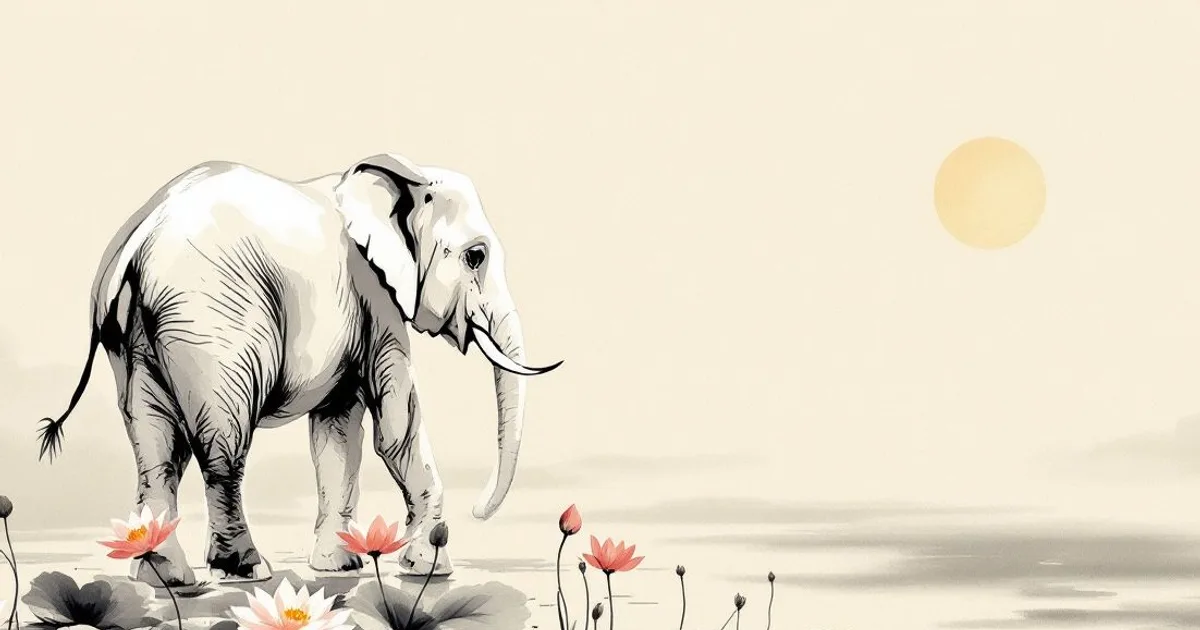
In Buddhism, Samantabhadra is the name of two different figures, and they are worth keeping apart. In the Mahayana sutras he is a great bodhisattva of vows and practice who rides a six-tusked white elephant: Puxian in China, Fugen in Japan, Bohyeon in Korea. In the Nyingma school of Tibetan Buddhism the same name, Kuntu Zangpo in Tibetan, belongs to the primordial buddha, usually shown naked and blue-black, who stands for the dharmakāya.
The Sanskrit name means “completely good” in Peter Alan Roberts’s translation for 84000; the JAANUS dictionary of Japanese art glosses Fugen as “universally good.” Some English translations from the Chinese call him “Universal Worthy”: the City of Ten Thousand Buddhas’ commentary edition of the Avatamsaka has “Universal Worthy Bodhisattva,” and a Cleveland Museum of Art label calls him “the bodhisattva of universal virtue.”
Two Samantabhadras, kept apart
The confusion starts in Tibetan, which calls both kun tu bzang po. 84000’s glossary to its Lotus Sutra calls the bodhisattva “a principal bodhisattva in the Mahāyāna sūtras” and adds: “Not to be confused with the primordial buddha of the Nyingma tradition.” Himalayan Art Resources (HAR) catalogues the bodhisattva as ‘phags pa kun tu bzang po, the “noble” Samantabhadra, and states that the two are unrelated. How the Nyingma buddha compares with Vajradhara, the primordial buddha of the other Tibetan schools, is set out in our guide to types of buddhas.
| The bodhisattva | The primordial buddha | |
|---|---|---|
| Tradition | Mahāyāna sutras; honoured in China, Japan, Korea and Tibet | Nyingma school of Tibetan Buddhism (Bon has a deity of the same name) |
| Names | Puxian, Fugen, Bohyeon; Tibetan ‘phags pa kun tu bzang po | Kuntu Zangpo (kun tu bzang po) |
| Source texts | The Avataṃsaka (its Gaṇḍavyūha) and the Lotus Sutra | The Guhyagarbha Tantra and other early Nyingma tantras (HAR) |
| Appearance | In China and Japan usually on a white elephant | Typically blue-black and naked, embracing his consort Samantabhadrī (some textual traditions clothe them) |
| His prayer | The King of Aspiration Prayers (Zangchö Mönlam) | The Aspiration of Samantabhadra (Kunzang Mönlam) |
The bodhisattva of the Mahayana sutras
Sudhana’s last teacher in the Avatamsaka
Samantabhadra frames the Gaṇḍavyūha, the closing chapter of the Avatamsaka Sutra. 84000 notes that “While the Buddha sits silently in meditation, the bodhisattva Samantabhadra gives a teaching to the assembled bodhisattvas.” At the other end of the pilgrim Sudhana’s journey, “The final three in the succession of kalyāṇamitras are the three bodhisattvas Maitreya, Mañjuśrī, and Samantabhadra.” Samantabhadra lays his hands on Sudhana’s head, and Sudhana sees vast visions within each pore of his body, until “he eventually attained equality with the ocean of the prayers and the conduct of the bodhisattva Samantabhadra” (56.70).
Here name and ideal blur. Roberts notes that the compound samantabhadra-bodhisattvacaryā can mean “completely good” bodhisattva conduct or the conduct of the bodhisattva Samantabhadra: “At times it could mean both simultaneously.” The sutra’s structure and the history of its closing prayer are on our Avatamsaka Sutra page.
The ten great vows
In East Asian Buddhism ten great vows are attributed to Samantabhadra, and they come from one translation. The Kashmiri monk Prajñā (744–c. 810 in Gimello’s dating) made a forty-fascicle Chinese version of the Gaṇḍavyūha (T 293); Robert Gimello dates it to 796–798 and names the Huayan master Chengguan among his assistants. In its last fascicle Samantabhadra says that those wishing to accomplish this virtue “should cultivate ten expansive and great practices and vows,” in the English of Fo Guang Shan’s translators Shujan Cheng and Tom Manzo (2019).
| Chinese (T 293, CBETA) | Fo Guang Shan’s English (2019) | |
|---|---|---|
| 1 | 禮敬諸佛 | to pay homage and respect to all Buddhas |
| 2 | 稱讚如來 | to praise the Tathagatas |
| 3 | 廣修供養 | to extensively cultivate making offerings |
| 4 | 懺悔業障 | to repent and reform karmic obstacles |
| 5 | 隨喜功德 | to rejoice in virtue |
| 6 | 請轉法輪 | to request the turning of the Dharma wheel |
| 7 | 請佛住世 | to request that the Buddhas remain in the world |
| 8 | 常隨佛學 | to always study with the Buddhas |
| 9 | 恒順眾生 | to constantly accord with sentient beings |
| 10 | 普皆迴向 | to universally dedicate all virtue |
The ten are an East Asian inheritance. 84000 says the material Prajñā’s longer version adds is “not found in any surviving Sanskrit edition, nor … in the early ninth-century Tibetan translation”; the Samantabhadra chapter of its own translation from the Tibetan has no such list of ten. Gimello says the chapter “would soon become a standard and important component of the Hua-yen corpus.” Seven of the ten match the seven aspects 84000 finds in the verse prayer’s first twelve verses: homage, offering, confession, rejoicing, entreaty, supplication and dedication.
The King of Aspiration Prayers
The verse prayer that ends the Gaṇḍavyūha carries his name. 84000 explains that in the sutra “it is stated that the prayer was put into verse by the bodhisattva Samantabhadra,” so it is also called “The Prayer of Samantabhadra.” Lotsawa House says the Zangchö Mönlam, as Tibetans call it, is “known as the king of all aspiration prayers”; 84000 places it “among the most popular and widely recited aspiration prayers” in all Mahāyāna traditions. It closes with the wish for rebirth in Sukhāvatī, the pure land of Amitabha. Near the end, the prayer names its model:
I dedicate all this virtue
So that I may have the same conduct as that wise one,
The eldest son of all the jinas,
Whose name is Samantabhadra.
How that dedication works in practice is covered in our guide to merit.
In the Lotus Sutra: the white elephant
The six-tusked white elephant is described in the Lotus Sutra. In Kumārajīva’s Chinese, the version East Asia reads, the twenty-eighth and last chapter is “Encouragement of Bodhisattva Samantabhadra.” He arrives from the east with a host of bodhisattvas, asks how people may attain the sutra after the Buddha’s passing, and makes a promise:
If they recite this sutra, whether walking or standing, I will then come before them on a white elephant king with six tusks, together with the assembly of great bodhisattvas, manifest myself, pay homage and protect them, and console their minds for the sake of revering the Lotus Sutra.
To those who practise single-mindedly for twenty-one days he promises to appear, and he teaches a protective dhāraṇī that begins “Adaṇḍe daṇḍapati daṇḍāvartani daṇḍakuśale…” (BDK, p. 314). “Last chapter” holds only for the Chinese: in 84000’s translation from the Tibetan, “Samantabhadra’s Encouragement” is chapter 26 of 27, followed by “The Entrusting.” A companion text, the Samantabhadra Meditation Sutra (T 277, translated by Dharmamitra in the Liu Song dynasty), is described by the Tokyo National Museum as “the concluding volume of the Lotus Sutra.”
Why six tusks? Neither sutra says what they stand for, so any symbolic reading of them comes from outside these two texts. The Meditation Sutra describes the elephant at length: it rests seven limbs on the ground, and at the tip of each of its six tusks is a bathing pool (T 277, 389c29–390a03). The sutra names its own teaching, in our rendering, the method of “repenting the six sense faculties and contemplating Samantabhadra Bodhisattva” (懺悔六根觀普賢菩薩法, 393b14–15).
With Manjushri and Vairocana: the triads
Britannica notes that he “is often represented in a triad with Shakyamuni (the Buddha) and the bodhisattva Manjushri,” seated “on an elephant with three heads or with one head and six tusks”; Manjushri rides the lion. In Japan, JAANUS records that “in one version” of the Shaka triad Fugen is on the right “symbolizing praxis” and Monju on the left “symbolizing wisdom.”
In China the two bodhisattvas also stand beside the buddha Vairocana, the Avatamsaka’s fundamental buddha (see types of buddhas), as the “three sages” (san sheng). As Gimello presents it, the “three sages” is an interpretive device of the Huayan commentators, built on “the scripture’s three chief protagonists,” whom the sutra itself already uses as embodiments of universal truths. The Huayan master Chengguan (738–839) is famous for employing it, and the idea may first have been suggested to him by the lay scholar Li Tongxuan (635?–730?). In Chengguan’s scheme Mañjuśrī embodies faith, understanding and insight, and Samantabhadra the “object of faith,” “practice” and “principle.” A Chinese trinity of the late sixteenth or seventeenth century at the Minneapolis Institute of Art shows the set; its label notes that in China “this group of three is known as the Three Saints of Huayan.” In Korea, the Cleveland Museum of Art’s Joseon-dynasty Samantabhadra on an Elephant with Two Attendants (보현보살도) keeps the elephant (see Buddhism in Korea).
Mount Emei
“In China he is the patron deity of Mount Emei in Sichuan province,” Britannica says. Its article on Buddhist pilgrimage names four especially important mountain sites in China, “Emei, Wutai, Putuo, and Jiuhua,” each “devoted to a different bodhisattva.” UNESCO inscribed the Mount Emei Scenic Area with the Leshan Giant Buddha in 1996, calling Emei “one of four sacred Buddhist mountains in China.” Its Wannian Temple, founded in the fourth century, holds a 7.85-metre bronze of Puxian from the tenth; UNESCO’s listing calls it a “Puxian bronze Buddha,” although Puxian is a bodhisattva. Leshan is covered in our greatest Buddhist monuments, the wider story in Buddhism in China.
Fugen in Japan
The Tokyo National Museum explains that in the Heian period (794–1192) the court nobility patronised the Tendai school, with the Lotus Sutra at its core, and that Fugen, “being the protector of those who follow the Lotus Sutra,” came to be “worshipped fervently.” Its twelfth-century scroll of him on the white elephant is a National Treasure (see Buddhism in Japan). JAANUS adds further roles:
- Fugen Enmei, a form invoked in a rite for long life, important “especially in the Tendai” school.
- Fugen and the Ten Demonesses, a painting subject in which ten rasetsunyo, guardians of the Lotus Sutra, attend him.
- Esoteric Buddhism (mikkyō), where Fugen symbolises the mind of enlightenment, appears in both great mandalas, and is identified with Kongōsatta.
- The Thirteen Buddhas, among whom he presides over the memorial service on the twenty-eighth day after a death.
In Tibet
HAR’s Jeff Watt writes that, unlike Manjushri, Avalokiteshvara and Vajrapani, “Samantabhadra never gained the popularity and was not elevated in the Tantric literature to the level of a meditational deity.” He appears mainly among the Eight Great Bodhisattvas, who “commonly populate the foreground of Amitabha Buddha in Sukhavati paintings”: red with a vase and flower in the Shakyashri Rakshita tradition, blue with a book in that of Konchog Pende (about the sixteenth century). Tibetan practice also meets him through the verse prayer, whose first twelve verses, 84000 notes, are “regularly recited as part of many practices in Tibetan Buddhism.”
Kuntu Zangpo, the primordial buddha of the Nyingma
The second Samantabhadra belongs to one school. In the Nyingma, the oldest of the four schools of Tibetan Buddhism, he is, in HAR’s words, “the Primordial Buddha, representing the Dharmakaya,” arising from “the early Nyingma Tantric literature of the Guhyagarbha Tantra and others.” The Rubin Museum’s Himalayan art glossary uses the Sanskrit term Adibuddha for “the ‘dharma body’ or true, primordial form of all buddhas,” and notes that in the Nyingma tradition “this is often understood to be a specific buddha called Samantabhadra.” HAR describes him as “typically blue-black in colour, naked,” embracing Samantabhadrī, and adds that in some textual traditions the pair are shown clothed and jewelled. HAR’s page on the Nyingma treasure tradition reports that “According to Nyingma history, the three inner classes of tantra, Mahayoga, Anuyoga and Atiyoga, all derive ultimately from Samantabhadra.” In that account the Great Perfection (Dzogchen) instructions passed from Vajrasattva to a divine emanation, Adhicitta, and reached their first human recipient in Garab Dorje (Prahevajra) of Oddiyana. In the 1927 English Tibetan Book of the Dead, a footnote identifies “the All-Good” of the clear-light passage as Chös-nyid Kün-tu-bzang-po, Sanskrit Dharma-Dhātu Samanta-Bhadra; the notes add that the block-print copy reads Kuntu-Zang-mo, “All-Good Mother,” there, which they call an error.
The Aspiration of Samantabhadra (Kunzang Mönlam)
The Nyingma buddha has his own prayer, and it is not the King of Aspiration Prayers. The Kunzang Mönlam comes from the All-Penetrating Wisdom Mind (dgongs pa zang thal), a terma or revealed treasure of Rigdzin Gödem (1337–1408), the revealer of the Northern Treasures. Lotsawa House calls it “among the most popular texts of the Dzogchen tradition.” Its colophon says it was extracted from the nineteenth chapter of the Tantra of the Great Perfection that Reveals the All-Penetrating Wisdom Mind of Samantabhadra, the chapter that “teaches that through making a powerful prayer of aspiration all sentient beings cannot but awaken.” The buddha speaks in the first person:
Ho! All that appears and exists, saṃsāra and nirvāṇa,
Has one ground, two paths and two forms of fruition,
The magical displays of awareness and unawareness.
Through this, Samantabhadra’s prayer of aspiration,
May all attain complete and perfect awakening
Within the palace of dharmadhātu, the absolute sphere.
Lotsawa House’s page on Rigdzin Gödem notes that its recitation is especially recommended during solar and lunar eclipses, at the solstices and new year, and during earthquakes.
Bon, a Tibetan religion distinct from the Buddhist schools, has its own Kuntu Zangpo, “a peaceful deity found within the Bon religion” in HAR’s words. HAR says only that it is “possible” the name carries its Nyingma meaning in Bon Sarma.
What Samantabhadra stands for: the sources differ
Each source gives a different answer:
- Britannica: the bodhisattva “representing kindness or happiness.”
- The Minneapolis Institute of Art: with Manjushri, one of “the bodhisattvas of wisdom and benevolence.” A Cleveland Museum of Art label, quoted on our Manjushri page, makes him the bodhisattva of universal virtue.
- JAANUS, on one version of the Shaka triad: praxis, beside Monju’s wisdom.
- Chengguan’s Huayan, as Gimello presents it: the object of faith, practice and principle.
On his tantric role the sources describe different traditions and do not line up. Britannica says, naming no school or text, that in Vajrayana “he is regarded as the manifestation of Vairocana.” HAR says that, unlike Manjushri, Avalokiteshvara and Vajrapani, the bodhisattva was never raised in tantric literature to a meditational deity. JAANUS records that Japanese esoteric Buddhism identifies Fugen with Kongōsatta.
How the traditions differ
The bodhisattva comes from Mahāyāna literature; the Lotus and Avataṃsaka are not in the Pali canon of Theravada Buddhism. China gives him the Huayan “three sages,” Mount Emei and Prajñā’s ten vows; Japan, the Lotus devotion of Tendai, the Fugen Enmei rite and the mikkyō mandalas. In Tibet two figures share one name: the bodhisattva of the Zangchö Mönlam and, in the Nyingma school, the primordial buddha of the Kunzang Mönlam. Both have their place among the buddhas and bodhisattvas and in Tibetan Buddhism.
Frequently asked questions
Is Samantabhadra the bodhisattva the same as Samantabhadra the buddha?
No. The bodhisattva comes from Mahayana sutras such as the Avatamsaka and the Lotus Sutra and is honoured across East Asia and Tibet. The buddha Kuntu Zangpo belongs to the Nyingma school of Tibetan Buddhism, where he stands for the dharmakaya. They share a Tibetan name, kun tu bzang po, but Himalayan Art Resources treats them as unrelated; 84000's glossary warns the bodhisattva is 'not to be confused with' the Nyingma buddha.
Why does Samantabhadra ride a white elephant?
The Lotus Sutra describes him on it. In its chapter on him, the last in Kumarajiva's Chinese, he promises to come before anyone reciting the sutra 'on a white elephant king with six tusks' to protect them (BDK translation). JAANUS links Fugen's usual elephant in Japanese art to that sutra's popularity. Neither the Lotus nor the Samantabhadra Meditation Sutra says what the six tusks stand for.
What are the ten vows of Samantabhadra?
They are a prose list in Prajna's Chinese Gandavyuha (T 293, fascicle 40): pay homage to all buddhas, praise them, make offerings, repent karmic obstacles, rejoice in virtue, request the teaching, ask the buddhas to remain, always study with them, accord with all beings, and dedicate all virtue. 84000 says Prajna's additions survive in no Sanskrit edition and not in the Tibetan, and its translation from the Tibetan has no such list.
What is the Samantabhadra prayer?
There are two. The King of Aspiration Prayers (Zangcho Monlam) closes the Gandavyuha, which says the bodhisattva put it into verse; 84000 counts it 'among the most popular and widely recited aspiration prayers' in all Mahayana traditions. The Aspiration of Samantabhadra (Kunzang Monlam) is a Nyingma Dzogchen text presented as the words of the primordial buddha, from a treasure revealed by Rigdzin Godem (1337-1408).
Which mountain is sacred to Samantabhadra?
Mount Emei in Sichuan, China. Encyclopaedia Britannica calls him its patron deity, and it is one of China's four sacred Buddhist mountains, each devoted to a different bodhisattva. UNESCO inscribed Mount Emei, together with the Leshan Giant Buddha, as a World Heritage Site in 1996; its Wannian Temple keeps a 7.85-metre bronze of him from the tenth century.
Does Samantabhadra have a mantra?
The spell his own scripture gives him is a dharani. In the Lotus Sutra's chapter on him he teaches one that begins 'Adande dandapati dandavartani dandakusale', and says that any bodhisattva who hears it should know it is through Samantabhadra's power (BDK translation, p. 314; T 262, 61b).
Sources
- Jeff Watt, 'Bodhisattva Samantabhadra', Himalayan Art Resources (4-2013, updated 5-2017, 5-2022) — the bodhisattva 'known from Mahayana literature', his Tibetan name 'phags pa kun tu bzang po, his place among the Eight Great Bodhisattvas in Sukhavati paintings, the note that he was never made a meditational deity, and the red (Shakyashri Rakshita) and blue (Konchog Pende) forms
- Jeff Watt, 'Samantabhadra Buddha' (Nyingma Tradition), Himalayan Art Resources (4-2013, updated 5-2017) — the primordial buddha 'representing the Dharmakaya', his source in the Guhyagarbha Tantra and other early Nyingma tantras, and his iconography with Samantabhadri
- 'Tradition: Nyingma School Revealed Treasure (Terma)', Himalayan Art Resources (authors listed: Matthieu Ricard, Jakob Leschly, Ron Garry, Gyurme Dorje, Alexander Gardner) — the three inner classes of tantra derived from Samantabhadra, and Garab Dorje as first human recipient of the Great Perfection lineage
- 'Kuntu Zangpo (Bon)', Himalayan Art Resources — Kuntu Zangpo as a peaceful Bon deity and an epithet, and the hedged Bon Sarma parallel
- The Stem Array (Gaṇḍavyūha), chapter 45 of A Multitude of Buddhas (Toh 44-45), trans. Peter Alan Roberts, 84000 (2021) — introduction i.5, i.20, i.64 and i.121, summary s.1, and 56.70
- The Prayer of Good Conduct (Toh 1095), trans. Peter Alan Roberts, 84000 (2025) — summary s.1, introduction i.2, i.3 and i.6, and verse 42 (1.43)
- The White Lotus of the Good Dharma (Toh 113), trans. Peter Alan Roberts, 84000 (2018) — chapter 26, 'Samantabhadra's Encouragement', chapter 27, 'The Entrusting', and the glossary entry for Samantabhadra
- The Lotus Sutra (Taishō 262, Kumārajīva), trans. Tsugunari Kubo and Akira Yuyama, BDK English Tripiṭaka (2007), chapter XXVIII 'Encouragement of Bodhisattva Samantabhadra', pp. 313–317
- Da fangguang fo huayan jing 大方廣佛華嚴經 (T 293), trans. Prajñā, fascicle 40, the chapter on Samantabhadra's practices and vows — the ten vows at T10n0293_p0844b23–b28, CBETA
- The Flower Adornment Sutra's Practices and Vows of Samantabhadra Bodhisattva Chapter, trans. Shujan Cheng and Tom Manzo, Fo Guang Shan International Translation Center (2019) — English of the ten vows
- Foshuo guan Puxian pusa xingfa jing 佛說觀普賢菩薩行法經 (T 277), trans. Dharmamitra (Liu Song, 424–453), CBETA — the elephant at T 277, 389c29–390a03, and the sutra's name for its teaching at 393b14–15
- Robert M. Gimello, 'Ch'eng-kuan on the Hua-yen Trinity', Chung-Hwa Buddhist Journal 9 (July 1996), pp. 341–411 — the 'three sages', Li Tongxuan and Chengguan (pp. 341–345), and Prajñā's 796–798 translation (pp. 367–368)
- 'The King of Aspiration Prayers: Samantabhadra's Aspiration to Good Actions' (Zangchö Mönlam), trans. Rigpa Translations, Lotsawa House
- 'Aspiration Prayers' topic page, Lotsawa House — the Aspiration to Good Actions (bzang spyod smon lam) 'known as the king of all aspiration prayers'
- 'The Powerful Prayer of Aspiration from the Tantra of the Great Perfection that Reveals the All-Penetrating Wisdom Mind of Samantabhadra (Kunzang Mönlam)', revealed by Rigdzin Gödem, trans. Adam Pearcey (2019), Lotsawa House — the text and its colophon
- 'Rigdzin Gödem Series', Lotsawa House — Rigdzin Gödem Ngödrup Gyaltsen (1337–1408), discoverer of the Northern Treasures, and the note on the Kunzang Mönlam as 'among the most popular texts of the Dzogchen tradition' and when its recitation is recommended
- JAANUS (Japanese Architecture and Art Net Users System, comp. Mary Neighbour Parent), 'Fugen 普賢'
- 'Fugen Bosatsu (Samantabhadra)', National Treasure Heian Buddhist Paintings in the Tokyo National Museum, Tokyo National Research Institute for Cultural Properties with the Tokyo National Museum (2021)
- 'Samantabhadra' (entry), Encyclopædia Britannica (last revised by Matt Stefon)
- 'Buddhism: Buddhist pilgrimage', Encyclopædia Britannica — the four mountains of China, each devoted to a different bodhisattva
- 'Mount Emei Scenic Area, including Leshan Giant Buddha Scenic Area', UNESCO World Heritage Centre, dossier 779 (inscribed 1996)
- 'Buddhist trinity of Vairocana, Manjusri and Samantabhadra', China, late 16th–17th century, Minneapolis Institute of Art (2003.199.1)
- 'Shakyamuni Triad: Buddha Attended by Manjushri and Samantabhadra', late 1300s, Fuzhou, Yuan dynasty, set of three hanging scrolls, Cleveland Museum of Art (2009.342)
- 'Samantabhadra on an Elephant with Two Attendants (보현보살도 普賢菩薩圖)', Korea, Joseon dynasty, Cleveland Museum of Art (1915.219)
- The Tibetan Book of the Dead, trans. Kazi Dawa-Samdup, ed. W. Y. Evans-Wentz (Oxford University Press, 1927) — the clear-light passage and its footnote on 'the All-Good', Internet Archive
- 'Adibuddha' (glossary), Project Himalayan Art, Rubin Museum of Art — the Adibuddha as the primordial form of all buddhas, and in the Nyingma tradition 'often understood to be a specific buddha called Samantabhadra'
- The Flower Adornment Sutra with Commentary, chapter 40, 'Universal Worthy's Conduct and Vows', City of Ten Thousand Buddhas — the rendering 'Universal Worthy Bodhisattva'