Japanese Zen Gardens: The Rock Garden and Its Meaning
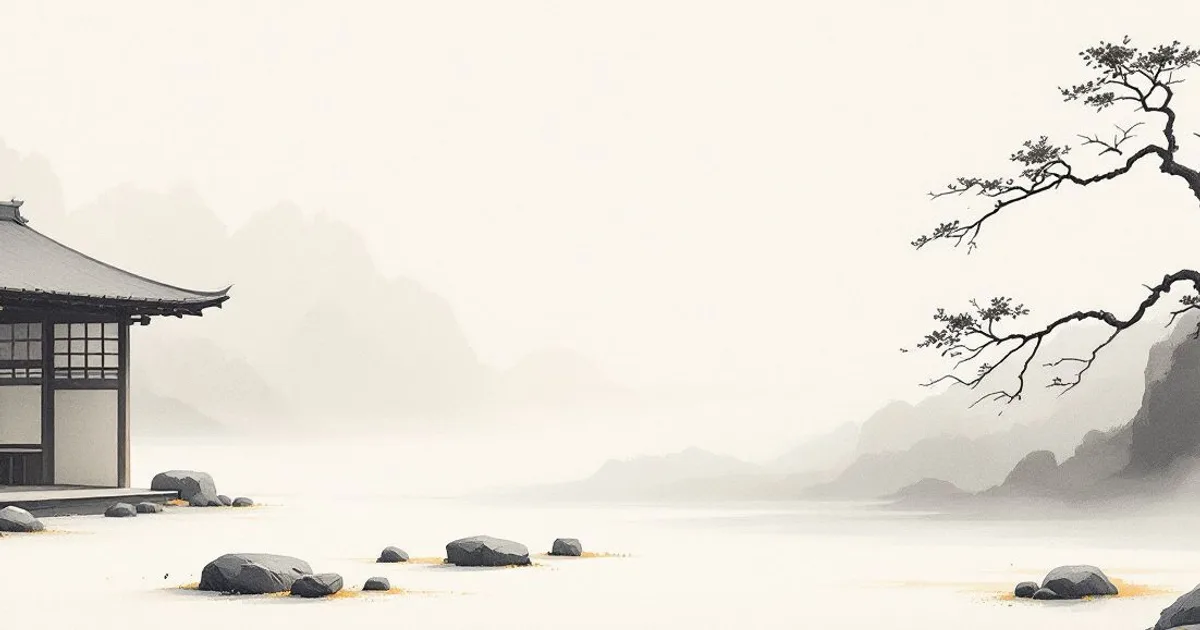
A Japanese Zen garden is usually a karesansui (枯山水), a “dry landscape” that suggests mountains and water with stones, raked white gravel or sand, moss and clipped shrubs, and no water at all. The best known, such as Ryōan-ji and Daisen-in, lie beside the abbots’ halls of Kyoto’s Rinzai Zen temples and are made to be viewed seated. The English name “Zen garden” is modern, and scholars still argue about how Zen the gardens are.
For the tradition behind them, see Zen Buddhism; for the aesthetic often read into them, wabi-sabi.
What is a Japanese Zen garden?
The Nara National Research Institute for Cultural Properties (Nabunken) defines karesansui as “a garden style unique to Japan, which appeared in the Muromachi period.” It uses no ponds or streams, and represents landscapes with stone arrangements, white sand, moss and pruned trees. Water is shown, the art dictionary JAANUS notes, by a dry waterfall (karetaki) of rocks and a dry stream (karenagare) of raked sand, and “like paintings, the gardens are meant to be viewed from a single, seated perspective.”
Not every Japanese garden is a Zen garden. At Byōdō-in, inaugurated in 1053, Nabunken describes a Heian pond garden with the Amida hall on an island, worshipped from the shore as a symbol of the western Pure Land (see Pure Land Buddhism).
Is a “Zen garden” really Zen?
Scholars disagree. Glenn Masuchika, surveying the literature in 2012, describes “a recent controversy among scholars”: is the Zen garden a true expression of Zen, made to aid training, or the product of a commercial effort by temples after the Second World War? He adds that “few scholars or laypeople doubt” that some dry gardens were influenced by Zen.
The sceptics. In Masuchika’s summary, the garden historian Wybe Kuitert (2002) argues that the Zen garden is a twentieth-century invention, and that the dry garden grew out of medieval garden art “with little or no initial affiliation to the Zen Buddhist religion.” Kuitert traces the term to Loraine Kuck’s One Hundred Kyoto Gardens (1935): Kuck, an American in Japan and a friend of D. T. Suzuki, “superimposed her love of Zen” on the gardens, above all Ryōan-ji. The Japanese zenteki teien, he says, came into use only in the 1950s. Shoji Yamada (Shots in the Dark, 2009), as Victor Sōgen Hori summarises him, found that until around 1950 Ryōan-ji was a poor, rarely visited temple whose garden few linked with Zen, and that the explicit Zen connection grew in postwar school textbooks. Hori adds a reason Yamada underplays: before 1907 Ryōan-ji had had no chief priest for close to three hundred years, and there was no freedom of religious expression until the war ended.
The case for Zen. Graham Parkes and Adam Loughnane, in the Stanford Encyclopedia of Philosophy, write that in the Muromachi period dry landscape gardening, like ink painting, tea and Nō, flourished “as expressions of the Zen, especially Rinzai Zen, spirit of the time.” JAANUS calls the dry garden the preferred type for Zen temples, because of its Chinese associations. Hori, a McGill scholar who discloses that he is an ordained Rinzai monk, answers Yamada: “I am not convinced.” He recalls that Hisamatsu Shin’ichi first called Ryōan-ji an “empty garden,” and argues that its lack of any fixed essential nature is precisely why it deserves to be called a Zen garden (see emptiness). The Portland Japanese Garden, for its part, calls karesansui the “more accurate” name. This page uses both.
A short history of the dry garden
Heian: the word before the style
The word karesansui appears in the Sakuteiki, which JAANUS calls an 11th-century garden manual and Nabunken the oldest Japanese text on gardening. Nabunken says there is “no established theory” about its author, though it is generally said to be by Tachibana no Toshitsuna (1028–1094). There, Nabunken explains, the word meant only a stone arrangement in a part of the garden without water, which JAANUS notes garden historians class as early karesansui (zenki karesansui, 前期枯山水).
Musō Soseki: Saihō-ji and Tenryū-ji
The Rinzai priest Musō Soseki (1275–1351), Nabunken says, was “extremely knowledgeable about garden building” and brought “a decisive change in garden design, in accordance with the spirit of austere meditation on nature, the Zen ideal shown in Hekiganroku” (the Blue Cliff Record).
At Saihō-ji, which Musō converted from a Pure Land (Jōdo) temple to Zen in 1339, his garden had an upper section with a dry stone arrangement and a lower one around a pond (Nabunken). Its famous moss was not Musō’s design: the temple says it spread after disasters and war and took over 100 years to cover the garden.
Tenryū-ji, founded in 1339 by the shogun Ashikaga Takauji with Musō as founding abbot, has “a strolling pond garden,” Sōgenchi, that borrows the nearby mountains as scenery (shakkei). Rocks across the pond, the temple says, stand for the Dragon Gate Falls, where a carp that climbs becomes a dragon, “a transformation that in Zen has come to symbolize enlightenment.”
Muromachi abbots’ gardens: Daisen-in and Ryōan-ji
JAANUS names Daisen-in and Ryōan-ji as model Muromachi dry gardens. At Daisen-in, a subtemple of Daitoku-ji, Nabunken dates the abbot’s quarters to 1513 and the gardens, built under the supervision of the chief priest Kogaku Sōkō, to about then. In its shoin garden, northeast of the abbot’s quarters, pruned trees and upright stones form distant mountains, cliffs and a waterfall, and white sand and stones carry the water from stream to river to ocean: “a landscape painting in three-dimensional form,” in Nabunken’s words. The front garden, JAANUS notes, is raked gravel alone.
The makers were not all priests. Nabunken records that some gardens were made by senzui kawaramono, garden-makers from a class that suffered discrimination in medieval times; one well-known senzui kawaramono, Zen’ami, was promoted to the priest-artists’ guild by the shogun Ashikaga Yoshimasa.
Edo and the twentieth century
At Ginkaku-ji (Jishō-ji), the sand terrace Ginsadan and sand cone Kōgetsudai date, says Nabunken, from the mid-Edo period or later. Early Edo dry gardens, JAANUS notes, often set raked gravel against moss and larger plants along the rear wall; it names those of the abbot’s quarters and of Konchi-in at Nanzen-ji, and of Shinju-an and Ōbai-in at Daitoku-ji, as good examples. In the 20th century, JAANUS writes, the dry garden revived largely through its kinship with abstract art; it cites Shigemori Mirei (1896–1975), whose 1939 gardens at Tōfuku-ji the temple’s leaflet says are “regarded as a fine example of contemporary Zen garden.”
Rocks, gravel and moss: what the elements mean
| Element | What it is | What it is said to represent | Who says so |
|---|---|---|---|
| Stones | Set upright or flat, usually in groups | Mountains, cliffs, islands; Mount Hōrai of ancient Chinese immortality lore | JAANUS; Nabunken; Tōfuku-ji |
| Triad stones (sanzonseki) | One large stone flanked by two smaller ones | A Buddhist trinity, such as Amida with Kannon and Seishi (described in the Sakuteiki) | Nabunken |
| Dry waterfall (karetaki) | Stones and white sand | Falling water, with a “mirror stone” | Nabunken |
| Gravel or sand | Often Shirakawa sand, pebbles of weathered granite | Water: stream, river, sea | Nabunken; JAANUS |
| Raked patterns (samon) | Swirls, swells, waves | Waves, “but may well be pure abstraction” | Nabunken; JAANUS |
| Moss | Ground cover, planted or grown over years | At Tōfuku-ji, five moss-covered mounds stand for Gozan, “the 5 sacred mountains”; at Saihō-ji the moss spread long after Musō | Nabunken (what it is); Tōfuku-ji; Saihō-ji (its history) |
| Walls, borrowed scenery | A wall; distant hills in the view | A frame (Ryōan-ji’s wall); added depth (Tenryū-ji’s borrowed hills) | Ryōan-ji; Tenryū-ji |
Raked gravel predates the Zen garden: JAANUS traces raked courtyards to Shinto shrines and the Heian palace.
Ryōan-ji’s fifteen stones
Ryōan-ji, the temple says, was founded in 1450 by Hosokawa Katsumoto, who invited the Zen priest Giten Genshō of Myōshin-ji; Masuchika places it in “the temple complex of a Rinzai sect.”
When and by whom. Neither is certain. The temple says its abbot’s hall was built in 1499 and the garden “presumably” at the same time (that hall burned in 1797; the present one was moved from the subtemple Seigen-in). Nabunken gives 1499 as what is “said,” adding a view that the garden took its present form in the early Edo period. The painter Sōami was long credited, but the temple finds “no definite proof” and lists Giten, Katsumoto, his son Masamoto and the tea master Kanamori Sōwa as other theories. Two names carved on the back of one stone, “Kotarō” and an illegible “-jirō”, the temple adds, have not settled the question.
What is there. Fifteen stones in five groups on 248 square metres of white gravel (the temple’s figure), inside a 180 cm wall of clay mixed with rapeseed oil whose height, the temple says, is adjusted to deepen the perspective.
Fifteen at once? Kyoto’s official city tourism site says that “from whatever angle you view the garden, you can never see all fifteen stones.” Hori reports it more cautiously, as something that “is said.” The temple’s own garden pages that we read (English and Japanese, archived) do not make the claim.
What it means. The temple lists the readings:
Usually this stone garden is referred to as either a “Tiger taking the cubs over the stream” or “Seven-Five-Three” (auspicious numbers) garden type. Another explanation could be either islands in the sea or mountain peaks in the clouds.
It adds two more readings, the stones as the character 心 (“heart”) or as the Five Mountains of the main Zen monasteries, says that “nobody knows for sure what the author’s intentions were,” and notes that some might see a Zen kōan in it, a garden that “sets the viewers’ imagination free.” Yamada, in Hori’s account, finds the tiger-cubs reading in early twentieth-century writing about the garden and says it has nothing to do with Zen.
Parkes and Loughnane see the rocks’ interrelations as exemplifying “dependent co-arising” (engi; see dependent origination), and the garden as embodying “the central Buddhist insight of impermanence” (see impermanence). That is their reading, not the temple’s.
Vision science offers another reading. In a 2002 Nature paper, Gert van Tonder, Michael Lyons and Yoshimichi Ejima applied a model of early visual shape analysis to the garden and found its seemingly empty space “implicitly structured and critically aligned with the temple’s architecture,” a hidden design that, they propose, creates the garden’s visual appeal and “was probably intended.” The study is about how the layout is seen, not about calm.
How Zen temples use their gardens
The dry gardens are looked at, not walked in. Nabunken says the main garden of an abbot’s quarters (hōjō) “is usually designed to be most picturesque when looked at from this room,” and Hori describes Ryōan-ji as meant to be viewed by someone seated inside.
Contemplation rather than zazen. The Portland Japanese Garden, describing its own dry garden’s style, says it “was not meant for meditation [zazen], but for contemplation” (on seated meditation itself, see zazen). Masuchika notes that the familiar image of a monk meditating before such a garden faces accusations of being staged for tourists.
Raking is work practice. Because raking long lines takes intense concentration, JAANUS says, “the maintenance of these gardens is considered part of Zen practice.” The Joint Council for Japanese Rinzai and Ōbaku Zen calls such manual labour, samu, “a part of training equally important to zazen” (see Zen living).
Zen gardens, tea gardens and stroll gardens
| Garden type | How you experience it | Typical features | Example |
|---|---|---|---|
| Dry landscape (karesansui) | Viewed seated from a building | Stones, raked gravel, moss | Ryōan-ji; Daisen-in |
| Tea garden (roji) | Walked through to the tea room | Stepping stones, lantern, low water basin | Tea-house gardens |
| Stroll garden (kaiyūshiki) | Walked around a pond | Pond, path, changing views | Katsura detached palace |
| Pond garden with borrowed scenery | Walked around, hills beyond | Pond, waterfall stones | Tenryū-ji’s Sōgenchi |
Nabunken places the roji between the waiting room and the tea room. For the tea gathering itself, see the Japanese tea ceremony.
Famous Zen gardens to visit in Kyoto
- Ryōan-ji (Rinzai). The rock garden; a World Heritage site since 1994, the temple notes (visiting details from the city’s tourism site).
- Daisen-in, Daitoku-ji (Rinzai). “Famous for its stone garden,” says the Rinzai council’s Daitoku-ji page.
- Saihō-ji (Rinzai, by its own timeline). Reservation only, since 1977; the basic visit pairs sutra copying with a walk in the moss garden.
- Tenryū-ji, head temple of the Tenryū-ji branch of Rinzai. Musō’s pond garden, Sōgenchi.
- Tōfuku-ji, head temple of the Tōfuku-ji branch of Rinzai. Shigemori’s 1939 gardens around the abbot’s hall (visitor guide, in Japanese).
- Ginkaku-ji (Jishō-ji) (Rinzai, Shōkoku-ji branch, per Shōkoku-ji’s page on it). Its raked sand terrace and cone.
Outside Japan, the Portland Japanese Garden in Oregon has a dry garden, its Sand and Stone Garden, designed, the garden says, by Professor Takuma Tono in the 1960s.
Hours and fees change, so check each temple’s page first, and see our guide to temple etiquette.
How to design and make a small Zen garden
This is our own practical advice, not a temple tradition.
- Choose the viewpoint first. Temple gardens are composed for one seat.
- Make a level, edged bed over a weed membrane, so the gravel stays put.
- Use light, fine gravel. Crushed granite holds raked lines; round pebbles blur them. Nabunken says dry gardens widely use Shirakawa sand, a Kyoto granite.
- Set a few stones firmly, partly buried so they look rooted. Group them (three can echo the triad stones above) and leave plenty of empty gravel.
- Rake simply. Straight lines, rings around each stone; re-rake after rain or leaf fall.
- Plant little. Nabunken lists pruned trees among a dry garden’s materials; one clipped evergreen at the edge is plenty. Lanterns and statues are better left out.
- Add moss only where it will thrive, in shade and moisture.
A desk-sized version. A tabletop sand tray is a modern miniature of the idea, not a copy of any temple garden: a shallow tray, fine dry sand, a few small stones and a small rake.
We make no health claims for either. For a place to sit, see home meditation space; for simplicity as a teaching, Buddhist minimalism; for how Zen-influenced Japanese arts relate to Buddhism, Eastern wisdom traditions; for Zen’s history in Japan, Buddhism in Japan.
Frequently asked questions
What is a Zen garden?
A Zen garden is usually a karesansui, or dry landscape garden: stones, raked white gravel or sand, moss and clipped shrubs arranged to suggest mountains and water without using any water. The best-known examples sit beside the abbots' halls of Zen temples in Kyoto, such as Ryoan-ji and Daisen-in, and are meant to be viewed from a seated position rather than walked through.
What do the rocks and sand in a Zen garden represent?
Usually mountains and water. Japanese garden dictionaries say the stones suggest mountains or the mythical Mount Horai, and the white gravel stands for water, with raked lines as a stream or waves. JAANUS adds that the raked ridges may well be pure abstraction. For Ryoan-ji, the temple lists several readings, from a tiger taking its cubs over a stream to islands in the sea, and says nobody knows for sure.
Why is it called a Zen garden?
Largely because of 20th-century writing, on one scholarly view. The garden historian Wybe Kuitert traces the term to Loraine Kuck's One Hundred Kyoto Gardens (1935) and says the Japanese zenteki teien came into use only in the 1950s. Others defend the name: many fine dry gardens belong to Rinzai Zen temples, and the Stanford Encyclopedia of Philosophy treats Muromachi dry gardening as an expression of the Zen spirit of the time.
Are Zen gardens for meditation?
Not for seated meditation, on the account of the Portland Japanese Garden, which says the style was meant for contemplation, not zazen. In Zen temples the dry gardens are looked at from the hall rather than sat in. Raking and caring for them is another matter: JAANUS notes that raking long lines takes intense concentration, so their maintenance is considered part of Zen practice.
Can you see all 15 stones at Ryoan-ji at once?
Popular accounts say no. Kyoto's official tourism site says that from whatever angle you view the garden you can never see all fifteen stones, and Victor Sogen Hori, in a 2010 review, reports it more cautiously as something that is said. The Ryoan-ji garden pages we read, in English and Japanese, do not make the claim, so treat it as a tradition about the garden rather than the temple's statement.
How do I make a small Zen garden at home?
Choose where you will look at it from, then build a level, edged bed of light, fine gravel with a weed barrier beneath, or use a shallow tray of sand on a desk. Set a few stones firmly and partly buried, grouped rather than scattered, and rake the gravel with a wooden rake into straight lines and rings around the stones. Plant little, and re-rake it after rain or leaf fall.
Sources
- 'dry landscape (garden)', Japanese Garden Dictionary (Ono Kenkichi and Walter Edwards, 2010), Nara National Research Institute for Cultural Properties
- 'garden at the abbot's quarters of Ryōanji temple', Japanese Garden Dictionary, Nara National Research Institute for Cultural Properties
- 'garden at Saihōji temple', Japanese Garden Dictionary, Nara National Research Institute for Cultural Properties
- 'garden at the shoin of Daisen'in temple', Japanese Garden Dictionary, Nara National Research Institute for Cultural Properties
- 'garden at Tenryūji temple', Japanese Garden Dictionary, Nara National Research Institute for Cultural Properties
- 'garden at Jishōji temple (Ginkakuji)', Japanese Garden Dictionary, Nara National Research Institute for Cultural Properties
- 'garden at Byōdōin temple', Japanese Garden Dictionary, Nara National Research Institute for Cultural Properties
- 'Sakuteiki (The book of gardening)', Japanese Garden Dictionary, Nara National Research Institute for Cultural Properties
- 'Musō Soseki', Japanese Garden Dictionary, Nara National Research Institute for Cultural Properties
- 'kawaramono gardener', Japanese Garden Dictionary, Nara National Research Institute for Cultural Properties
- 'abbot's quarters', Japanese Garden Dictionary, Nara National Research Institute for Cultural Properties
- 'raked pattern', Japanese Garden Dictionary, Nara National Research Institute for Cultural Properties
- 'dry waterfall', Japanese Garden Dictionary, Nara National Research Institute for Cultural Properties
- 'Shirakawa sand', Japanese Garden Dictionary, Nara National Research Institute for Cultural Properties
- 'moss garden', Japanese Garden Dictionary, Nara National Research Institute for Cultural Properties
- 'Hōrai stone arrangement', Japanese Garden Dictionary, Nara National Research Institute for Cultural Properties
- 'stroll garden', Japanese Garden Dictionary, Nara National Research Institute for Cultural Properties
- 'tea garden (roji)', Japanese Garden Dictionary, Nara National Research Institute for Cultural Properties
- 'karesansui', JAANUS: Japanese Architecture and Art Net Users System
- 'samon' (raked patterns), JAANUS: Japanese Architecture and Art Net Users System
- 'zakanshiki teien' (gardens viewed seated), JAANUS: Japanese Architecture and Art Net Users System
- 'roji' (tea garden), JAANUS: Japanese Architecture and Art Net Users System
- 'SAKUTEIKI', JAANUS: Japanese Architecture and Art Net Users System
- Ryōan-ji, 'Our History', official English pages (archived copy, Internet Archive)
- Ryōan-ji, 'A True Work of Art' (the rock garden's design), official English pages (archived copy, Internet Archive)
- Ryōan-ji, 'Unsolved Mystery' (who made the garden), official English pages (archived copy, Internet Archive)
- Ryōan-ji, 'Superb Layout and Attainment of Effect' (slope and perspective), official English pages (archived copy, Internet Archive)
- Ryōan-ji, 'The Masterpiece's Frame' (the earthen wall), official English pages (archived copy, Internet Archive)
- Ryōan-ji, 'Message' (World Heritage listing, 1994), official English pages (archived copy, Internet Archive)
- Tenryū-ji, 'About Tenryu-ji', official site
- Tenryū-ji, 'What to See at Tenryu-ji' (the Sōgenchi garden), official site
- Saihō-ji (Kokedera), official English site: visiting by reservation, and the temple's timeline
- Saihō-ji, 'History', intosaihoji.com (Saihokai Association for Saihō-ji)
- Tōfuku-ji, 'Tôfuku-ji's Hôjô Hassô Garden', official leaflet (PDF)
- Tōfuku-ji, visitor guide (拝観案内), official site
- Joint Council for Japanese Rinzai and Ōbaku Zen, 'Head Temples: Daitoku-ji'
- Joint Council for Japanese Rinzai and Ōbaku Zen, 'Head Temples: Tenryu-ji': the head temple of the Tenryu-ji branch of Rinzai, established in 1339
- Joint Council for Japanese Rinzai and Ōbaku Zen, 'Zen Terminology' (samu)
- Graham Parkes and Adam Loughnane, 'Japanese Aesthetics', Stanford Encyclopedia of Philosophy (substantive revision 2023), sections 7 and 9
- Victor Sōgen Hori, review of Shoji Yamada, Shots in the Dark: Japan, Zen and the West (University of Chicago Press, 2009), Japanese Journal of Religious Studies 37/1 (2010), pp. 153-160
- Glenn Masuchika, 'Zen Garden and No Zen Garden: A Bibliographic Essay', Theological Librarianship 5/1 (2012), pp. 67-70, summarising Wybe Kuitert, Themes in the History of Japanese Garden Art (2002), Loraine Kuck (1935), Marc P. Keane (1996) and Christian Tschumi (2005)
- 'triad stones', Japanese Garden Dictionary, Nara National Research Institute for Cultural Properties
- Gert J. van Tonder, Michael J. Lyons and Yoshimichi Ejima, 'Visual structure of a Japanese Zen garden', Nature 419 (2002): 359-360 (PubMed abstract)
- Portland Japanese Garden, 'Sand and Stone Garden'
- Shōkoku-ji, 'Ginkaku-ji' (Rinzai, Shōkoku-ji branch), official site
- 'Ryoan-ji Temple', Kyoto Travel (City of Kyoto and Kyoto City Tourism Association)