The Buddhist Swastika: Meaning, History and the Manji
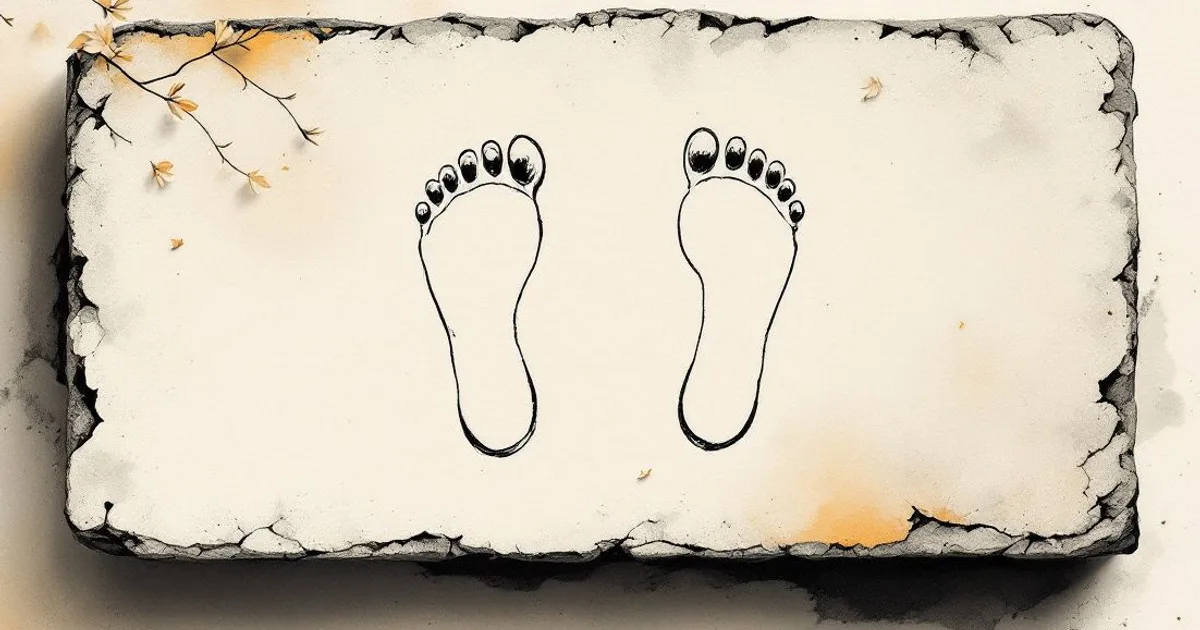
The Buddhist swastika is an ancient sign of good fortune that Buddhists share with Hindus and Jains. Its Sanskrit name, svastika, means “conducive to well-being”. In the Buddhist tradition it stands for the Buddha’s feet or footprints and often opens and closes inscriptions; Chinese Buddhist images often carry it on the Buddha’s chest; in Japan it is the manji, 卍, which marks temples on maps. It is not the Nazi Hakenkreuz, a twentieth-century appropriation that remains a symbol of Nazism and its crimes.
For the other Buddhist emblems, from the Dharma wheel to the eight auspicious symbols, see our guide to Buddhist symbols.
- Sanskrit
- svastika, from svasti, “well-being, fortune, luck”; Pali sotthi.
- Meaning
- “Conducive to well-being”: a sign of good fortune.
- In Buddhism
- The Buddha’s feet and footprints; the start and end of inscriptions; the Buddha’s chest in Chinese images.
- Japanese / Chinese
- 卍, read manji in Japanese, wàn in Mandarin, man in Korean.
- Direction
- Both 卍 (left-facing) and 卐 (right-facing) occur in Buddhist art; Bön uses only the left-turning form.
- Not to be confused with
- The Nazi Hakenkreuz, “hooked cross”: oblique arms, black in a white circle on red.
What does svastika mean?
The word is Sanskrit. Monier-Williams’s Sanskrit-English Dictionary (1899) lists svastika under sv-asti, “well-being, fortune, luck, success, prosperity”, a word also used as a greeting, especially at the beginning of letters. Among its senses for svastika are any lucky or auspicious object and, especially, “a kind of mystical cross or mark made on persons and things to denote good luck”. It also records two explanations of the shape current in its day: most scholars took it for a solar symbol, while “the late Sir A. Cunningham” read it as a monogram of the letters of su asti in the script of Aśoka’s inscriptions.
In Pali the word that answers to svasti is sotthi. The Pali Text Society’s dictionary derives it from Sanskrit svasti (su + asti), glosses it as well-being, safety and blessing, and gives suvatthi as a variant. Its entry for sovatthika, which it connects with Sanskrit svastika, gives the sense “safe”; it records the compound sovatthikâlankāra, “a kind of auspicious mark”, in the Jātaka, and suggests, with a question mark, that one Jātaka passage uses sovatthika to mean “in the shape of a svastika”.
In the discourses quoted here the word names a hope rather than a picture. Twelve stanzas of the Ratana Sutta, a poem in the Sutta Nipāta, close on the refrain etena saccena suvatthi hotu:
Whatever wealth — here or beyond —
whatever exquisite treasure in the heavens,
does not, for us, equal the Tathagata.
This, too, is an exquisite treasure in the Buddha.
By this truth may there be well-being.
The Maṅgala Sutta (Snp 2.4) takes up the auspicious itself. Its key word, maṅgala, means “auspicious, prosperous, lucky” and, as a noun, “good omen, auspices”. A deva tells the Buddha that many devas and human beings “give thought to protection, desiring well-being”: Ṭhānissaro Bhikkhu’s rendering of maṅgalāni and of sotthānaṁ, a word the dictionary compares with Sanskrit svastyayana. None of the Buddha’s answers is an object or an omen. They are kinds of conduct and states of mind, from “Not consorting with fools” to a mind “unshaken, sorrowless, dustless, at rest”, and those who live this way, the sutta ends, “go everywhere in well-being” (sabbattha sotthiṁ gacchanti).
Svastika was also a name. Franklin Edgerton’s Buddhist Hybrid Sanskrit Dictionary (1953) records it as the name of the grass-seller from whom the bodhisattva asked for grass for his seat at the bodhi tree (see the Buddha’s enlightenment), in the Lalitavistara and the Mahāvastu; his Pali name is Sotthiya.
The swastika in the Buddha’s footprints
In the Buddhist tradition, Britannica notes, the swastika symbolises the feet or footprints of the Buddha, and it is often placed at the beginning and end of inscriptions. The early discourse that describes the footprints themselves, however, sees wheels on them:
Doṇa saw that the Buddha’s footprints had thousand-spoked wheels, with rims and hubs, complete in every detail.
Wheel-marked soles are also one of the 32 marks of a great man in the Lakkhaṇa Sutta (DN 30).
Footprints in art grew more elaborate over time. In Buddhapada and the Bodhisattva Path, Bhikkhu Anālayo observes that early representations, at Bhārhut and Sāñcī, “tend to be rather simple and, if marked at all, just carry the wheel”, while later footprints add various other symbols. Pali literature grows the same way: the commentary on the Mahāpadāna Sutta adds a list of about forty marks to the wheel, and still later Pali texts give the Buddha’s feet 108.
In art the swastika is among the added signs. Two sets of footprints from Kanaganahalli, in Karnataka, which Anālayo illustrates, show svastikas on the toes beside a wheel, a lotus and other signs. A Gandhāran relief of the Kushan period, dated to the 2nd century CE and now at the Yale University Art Gallery, fills the soles and toes of the footprint with auspicious motifs, wheels and swastikas among them. The Himalayan Art Resources (HAR) reference site describes the Buddhist swastika as first appearing among the many auspicious shapes believed to decorate the soles of the Buddha’s feet, often on the pads of the toes.
On the Buddha’s chest
In Chinese Buddhist painting and sculpture it is common to find a swastika, turning either way, on the Buddha’s chest, drawn or etched as an outline over the heart. The practice is not found in Tibetan art, or in Himalayan-style art in general. The Horniman Museum in London, for one, catalogues a seated Buddha from China, cast in gold-coloured metal, with a swastika on his chest. (See also what a Buddha statue means.)
China, Korea and Japan: wan and manji
As Buddhism spread, the swastika passed into the art of China and Japan, where it has been used to denote plurality, abundance, prosperity and long life. In East Asia it also became a written character. The Unicode Consortium’s Unihan database encodes both 卍 and 卐 as Chinese characters, read wàn in Mandarin, man in Korean and manji in Japanese, and lists 卍 as a variant of 萬 (万), “ten thousand; innumerable”. The Cleveland Museum of Art holds two bronze mirrors from China decorated with the sign, one from the Tang dynasty (700s–800s) and one from the Liao (early 1000s); it calls the sign the wan symbol and notes that in Asia it is associated with prosperity, good fortune and various religions, Buddhism in particular.
How 卍 came to be read wan is debated. The Asian Civilisations Museum in Singapore, describing a gold dish of around the 830s recovered from a Tang-dynasty shipwreck, gives the account often repeated: in 693 Empress Wu Zetian decreed that the symbol “would be called wan 万”, meaning ten thousand. A 2024 study by Lu Lu of Zhejiang University, in the journal Religions, argues otherwise: in its reading, the link more likely appeared during the early transmission of Buddhism to China, when the cursive form of 萬 was used to approximate the shape of the svastika symbol, and the legend of the empress’s decree arose only in the Song dynasty.
In Japan the sign is the manji, and on the maps of the Geospatial Information Authority of Japan (GSI), the government’s mapping agency, a sign in the shape of the manji marks a Buddhist temple. In January 2016 the GSI published a panel’s report and 18 draft symbols for maps meant for foreign visitors, among them a three-storey pagoda for temples. The National Diet Library’s summary of the report gives the reason for the new temple design: the existing sign calls Nazi Germany to mind. The GSI added that the drafts did not require any change to the symbols on existing maps. After public comment it decided on 15 symbols in March 2016. The published list has a shrine and a church but no temple: the pagoda was not adopted, and the manji remains the temple sign on the GSI’s maps.
Which way does the Buddhist swastika face?
Both ways. Unicode pairs its Tibetan right-facing svasti sign with 卐 and the left-facing one with 卍. HAR is direct: “The legs of the svastika employed by Buddhists can turn in either direction, right or left. In general, direction is not important.” On its page on the Bön symbol it adds that Buddhists use both directions almost equally. A curatorial note at the Los Angeles County Museum of Art (LACMA) weighs it differently: Buddhist swastikas are “typically clockwise although both directions are known”.
In Tibet the choice can still carry a signal. The Bön religion uses only the left-turning, counter-clockwise form, so, depending on context, Buddhists sometimes use the right-turning, clockwise form simply to differentiate their use from Bön’s. The turn is felt to follow circumambulation: Buddhists generally walk clockwise around a stupa or other holy site, Bön followers always counter-clockwise. LACMA likewise ties the Bön swastika to the direction in which its practitioners circle holy sites and spin prayer wheels.
In Hindu use the distinction is sharper. Britannica records that Hindus distinguish the right-hand swastika, which moves clockwise and is considered a solar symbol, imitating the sun’s daily course, from the left-hand form, more correctly called the sauvastika, which “more often stands for night, the terrifying goddess Kālī, and magical practices”. That is Hindu usage; the Buddhist sources cited here describe no such split. The Sanskrit dictionaries give sauvastika other senses altogether: Monier-Williams has “benedictive, salutatory”, Edgerton “benediction”.
How the traditions differ
| Tradition | Where the sign appears | Direction |
|---|---|---|
| Pali texts (Theravāda) | The word sotthi, well-being, in verses; footprint marks multiply in commentaries and later texts | Not specified in the sources used here |
| Chinese Buddhism | The Buddha’s chest; in wider Chinese use, 卍 as the character wan on mirrors and dishes | Either |
| Japanese Buddhism | The manji 卍, the temple sign on maps | 卍 on maps; otherwise not specified in the sources used here |
| Tibetan Buddhism | Decoration: throne cloths, carpets, doors, initiation cards, clothing; not on the Buddha’s chest | Either, sometimes right-turning to differ from Bön |
| Bön | The yungdrung, its principal symbol | Left-turning only |
| Hindu | Account books, thresholds, doors, offerings | Right-hand (solar) and left-hand distinguished |
| Jain | Account books, thresholds, doors, offerings; emblem of the seventh Tīrthaṅkara | Not specified in the sources used here |
The sources used here say nothing about the swastika in Theravāda practice today, so this page makes no claim about it. In Mahāyāna East Asia, by contrast, the sign became writing and ornament as well as a mark on the Buddha’s body.
In the Buddhism of the Himalayas, Tibet and Mongolia the swastika is used essentially as a decorative element: on throne cloths and carved thrones, carpets, doors, initiation cards and yantra diagrams. Modern Tibetan Buddhists also use it to decorate clothing. HAR sees no Buddhist use of it as a hand attribute, a mandala direction marker or an object of meditation; the first two are Bön uses, in the hands of Bön teachers and deities and to mark the eastern direction of a mandala. The Tibetan name is yungdrung. For Bön it is the principal symbol, and the term, from the Zhangzhung language, means “everlasting”. See also Buddhism in Tibet.
In India the swastika is still the most widely used auspicious symbol of Hindus, Jains and Buddhists. Hindus and Jains mark the opening pages of their account books, thresholds, doors and offerings with it. Among Jains it is the emblem of the seventh Tīrthaṅkara, and its four arms are said to recall the four possible places of rebirth; Monier-Williams likewise counts it among the Jains’ 24 auspicious marks. For the wider comparisons, see Buddhism and Hinduism and Buddhism and Jainism.
The Nazi Hakenkreuz: an appropriation
The shape itself is older and more widespread than any one religion. It was a favourite symbol on ancient Mesopotamian coinage, appeared in early Christian and Byzantine art as the gammadion cross, and occurred among the Maya and the Navajo.
In 1910 the poet and nationalist ideologist Guido von List suggested the swastika as a symbol for all antisemitic organisations, and when the National Socialist Party was formed in 1919–20 it adopted it. In German the Nazi sign is the Hakenkreuz, the “hooked cross”. On 15 September 1935 a black swastika on a white circle with a red background became the national flag of Germany. That use ended with the German surrender in May 1945, but not the sign’s meaning. Under that flag Nazi Germany and its collaborators carried out the Holocaust, “the systematic state-sponsored killing of six million Jewish men, women, and children and millions of others”, in Britannica’s words. It has become a symbol of the Nazi Party and its crimes against humanity, committed above all against Jewish people, and neo-Nazi groups and others still use it to intimidate, to incite hatred and to spread antisemitism.
For many Jewish people the emblem is not only history. Dvir Abramovich, chairman of the Anti-Defamation Commission, told SBS News in 2022 that it represents “the final solution”, the extermination of six million Jews, and that for a Jewish person, whether a Holocaust survivor or a child or grandchild of one, being confronted with it “is as threatening as being confronted by a gun”.
The two signs are told apart by design and setting, not by any rule of direction:
- The Nazi Hakenkreuz: oblique arms turned clockwise, black, in a white circle on a red field; the national flag of Germany from 1935 to 1945.
- The Buddhist swastika: facing either way; in the Buddha’s footprints, on his chest in Chinese images, at the start and end of inscriptions, and on Japanese maps as the sign of a temple.
The swastika today
Outside Asia, the two meanings now meet in law. In the Australian state of Victoria it has been a criminal offence since 29 December 2022 to display the Nazi Hakenkreuz intentionally in public, but displaying the swastika, which may be mistaken for it, is lawful for genuine cultural or religious purposes. The state government’s examples of permitted use include a Buddhist who displays a sculpture of the Buddha with a swastika on the chest, as a symbol of auspiciousness, at a Buddhist temple. When the law passed in June 2022, Surinder Jain, vice-president of the Hindu Council of Australia, told SBS News that the community’s swastika had “been in an indoor prison” because people took it for the Nazi symbol, and welcomed the clear distinction the bill drew between the two.
In Japan the same association lay behind the 2016 proposal of a different temple sign for maps meant for foreign visitors; there the manji stayed. For how Buddhism has travelled into new cultures, see Buddhism in the West and the history of Buddhism.
Frequently asked questions
What does the swastika mean in Buddhism?
It is a sign of good fortune and well-being. The Sanskrit word svastika, from svasti, well-being, means conducive to well-being. In the Buddhist tradition it stands for the feet or footprints of the Buddha and is often placed at the beginning and end of inscriptions. Chinese Buddhist images often carry it on the Buddha's chest, and in Japan the same sign, the manji, marks Buddhist temples on maps.
Is the Buddhist swastika the same as the Nazi swastika?
No. The shape is ancient: Buddhist carvings set swastikas in the Buddha's footprints by the 2nd century CE. The Nazi Party adopted it in 1919 to 1920, and from 1935 to 1945 a black swastika with oblique arms, in a white circle on red, was Germany's national flag. That emblem stands for Nazism and its crimes against humanity, above all against Jewish people, and neo-Nazi groups still use it.
Which way does the Buddhist swastika face?
Either way. Buddhist art uses both the left-facing 卍 and the right-facing 卐. Himalayan Art Resources says direction is generally not important in Buddhist use, and Chinese Buddha images carry either form on the chest, though a Los Angeles County Museum of Art note calls clockwise more typical. The Bön religion of Tibet uses only the left-turning form. Japanese maps use 卍, the manji, for temples.
Why is there a swastika on Buddha statues?
Because it is one of the auspicious signs placed on the Buddha's body. Buddhist art from Gandhara and from Kanaganahalli in Karnataka sets swastikas on the soles and toes of the Buddha's footprints. In Chinese Buddhist painting and sculpture it is common on the Buddha's chest, drawn over the heart, in either direction. Himalayan Art Resources notes that this chest mark is not found in Tibetan art.
What is a manji?
Manji is the Japanese name for the sign 卍. The same character is read wan in Mandarin and man in Korean, and is listed as a variant of the character for ten thousand. In Japan it marks Buddhist temples on maps. In 2016 a government panel proposed a pagoda instead on maps for foreign visitors, as the manji can recall Nazi Germany, but the symbols finally adopted include no temple sign.
Is it offensive to display the Buddhist swastika?
It depends on the setting. In Buddhist, Hindu and Jain contexts it is a sacred sign of good fortune, and the Australian state of Victoria, which makes it an offence to display the Nazi Hakenkreuz in public, expressly allows the swastika for genuine religious or cultural purposes. Outside those contexts it is easily mistaken for the Nazi emblem, which for many Jewish people recalls the Holocaust and is felt as a threat.
Sources
- Swastika (entry), Encyclopædia Britannica (Britannica Editors; revised by Adam Augustyn)
- Monier-Williams, Sanskrit-English Dictionary (1899), 'svastika' (p. 1283), Cologne Digital Sanskrit Dictionaries
- Monier-Williams, Sanskrit-English Dictionary (1899), 'svasti' (p. 1283), Cologne Digital Sanskrit Dictionaries
- Monier-Williams, Sanskrit-English Dictionary (1899), 'sauvastika' (p. 1255), Cologne Digital Sanskrit Dictionaries
- Franklin Edgerton, Buddhist Hybrid Sanskrit Dictionary (1953), 'Svastika' (p. 616): the grass-seller of the Lalitavistara and Mahāvastu, Pali Sotthiya, Cologne Digital Sanskrit Dictionaries
- Franklin Edgerton, Buddhist Hybrid Sanskrit Dictionary (1953), 'sauvastika' (p. 607), Cologne Digital Sanskrit Dictionaries
- The Pali Text Society's Pali-English Dictionary, 'Sotthi' (p. 725), Digital Dictionaries of South Asia
- The Pali Text Society's Pali-English Dictionary, 'Sovatthika' (p. 726), Digital Dictionaries of South Asia
- The Pali Text Society's Pali-English Dictionary, 'Sotthāna' (p. 725), Digital Dictionaries of South Asia
- The Pali Text Society's Pali-English Dictionary, 'Mangala' (p. 513), Digital Dictionaries of South Asia
- Ratana Sutta: Treasures (Snp 2.1), Access to Insight (trans. Ṭhānissaro Bhikkhu)
- Ratanasutta (Snp 2.1), Pali text, SuttaCentral: the refrain etena saccena suvatthi hotu
- Maha-mangala Sutta: Protection (Snp 2.4), Access to Insight (trans. Ṭhānissaro Bhikkhu)
- Maṅgalasutta (Snp 2.4), Pali text, SuttaCentral: maṅgalāni, sotthānaṁ, sabbattha sotthiṁ gacchanti
- Doṇasutta, Doṇa (AN 4.36), SuttaCentral (trans. Bhikkhu Sujato)
- Lakkhaṇasutta, The Marks of a Great Man (DN 30), SuttaCentral (trans. Bhikkhu Sujato)
- Bhikkhu Anālayo, Buddhapada and the Bodhisattva Path (Hamburg Buddhist Studies), open-access PDF, University of Hamburg: early footprints carry only the wheel, later Pali texts give 108 marks (p. 25); footprints with svastikas on the toes from Kanaganahalli (pp. 62-63)
- Footprints of the Buddha (Buddhapada), Gandhara, Kushan period, 2nd century CE (2015.141.1), Yale University Art Gallery
- Jeff Watt, 'Svastika (Buddhist)', Himalayan Art Resources (2013, updated 2020)
- Jeff Watt, 'Svastika - Yungdrung Main Page', Himalayan Art Resources (2007, updated 2020)
- Jeff Watt, 'Yungdrung (Bon)', Himalayan Art Resources (updated 2020, 2021)
- The Bon Meditational Deity Kunzang Akor, Central Tibet, 16th century (M.83.191), curatorial notes, Los Angeles County Museum of Art
- Seated figure of the Buddha with a swastika on his chest, China (NN4344), Horniman Museum and Gardens
- Unihan Database, U+534D 卍 (kDefinition, readings and variants), The Unicode Consortium
- Unihan Database, U+5350 卐, The Unicode Consortium
- Unihan Database, U+842C 萬, The Unicode Consortium
- Unicode Character Database, NamesList: U+0FD5 RIGHT-FACING SVASTI SIGN and U+0FD6 LEFT-FACING SVASTI SIGN, The Unicode Consortium
- Quadrilobed Mirror with Wan Symbol, China, Tang dynasty, 700s-800s (1995.362), Cleveland Museum of Art
- Square Mirror with Wan Symbol, China, Liao dynasty, early 1000s (1995.368), Cleveland Museum of Art
- Square dish with swastika, Tang dynasty, around 830s (2005.1-00922), Asian Civilisations Museum, Singapore (Roots.sg, National Heritage Board)
- Lu Lu, 'Did Wu Zetian Name 卍 as Wanzi? A Historical Reassessment', Religions 15(11), 2024, article 1349, doi 10.3390/rel15111349 (abstract, Directory of Open Access Journals record)
- Map symbol: temple (地図記号:寺院), Geospatial Information Authority of Japan
- Making maps easy for foreign visitors to understand (外国人にわかりやすい地図作成の取り組み), Geospatial Information Authority of Japan
- List of map symbols for foreign visitors (外国人向け地図記号一覧, 20 July 2017), Geospatial Information Authority of Japan
- Press release, 20 July 2017: map symbol for tourist information centres decided, recording that 15 symbols were decided in March 2016, Geospatial Information Authority of Japan
- Current Awareness Portal, National Diet Library of Japan, 6 January 2016: the GSI panel report on maps for foreign visitors
- Yoshiaki Kataoka, '18 draft map symbols for foreign visitors, published by the GSI for public comment' (in Japanese), INTERNET Watch (Impress), 14 January 2016
- About the Nazi symbol and gesture ban, Victorian Government (Australia)
- Victoria has banned the Nazi swastika. Faith groups say their 'sacred symbol' will be liberated, SBS News, 22 June 2022
- Holocaust (entry), Encyclopædia Britannica: 'the systematic state-sponsored killing of six million Jewish men, women, and children and millions of others by Nazi Germany and its collaborators during World War II'